

If you’ve been enjoying The Argument and would like to share it with friends and family for the holidays, you’re in luck! You can save 15% now through Dec. 24 when you gift a subscription to The Argument using the link below.
If I only watched movies where the character turns directly to the camera and says “I’m exactly the kind of liberal you are,” I would not watch very many movies. Still, it’s hard not to doom when every holiday season I’m accosted with anti-development, NIMBY-coded feel-good rom-coms.
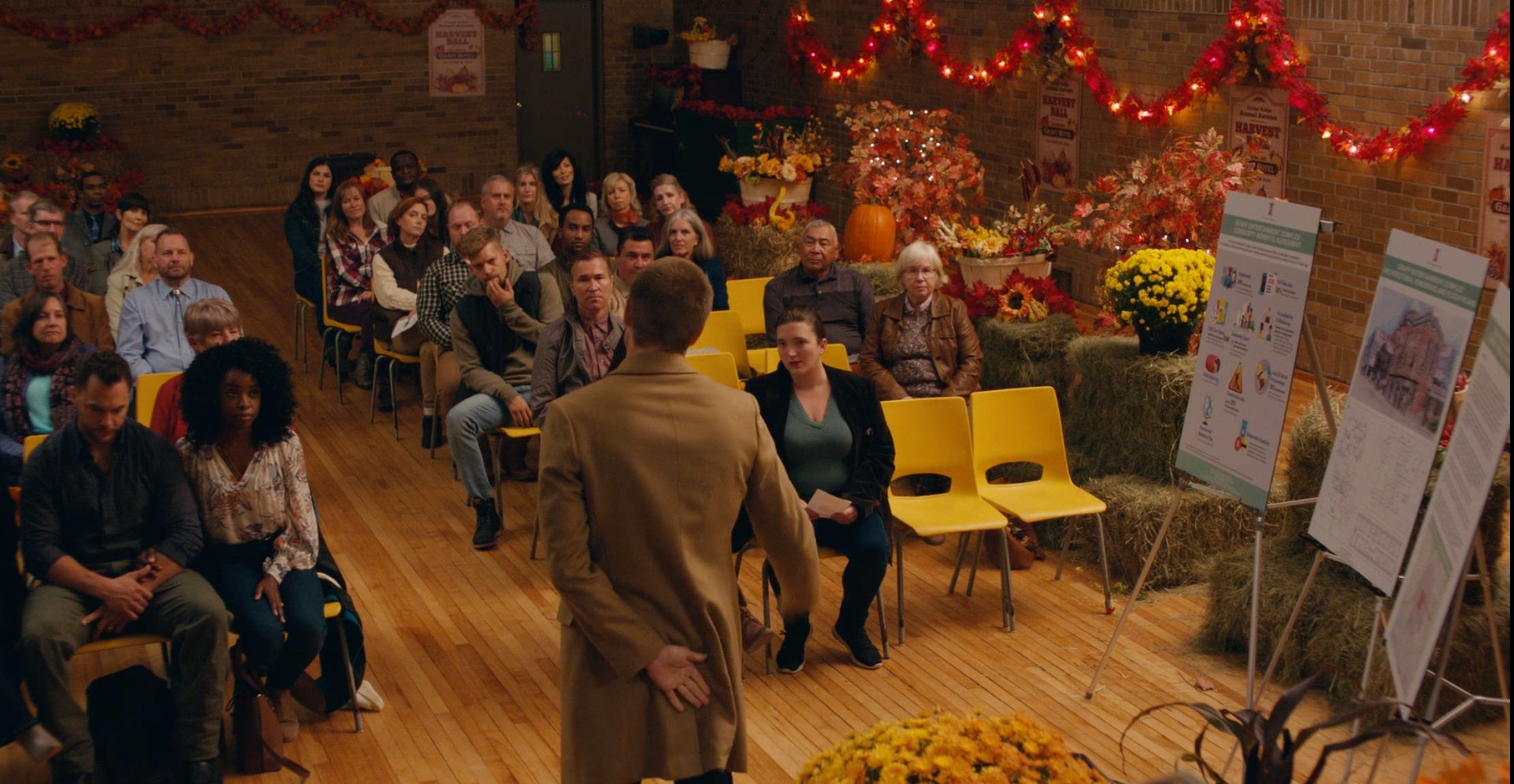
Last year, I stumbled onto An Autumn Romance1, wherein a librarian loses her job and must, of course, move to a small Montana town to live with her brother. Her brother is working to “save” a historic hotel from developers who have bought it with plans to turn it into a resort and “bring more money into town.” One of those developers, played by Chad Michael Murray (!!), is a former townie who (you guessed it) is now a big-money-guy-who-has-lost-touch-with-what-really-matters.
The librarian discovers that because the hotel is more than 100 years old, it’s eligible for landmark status2 — they just have to prove that a significant historical event took place on the property. You know where this is going, I know where this is going, and yet, I still can’t believe it.
Our main character discovers a photo of Teddy Roosevelt pictured in front of the hotel, saving the hotel and showing Chad Michael Murray that everything he’s been looking for is in this small Montana town.
The plot of An Autumn Romance was designed in a lab to give me an aneurysm, but it’s hardly the first. Two Weeks Notice even has my beloved Sandra Bullock lie in front of a bulldozer to prevent the erection of an apartment building.3
I’d been thinking for a long time about the prevalence of the anti-development holiday romcom when I saw a recent piece by comedian and writer Jeff Maurer who came up with his own, depressing, answer for why anti-development themes do better than pro-development ones in movies:
“YIMBY narratives aren’t compatible with screenwriting principles or with human psychology, generally,” Maurer argued, adding that “movies inevitably focus on the fear of loss, not the potential for gain.”
Maurer certainly has more expertise in the screenwriting business than I do, but I don’t think this is quite right. 4
First, because there is at least one very good YIMBY TV show: Show Me a Hero, starring Oscar Isaac. It’s the story of how NIMBYs in Yonkers, New York, stubbornly opposed the development of townhomes for low-income families. It’s a complicated (and tragic) TV show, but the villains are pretty obviously the NIMBYs. There are even subplots tracing the lives of low-income public housing residents who end up in the new development. 5
So it’s clearly possible to poignantly express the benefits of new housing through film, though I’d grant that it’s probably more difficult.
But why then has NIMBYism loomed so large in the genre?
Well, the holidays are a time when people tend to go back to their childhood homes, creating the perfect setting for reflecting on community, growing up, the poignancy of change, and tradition. In the same way that coming-of-age films augur change, dynamism, adventure, and striking out into the unknown, Christmas films set up the exact opposite dynamic.
Further, the very same forces that make YIMBYism politically hard — that losses from development prevention are concentrated and benefits are diffuse — are what make YIMBY narratives more complicated. It’s not that a complex film showing the knock-on benefits and harms of new housing is impossible, but it’s much easier to showcase conflict of a more direct sort: Developer bulldozes a family’s beloved Christmas treefarm.
For low-budget rom-coms, defaulting to a simpler, tried-and-true narrative is just safer than trying to subvert the genre.
A healthy community features a lot of change
The widespread association of family and community with tradition and stasis is a culturally potent force with political and economic implications.
One of the most effective parts of these movies is how they transform the developer. Sometimes the developer is a random evil man who is never redeemed, but more often than not, he is the love interest who is reminded of what really matters. By abandoning his plans for redevelopment in the name of love, we witness not just a satisfying resolution to the marriage plot but also an ideological conversion. Love, family, community … these things come when you abandon your dreams of stimulating the local economy.
Change and stability are balancing forces. Communities need change; new children, new neighbors, new teachers, and new businesses breathe life into a community. Families need to move for better jobs, to be near ailing parents, or to add room for one parent to work from home. Communities also need forms of stability: stable income, health care, and relationships. When these forces are out of balance, there’s a problem.
What the NIMBY Christmas movie does is reiterate the pervasive trope that what ails communities, families, and tradition is change, growth, and dynamism. Particularly frustrating is the argument that economic growth, development, and newcomers — the very things that ailing small towns desperately need — are actually the root of their problems. How perverse that these paeans to small-town life are Trojan horses for the very ideas that undermine these communities.
The symbolic politics of anti-developer movies
One of the most interesting recent papers in housing policy world is by law professor Chris Elmendorf and political scientists David Broockman and Josh Kalla about what they call the “symbolic politics of housing.” There are a lot of strict materialist explanations for NIMBYism, but is opposition to new housing driven by concerns about property values? What about the classic NIMBY concerns about parking, overcrowding, and aesthetic changes?
Over the years reporting on these issues, I’ve become less convinced that pure self-interest is playing a large role.6 When you actually talk to NIMBYs, their invocation of “property values” is less a laser-focus on their Zestimate and more a catch-all term for “things that make a good life.”
And indeed, Broockman, Elmendorf, and Kalla found that voters are often evaluating housing policies based on their associations with various symbols like “cities, tall buildings, developers, various government entities, and the groups who might live in new housing.”
It may sound elementary at first, but the idea that if you are a city dweller who likes tall buildings and density you are more likely to support more tall buildings and urbanization is actually in tension with the idea that people are opposed to new housing near them.
NIMBYism alone would predict that putting housing near people will just spark opposition no matter how they feel about housing in general. The Broockman-Elmendorf-Kalla thesis predicts less opposition near people who already like cities!
This raises the obvious question: How do people develop an affinity for or aversion to various symbols? What makes some people like tall buildings and others detest developers?
Symbolic politics theory posits that people develop feelings toward various symbols at a relatively early age, which allows the researchers to trace cohorts through time who have positive or negative associations with tall buildings or developers. The authors of this paper found evidence that Boomer disinterest in city living isn’t new and a function of old age; even when Boomers were young (in the 1970s and 80s), they were less interested in living in cities than people born in the 1910s and 1920s.
Fair enough, it was kind of a shitty time to be living in the big city.
One thing that Show Me a Hero does well is show how localities can refuse to follow the law even when courts yell at them to do so. Strict enforcement is slower and much more expensive than actually persuading people that they want to comply.
Racists fighting a desegregation order are the extreme, but small towns often find loopholes to new housing laws. In 1982, California encouraged localities to legalize accessory dwelling units everywhere where single-family homes were already permitted. In response, towns made a range of ridiculous, facially legal moves like saying “yes, you can build an ADU but you have to reserve two parking spots for it” or “yes, you can build an ADU but only on lots larger than 15,000 square feet.”
This is called the “thousand paper cuts” response: “In other words, most California cities appeared to comply with the state mandate by amending their zoning rules to permit ADUs, but they imbedded many costly regulatory requirements within the “authorization” that dramatically curtail the likelihood that ADUs will actually be developed.”
Closing all these loopholes took decades. The state had to play whack-a-mole to achieve compliance and real housing production. But the housing crisis is an emergency; every day we’re not building more housing is another day we’re falling further behind. Every house not built is a family forced to overcrowd, a young person forced to give up on their dream of moving to the city, or a senior forced to age in an inaccessible house.
Fundamentally, until new housing symbolizes the benefits more than the harms, the housing crisis will continue to be a fact of modern life.
NIMBY holiday movies are part of the cultural machinery that propagates negative associations with symbols like new development, housing, and urbanization. I’m not going to pretend I can prove some grand causal impact of the marginal anti-developer film, but I do find it deeply ironic that the very towns that could benefit from some developer positivity most are being fed a fairy tale by producers living in the big city.
This piece has been updated to fix formatting and typo issues.
Aka Colors of Love, aka A Winter Romance, aka Tycoon’s Kiss. Always a good sign when a film goes by four titles.
I would love for historic preservation statutes to require buildings to be at least 100 years old. That would be a massive step forward for YIMBYism.
Not technically a holiday film, just a real punch to the gut.
In part because I’m not sure if the shitty Hallmark movies many of us like to watch over the holidays are really, uh, consistent with any sort of quality screenwriting principle.
Slight aside, but another example of a quality pro-permitting reform story is Ikiru, a Japanese movie about a man trying to slog through bureaucracy so he can help build a playground for local children.
In part, because if it were, there would be many instances of homeowners begging for their block to be upzoned so they could cash out to some rich developer salivating at the chance of turning one large single-family home into a quadplex or whatever.
I don't think there's anything intrinsic to what makes good cinema here. Perhaps the most iconic Christmas movie of all time is a YIMBY movie – It's A Wonderful Life! George Bailey is a housing developer. The villain, Mr. Potter, wants to stop him from constructing new high-quality market rate housing in Bedfor Falls so the residents have to stay in his overpriced slum. And the scene where George and Mary welcome the Martinis to their new Bailey Park home has to be one of the most effective depictions of the highly personal and concentrated benefits of housing in the movies. I think this isn't recognized as much now because Bailey Park is a 1940s suburban tract, not a dense urban development, but it's very much a feel-good story about building valuable things to enrich your community.
>> Particularly frustrating is the argument that economic growth, development, and newcomers — the very things that ailing small towns desperately need — are actually the root of their problems.
One of the major complications of this argument is that for the last 50 years, the suburban development machine has meant that the primary way ailing small towns get new development is via soulless stroads, chain restaurants, and McMansions, instead of the charming Main Streets that have been zoned out of existence.
So, when they’re protecting some stupid old hotel, they’re actually grasping for the type of charming small town development that feels hopelessly out of reach.