


American politics is increasingly organized around a simple conviction: There’s only so much to go around. Only so many good jobs, decent homes, and slots in the social hierarchy. If someone else starts doing better, that’s a threat—it means someone else (maybe you) is getting screwed.
The throughline of MAGA politics is this zero-sum worldview.
Whether it is immigrants taking all the good jobs or other nations developing domestic manufacturing at the expense of American industry or even women’s advancement in the workplace coming at the expense of men, the story is the same: When someone else wins, you lose. You are in a fight over scarce resources, and you have to protect your own.
Now, of course, many interactions are zero-sum: If someone passes you before the finish line of a race, their gain comes directly at your expense. But many other interactions and games are or can be positive-sum. For instance, if more kids know how to read, that’s better for everyone; it doesn’t necessarily come at another person’s expense.
But are the most important economic, political, and cultural questions more like the 50-meter dash or childhood literacy?
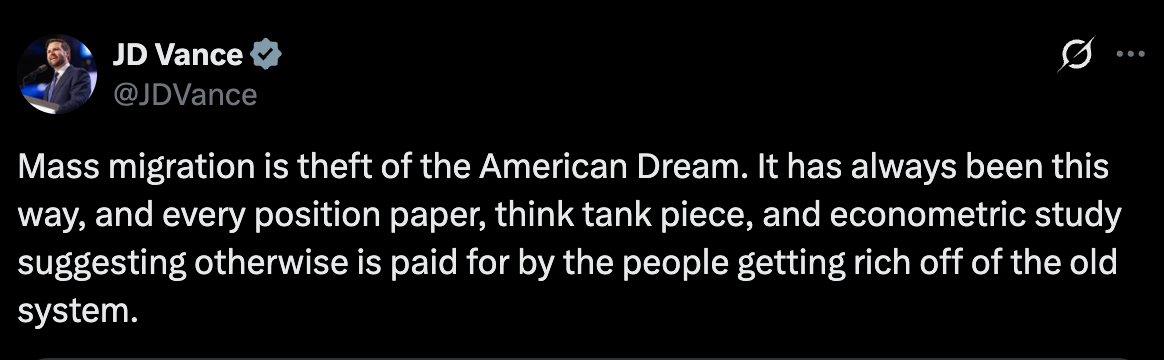
Zero-sum thinking is a self-fulfilling prophecy. If you think every extension of opportunity to one group necessarily hurts another, you’ll oppose immigration, trade, new housing, and eventually basic rights for anyone who isn’t already inside the circle. Eventually you get a politics of permanent siege, where every reform is framed as an attack on “heritage” Americans. That doesn’t just leave the country poorer; it makes it almost impossible to sustain a liberal society where people believe rights and prosperity can expand rather than being rationed.
But this isn’t a story about right vs. left. Zero-sum thinking cleaves both parties, and in fact Democrats are more likely than Republicans to hold such views. In a new paper, economists Sahil Chinoy, Nathan Nunn, Sandra Sequeira, and Stefanie Stantcheva ran a massive survey of 20,400 U.S. residents to investigate the roots of zero-sum thinking.1
Their analysis reveals that people who exhibit zero-sum thinking are more likely to support more restrictive immigration policies, yes, but also redistribution and affirmative action. The logic of this is that people who believe that some groups are behind because of other groups are more likely to support policies that rebalance that.