


Welcome to The Closing Argument, our verdict on the news, plus everything The Argument published and appeared in this week.
The Verdict, by Maibritt Henkel
Years before taking aim at Christopher Nolan’s adaptation of The Odyssey, the online right tried to cancel the 2017 translation of Homer that inspired him.
Far-right personalities like Bronze Age Pervert and his disciples have declared the translator, University of Pennsylvania professor Emily Wilson, a woke phony on a mission to emasculate Homer. They see a vindictive feminist — the first woman to complete a major English transla1tion of the poem — who holds all things white, male, and Western in contempt and, like Nolan’s multiracial cast, has sullied a precious urtext of the white, male, Western canon.
“Emily Wilson’s translation of the Odyssey sucks because she associates a belittling word with Odysseus wherever she can,” reads one tweet from Roman Helmet Guy. The account Raw Egg Nationalist posted a picture of a heavily tattooed Wilson next to the caption: “Women who look like this have no interest in anything other than revenging themselves on the men who have failed them.”
But the right’s critiques of Wilson’s translation do not reflect a close reading of her text — or a sophisticated understanding of Homer. In fact, Wilson’s decisions to render Odysseus “complicated”, omit sexist slurs, and favor unvarnished narrative over rhetorical flourish promote an accurate and traditional understanding of the poem, rather than undermine it. To call this “woke” is to expose how arbitrary that epithet has become — and how uninterested those who wield it are in good-faith debate, let alone the ancient Greeks they claim to celebrate.
Yes, Odysseus was complicated
According to some critics, Wilson’s hateful woke-ification of The Odyssey begins with her translation of the poem’s very first line. Where her predecessors have taken the Greek adjective “polytropos” to mean “the various-minded man” or “the man of twists and turns,” Wilson opts for “a complicated man.”
To anyone already convinced that Wilson has no respect for Homer, antiquity, or the discipline of translation, the word “complicated” represents a tedious progressive slight. The left doesn’t want you to celebrate Greek heroes just as it doesn’t want you to celebrate Columbus Day or Confederate monuments. For left-wing scolds, every glorious victory must be followed by an “it’s complicated.”
There are two problems here. The first is that “complicated” is not an inherently negative descriptor. The translation does not begin with the line “Tell me a story about a sexist piece of trash.”
As Wilson writes on her own Substack: “To me, ‘complicated’ doesn’t suggest either ‘good guy’ or ‘bad guy’: it’s a promise that this poem doesn’t stoop to those implausible simplifications.”
Then there’s the fact that Odysseus’ track record really is complicated. He owns slaves, pillages villages, brutally mutilates his enemies, and repeatedly cheats on his wife. Any self-respecting cancel culture would dismiss him in a second. But this is not Wilson’s approach. Her translation makes the case that Odysseus, despite all the sexism and slavery, is still a character who can speak to all of us. Much more than her critics do, Wilson is trying to defend his enduring relevance to modern readers — and that of the text as a whole.
Comparing her version to previous translations only underscores this point.
An essay in the Claremont Review of Books, the highbrow Trumpist journal, advises teachers against Wilson’s translations citing her “hostility to manly bravado.” A worthy translation must instead “honor Homer and his champions for who they are.” The essay instead recommends Fagles and Lattimore to those seeking to read Homer in English. And sure enough, there are several scenes in Fagles’ Odyssey that read quite differently from Wilson’s.
Take, for instance, the infamous scene in The Odyssey —tactfully left out by Nolan in the new adaptation — in which Odysseus’ son, Telemachus, has 12 female slaves killed for sleeping with Penelope’s suitors.
This is how Fagles translates the order given by Telemachus:
“No clean death for the likes of them, by god!
Not from me — they showered abuse on my head,
My mother’s too!
You sluts — the suitors’ whores!”
Emily Wilson’s translation reads as follows:
“I refuse to grant these girls
A clean death, since they poured down shame on me
And Mother, when they lay beside the suitors.”
That Wilson’s Telemachus does not call the girls “sluts” or “whores” is easy to mistake for some kind of modern feminist statement. In fact, her omission is truer to the original Greek, which does not feature any slur or epithet in the scene.
Fagles is often held up by Wilson’s critics as the more faithful, intellectually rigorous translator—the one serious people interested only in the unadulterated words of Homer should read. But in this passage, it is Fagles, not Wilson, who takes the liberty of giving Homer a moralizing twist.
This example also exposes how arbitrary the logic of what is and is not woke has become. Imagine if Wilson had been the one to add the modern pejoratives instead of Fagles. Wouldn’t that be more consistent with the notion that she is a man-hating lib, looking for any excuse to frame male characters as misogynistic bastards?
And, of course, anyone concerned about Wilson’s secret feminist agenda could simply listen to what she herself has said on the matter: “I keep urging journalists to ask men about their gender and how it informs their work, and please stop asking me about it, because I really don’t work on gender and it’s not my main interest.”
Twitter trolls don’t care about iambic pentameter
Gender politics aside, there is a technical explanation for why Emily Wilson’s edition can be considered more faithful to the shape of the original poem than the 60-some translations that came before it.
Wilson is the first English translator to confine herself to exactly the same number of lines as the original Greek. She also opted to write the entire poem in iambic pentameter, rather than free verse or prose, honoring the regular verse form of the poem.2
To pull this off, she had to keep her sentences more direct and less ornate than her predecessors. As a result, Wilson’s translation is unusually concise.
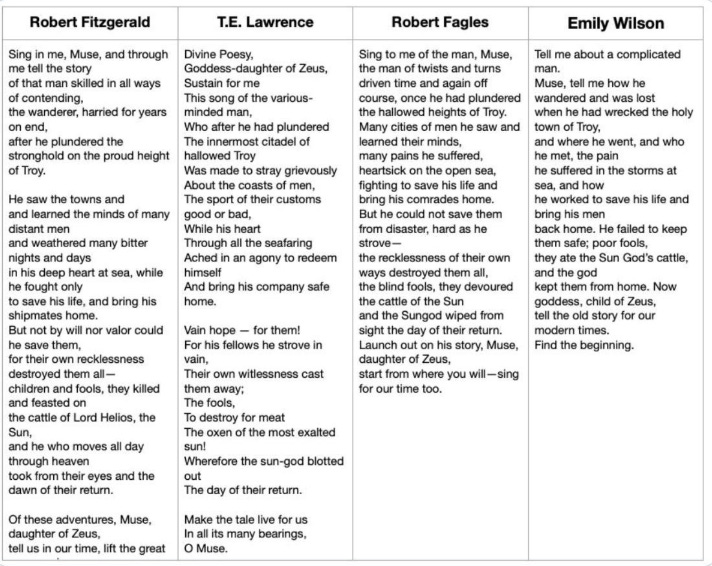
That Wilson’s Odyssey has less sentimental flair and pomp than earlier translations doesn’t make it a hateful indictment of Odysseus. Her translation is not a progressive manifesto that delights in the downfall of men. Nor is it a contrived celebration of comic-book-style heroism. Instead it is a tight, technically accurate translation of a 2,700-year-old-poem that turns out to be a lot more morally ambiguous than many modern readers can handle.
Top stories this week, by Milan Singh
As we grow, I want to make sure you see everything we’re doing without flooding your inbox with dozens of emails. But for the real libs, you can get every post as it drops by opting into The Mag here.
Another week, another new hire at The Argument. We’re excited to welcome John Thomason as our new senior editor. In his first piece, he discussed the climate left’s inability to set priorities. Fighting climate change is costly — both politically and economically — and some battles, such as the fight over Keystone XL pipeline, just might not be worth the squeeze.

Kelsey Piper wrote about the controversy surrounding elite public high schools such as Stuyvesant in New York City. These schools admit very few Black and Hispanic students, but that’s not because their entrance exams are racist; it’s because the exams reveal underlying inequality. But as Kelsey notes, many more Black students gained admission to New York City’s competitive schools in the 1970s, read below to find out what changed.

Both Bernie Sanders and Sam Altman have proposed giving the government an equity stake in the major AI labs. But staking the future of the welfare state on the profitability of OpenAI and Anthropic is a risky bet, Kobe Yank-Jacobs argues. The labs that develop cutting-edge large language models won’t necessarily be the ones that reap the profits from their innovations. Instead, we should go back to the basics and focus on raising taxes on capital.

🌟Abundance Wins of the Week🌟
Mayor Zohran Mamdani announced new reforms to simplify permitting and cut fines and fees for small businesses in New York City.
The Portland Planning Commission in Oregon unanimously recommended that the City Council adopt several YIMBY reforms to the city’s zoning code, as required by state law.
$1.7 billion solar project broke ground in Texas underscoring the Lone Star State’s dominance in utility-scale solar generation.
Worth watching...
This week on the podcast, Matt and Jerusalem were joined by Tim Lee, author of the newsletter Understanding AI, to discuss whether AI will automate everyone’s jobs. Jerusalem and Tim are optimistic; Matt thinks that the doomers are right to be worried. Give it a listen and decide for yourself!
What’s News with The Argument
The Argument recommends, by Milan Singh
This week, we decided to all stay on theme and recommend all things Odyssey-related:
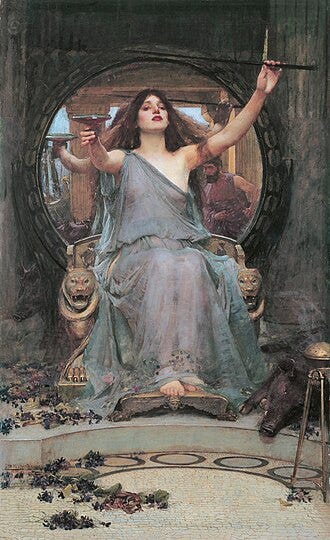
Jerusalem recommended the oil painting Circe Offering the Cup to Ulysses by John William Waterhouse: “It depicts Circe offering a potion to Odysseus, whose wary expression is captured in the mirror behind the witch. I just love everything about this painting Circe in the center of this image, one of Odysseus’ men-as-pig at her feet, and our hero relegated to a small reflection. It manages to make you feel entranced by the witch, just as she desires.”
Jeremiah Johnson gave honorable mentions to the movie O Brother Where Art Thou — one of his “favorite movies ever” — as well as the book Circe, a recommendation seconded by several others in the office (except for Jerusalem, who said she couldn’t get through it).
Maibritt recommended The Song of Achilles, which her grandmother gave her. It’s one of her favorite books of all time, and she told me that she probably rereads it once a year. “If you also felt that Nolan’s Odyssey was a little short on homoeroticism, this is the book for you.”
Finally, Angela said that she “could not recommend enough” the 2004 film The SpongeBob SquarePants Movie, which is “basically a 1:1” retelling of The Odyssey , featuring:
SpongeBob and Patrick leaving home to go on a quest
Poseidon, Princess Mindy as Athena, and David Hasselhoff as the divine intermediary
A magical bag of winds
A scuba diver standing in for Polyphemus
Plankton playing the role of the suitors and trying to take over the Krusty Krab
The old lady with the ice cream as a parallel to Circe.
Personally, I think that’s the best take I’ve heard during the entire time I’ve been working here.

We have merch!
We have quarter-zips, keychains, hats, and stickers. Each one is a great conversation starter in its own way. Buy them here.
More to read:


Scholar Anne Dacier translated the Odyssey into French in 1716.
While most recent translations of The Odyssey do not adhere to a strict metrical pattern, Wilson wanted to recreate the rhythmic experience of the original text. In Greek, the poem uses dactylic hexameter, the standard verse form of archaic poetry. In her modern translation, Wilson opts for iambic pentameter because it is the most common meter in dramatic English verse. Every line contains 10 syllables, broken into five pairs of alternating unstressed (da) and stressed (DUM) beats.
Hot Homer Summer
I just finished the Wilson translation, and I couldn't agree more with the writers of this timely essay. For me, there was a spareness in the telling, and a clarity of purpose in moving the story forward in time and in urgency. I appreciated the introduction, (which weighs in at 89 or so pages), as well as the translator's notes section. She gives context, and takes responsibility, for her approach to the language, and mentions how the translator sort of disappears in the transference of story to a modern reader. (And she defines all of us who are not ancients as "modern"). The very idea that there is a "woke" quality to the characters, is so absurd on its face: the whole world of classical Greeks would be defined as racist, and misogynist by modern standards. It is the world that it is: arbitrated by humans in negotiation with gods, who possess human-like characteristics; a world set in nature, controlled by natural forces, and given meaning and high stakes, through the same things that animate our lives today: love, friendship, hatred, jealousy, violence, conquest, wealth, poverty, loyalty, family, and - this one is the most important one I think : hospitality to the stranger. I am looking forward to seeing the movie on a big screen, and I also look forward to never having to share any space smaller than the entire planet Earth with these dweebs who cannot stop looking to make sure that no one is castrating them with language or ideas. WTF - Bronze this, limp biscuit that, No seed oil this and raw egg (ew) that. Girls - calm down.
Thank you for this.