

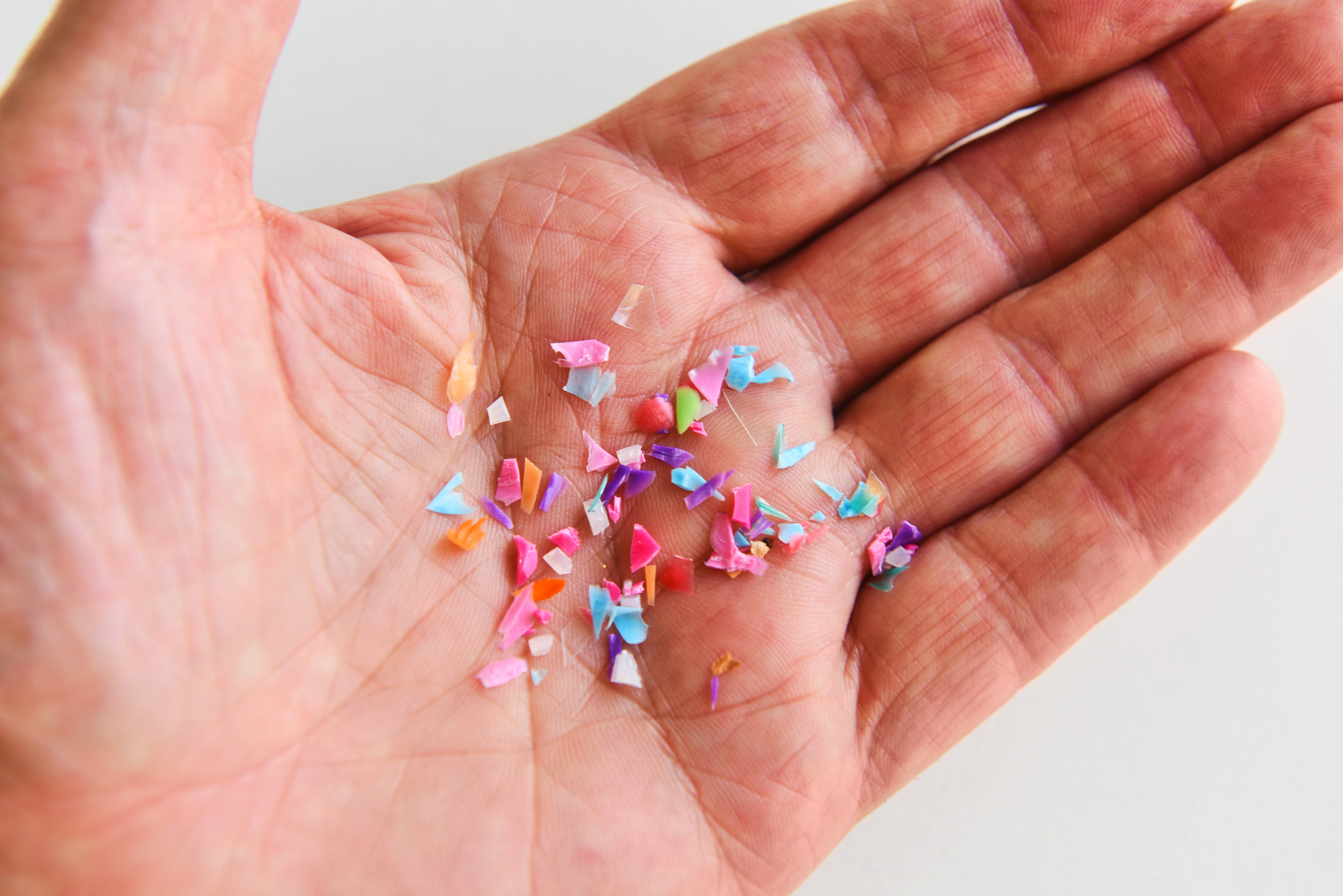
On Tuesday, The Guardian published the best news I’ve heard all year: The microplastics panic was based on dubious science.
Microplastics lack one standardized definition, but one report I saw cited widely by the Joint Group of Experts on the Scientific Aspects of Marine Environmental Protection defines it as plastic particles between one nanometer (nm) and below five millimeters. These are not magnitudes I’m used to thinking about, so for reference, a human hair is between 60,000 nm and 100,000 nm wide.
According to that same report, “small pieces of floating plastics in the surface ocean were first reported in the scientific literature in the early 1970s,” but the modern microplastics panic has focused more on the idea that these tiny pieces of debris are embedded into our bodies.
Studies and media stories have proliferated since 2018 highlighting that every inch of our bodies has been infiltrated by tiny pieces of plastic: our brains, our lungs, our stool, our blood, our semen, our placentas, and our breast milk. Even before we are born, the mounting evidence warned, we are polluted.
Two days ago, The Guardian — which has published its share of microplastics panic stories — dropped a “bombshell“ piece arguing that much of the microplastics research was being challenged. Their reporting relied on a “Matters Arising“ note, which is how researchers publish formal postpublication commentary on recent Nature papers.
This note, published on Nov. 13, 2025, was coauthored by nine scientists who wrote that contamination introduced during “sampling, sample preparation or detection” may occur, leading to false positives. Essentially, there’s lots of ways for nano or microplastics to be introduced throughout the process.
The note also takes issue with the primary analytical technique (Py-GC/MS) used to detect microplastics and nanoplastics in the human organs because many biological fats can look like the particles one might expect from the most commonly produced plastic.1 Which the authors argue leaves a ton of room for misidentification.
“Notably,” the authors continued, “findings that lack adequate validation may inadvertently shape public perception and regulatory discussions, despite underlying scientific uncertainty.”
On LinkedIn, one of the authors was less diplomatic: “Scientists don’t have time to ask themselves hard questions! The brain #microplastic paper is a joke.”
Microplastics are not just one of many avenues of scientific inquiry. In the past few years, they have become yet another part of the Toxic Modernity Narrative. That is, the idea that the economic and technological advances of modern life are poisoning us.
From high-fructose corn syrup and seed oils to blue light and aluminum in deodorant, the sense that modern life’s marvels must come with noxious byproducts is endemic — as is the idea that this requires returning to a more primitive economy.
To be clear, I think it is good that scientists do research on questions of varying significance. In part, because you cannot always know ex ante which questions will turn out to matter a lot and in part because expanding the set of human knowledge is just an unalloyed good. I have no problem with the fact that scientists looked into human bodies to figure out if there was some plastic swimming around in there.
But the microplastics panic is not the result of disputed science entering the public lexicon; it’s the result of shoddy science journalism and a nascent anti-modernity vibe that is plagued by confirmation bias.
A study of how microplastics risks are framed in scientific studies and the English-speaking media illustrated this problem perfectly. While 67% of the 464 scientific studies reviewed “frame microplastics risks as hypothetical or uncertain,” a whopping 93% of media articles (pulled from The Guardian, The New York Times, HuffPost, The Sun, and USA Today) “imply that risks of microplastics exist and harmful consequences are highly probable.”
The naturalistic fallacy
Before I get into the specifics of what we actually know about microplastics, I want to explain why I have always been skeptical of this narrative. Not for “I told you so” reasons — it’s too soon to say definitively that mainlining microplastics has no side effects — but because I think this whole debate is a (forgive me) microcosm of a larger orientation toward the world.