


Welcome to the The Closing Argument, our verdict on the news, plus everything The Argument published and appeared in this week.
The Argument is holding another live event, this time on June 17 in Washington, D.C.!
Jerusalem Demsas will be interviewing USC psychologist Darby Saxbe about her new book, Dad Brain: The New Science of Fatherhood and How It Shapes Men’s Lives.
Drawing on two decades of research, Darby explains how becoming a father changes men, from their hormones and brain architecture to their sense of purpose. (Yes, men experience postpartum depression, and “dad bod” is real.)
They’ll get into hot-button topics like:
Are great dads born or made?
How do men’s brains and hormones change when they become fathers?
Why does motherhood get all the attention while fatherhood goes overlooked?
Does the way dads play with their kids matter?
The conversation kicks off at 7 p.m. at Politics and Prose (5015 Connecticut Ave. NW).
The Verdict
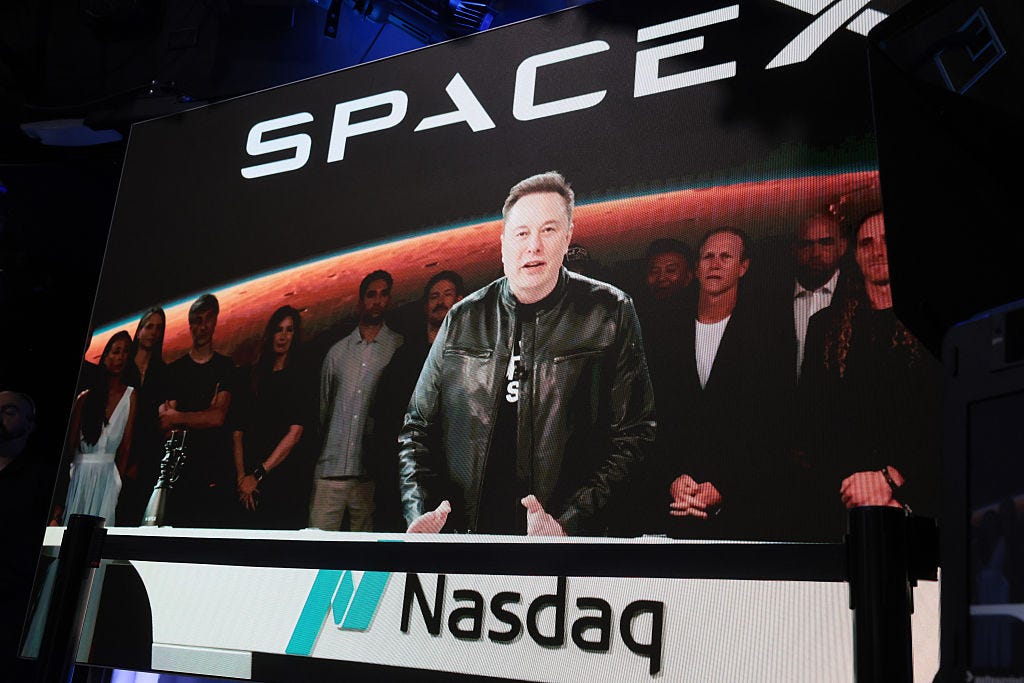
Elon Musk became a trillionaire this week after his company SpaceX went public.
SpaceX is a genuine achievement — yes, space stuff in general is cool, but what I find the most impressive is the financial powerhouse behind the company: Starlink.
Starlink is an achievement of physics, vertical integration, and manufacturing. Traditional satellites are launched up to roughly 35,000 km away from earth on a rocket and then are launched sideways at tremendous speed. But orbiting 35,000 km away presents a lot of challenges (your signal has to travel 70,000 km back and forth; that’s why the old satellite internet was SO slow).1
Starlink has instead blanketed its satellites at the 480km to 550km range, close enough that it actually beats fiber-optic cable since traveling through glass is slower than in empty space. This isn’t a post about how cool Starlink is, but the number of challenges SpaceX had to solve to do this is extraordinary: Launch costs, manufacturing speed, phased array antennas…
Most of the conversation about SpaceX’s IPO was about Musk himself, who has become a reactionary and powerful political figure seeking to prop up far-right political parties, anti-immigration politics, and a broad hostility to the liberal economic and political regime that made his life story possible.
I agree with all of those critiques of Musk, but I want to focus on the specific ire that his inauguration as the first trillionaire has drawn, because it’s exposed an unhealthy habit of mind among populists that focuses on gaps rather than absolute measures.
When people hear “world’s first trillionaire” they’re imagining that this is money in a bank account, but around 95% of Musk’s wealth is held in stocks of SpaceX and Tesla. That means if those companies start doing badly, his wealth will decline. Of course, Musk is able to liquify his assets by leveraging his stocks to borrow money if he so chooses, but that would require his companies to continue being successful, which is not an easy thing to do.
If we had a system where Elon was still CEO of SpaceX and Tesla but simply had to redistribute more of his shares and make many more billionares, would that really change how much political power he has? I doubt it. He’d still get to decide whether Ukraine or Russia gets Starlink access.
Sometimes Westerners will do a sort of cope where they point out that the multiples that separate the average American and Musk are way larger than those between the world’s poorest and the average American. But even under inequality-logic, that only works if you ignore the many, many people with zero wealth and negative wealth. After all, the multiple between zero and $193,000 is infinity, whereas the multiple between $193,000 and $1 trillion is 5.2 million.
But most importantly: the difference between me and someone living in rural Eritrea is not just our wealth but the inequality that comes with living in a country without basic access to civil liberties like freedom of speech, freedom of religion, strong property rights protections, government-provided infrastructure, and protection from casual violence.
Mostly, I just don’t think material inequality is a good way to organize one’s political thinking. Absolute measures of well-being like longevity, access to clean running water, health care, housing, and education are more conceptually clear.
After all, the same flawed logic that would indict Musk for his mindboggling amounts of wealth would indict everyone reading this article when compared to the billions of people living in abject poverty.
Gaps between people, absent material deprivation, is simply not a moral problem. If everyone in the world had access to a decent standard of living, but some people were quadrillionaires, I don’t know that I would care about the latter. Moreover, it’s easy to imagine a world without much inequality but significant deprivation; that’s just most of human history when most people lived in subsistence agrarian economies.
Largely, when you look at measures of inequality, it’s possible to have high-inequality, high-poverty countries (South Africa, Botswana, Namibia) and low-inequality, high-poverty countries (Belarus, Moldova, Ukraine). I just don’t think inequality is that related to the central problems facing society, and structuring our discourse around it makes for a genuinely incoherent politics.
Top stories this week, by Milan Singh
As we grow, I want to make sure you see everything we’re doing without flooding your inbox with dozens of emails. But for the real libs, you can get every post as it drops by opting into The Mag here.
Not to gas myself up too much, but I think my article on Monday was pretty good. I argued that centrist Democrats should just give up on the 2028 presidential primary. The party has changed a lot since the 1990s, and liberal Democrats are now in the majority.

Jerusalem had an excellent piece on the crisis of patriotism on the left. If you want to save our country from MAGA, you actually need to like our country. But it seems many people on the left are either too embarrassed to say that they do or are not-so-secretly ashamed of America.

Finally, Lakshya had a great piece breaking down the results of The Argument’s May poll. AI isn’t a top priority for most voters — yet. But to the extent that voters are thinking about AI, they’re skeptical of its benefits and fearful about the potential risks. For all the details on what we found in the data, take a look at the article below.

🌟Abundance Wins of the Week🌟
Switzerland voters libbed out and voted against capping the country’s population at 10 million.
California takes forever to count votes (they should fix this), but earlier this week, Los Angeles counted enough votes to confirm that Nithya Raman will advance to the mayoral runoff election against incumbent Karen Bass. People tend to sleep on Raman (and Zohran Mamdani) because they’re democratic socialists. But they both have elite ball knowledge when it comes to housing. Mamdani was much better than Andrew Cuomo on it, and Raman is far superior to Bass, too.
The CEO of AstraZeneca said that AI was helping the firm speed up the development of new medicines. “The value of AI in our industry is productivity improvement,” he said. “In the way you design a new medicine, a new drug, you can actually do it faster, of course, do it smarter.”
Worth watching...
On their latest podcast episode, Jerusalem and Matt talked about Silent Spring, which helped kickstart the modern environmental movement. Degrowth environmentalism is still alive and well, but how much can we blame Silent Spring for that? Listen in to find out:

Subscribe: Apple Podcasts | Spotify | YouTube | Overcast | Pocket Casts
Lakshya, Kobe, and Jerusalem broke down the results of The Argument’s latest poll on a Substack live video Wednesday. They discussed why so few voters seem to care about AI given the large portion that expects severely negative results from the technology. Will it take a crisis for voters to take notice?
What’s News with The Argument
The Argument recommends, by Milan Singh
Jerusalem said that the (horrific) The New Yorker piece on the Tate brothers “fucked [her] up.” I read the article too, and I concur. Among many other horrifying things, I learned that Paul Ingrassia — the Trump administration appointee who said in a group chat that he had a “Nazi streak” — got his start as the Tates’ lawyer. In the brothers’ defamation suit against a rape survivor who accused them of sex trafficking minors.
Angela read Martyr! for Joey Politano’s fiction book club. The novel follows a young Iranian-American poet as he tries to get sober. “There was so much going on here, to be expected from a poet’s debut novel,” Angela said. “But such fun to unpack every little piece with a group.”
Justin said he’s been listening to the album in “in filth your mystery is kingdom / far smile peasant in yellow music” by Dagmar Zuniga, which he said “feels like a lo-fi folk album out of the 1970s” with “perfect dreamy summer vibes.”
Maibritt finished the show Task, which she could have easily watched in one sitting. The show ticked many of her boxes: “good child acting, complicated yet ultimately positive depictions of masculinity, characters speaking a strong regional dialect, and, well, Mark Ruffalo in uniform.”
I really enjoyed Naomi Kanakia’s essay “The New Yorker offered him a deal,” which was recommended to me by my friend Charlotte. Absolutely fascinating piece; as someone who is not very familiar with this world, I learned a lot about fiction writing in a particular time and a particular place.
We have merch!
We have quarter-zips, keychains, hats, and stickers. Each one is a great conversation starter in its own way. Buy them here.
More to read:
Contrary to what you may read online, most Americans love Amazon. I discuss why that might be.

What The Argument’s aggregated polling says about how each state will vote this fall. Hint: Take a look at Ohio and Texas.

The reason most satellites choose 35,000 km is because orbiting at that distance keeps you at the same fixed position relative to the Earth's surface.
This is the first poorly thought out piece I’ve read in the Argument and I’ve read almost all of them. Sure, we aren’t going to curtail Musk’s power over his companies by sharing his distended dragon-horde of wealth with more people. That’s not the point of the critique! That straw-man has nothing to do with the question of whether one person should have so much material wealth that he becomes capable of exerting power over people who did not elect him to office. Whether you want to listen to Lincoln “that no man is good enough to govern another man, without that other's consent” or to Kanye “no one man should have all this power” the point is not about his companies it is about his money granting him access to the halls of power that were meant to be reserved for The People’s Representatives. The fact that “DOGE” goes unmentioned in this piece is a condemnation of its drafting.
What I usually hear from progressives, when the question comes up of why it's problematic for people like Elon Musk to have a trillion dollars, is that this means he can buy his preferred political outcomes. I think this can be argued against, but you do have to argue against it.