

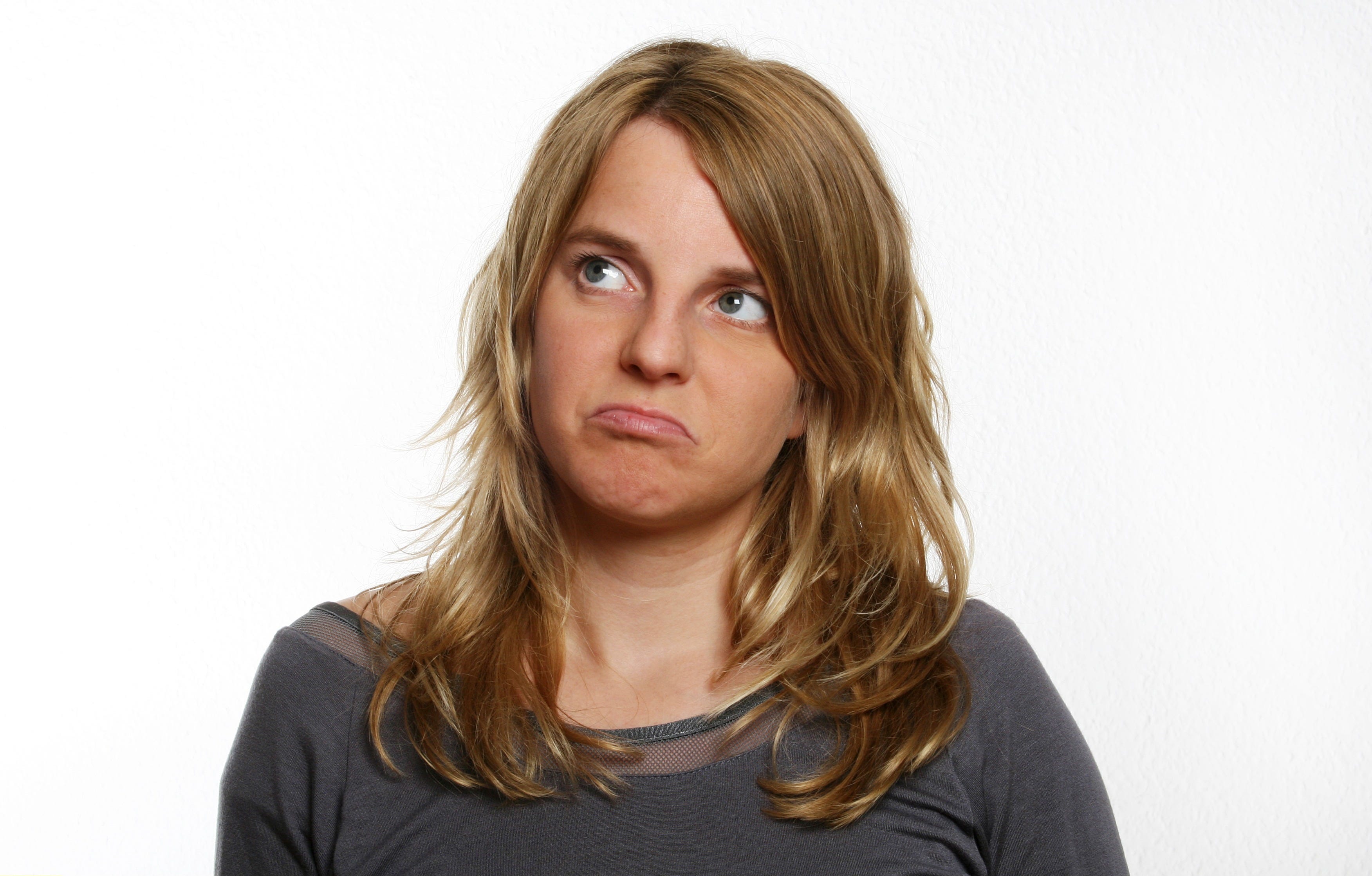
Women are more likely to register to vote and to actually vote than men. They are also more likely to boycott and sign petitions and volunteer. Yet, in poll after poll, question after question, month after month, and across ideology, race, and age, more women than men are telling us “I don’t know.”
Since August, of the 98 questions we’ve polled that offered “I don’t know” as a response, women consistently selected it at higher rates.
The gap isn’t massive — the average difference in rate was below 5 percentage points — but that can lead to systematic under- or overrating support for various issues. If, as I suspect is the case, a woman saying “I don’t know” is just more willing to register uncertainty than a man who has the same level of uncertainty, that can lead to meaningfully different interpretations of data.
Let’s take a look at one of the questions in our December survey: “Thinking about issues concerning K-12 education, which party’s approach do you think better reflects your values?”
Here, 36% answered with “The Republican Party,” 35% said “The Democratic Party,” 20% said “neither party,” and 9% said they were “not sure.”
The top line, of course, is that the Democrats had an issue disadvantage on education — a striking reversal from historical patterns. But just 7% of men — who favored Republicans by a 10-point margin on this question — said “not sure,” compared to 11% of women. Considering how Democratic women tend to be, it’s easy to imagine a world in which reversing that disparity would have driven Democrats to a breakeven margin (or even a slight lead) on this question.
This is a well-established pattern in survey research. A study done by The Washington Post, using Public Policy Polling’s data, found that women expressed uncertainty at notably higher rates than men did. This finding was also substantiated by The New York Times and Pew Research Center. In short, we’re not the only pollsters who have noticed it.
I don’t think this is simply a survey-related artifact. Instead, I’d guess that the reason women say “I don’t know” in polls is because they’re also more likely to say that in real life. Research suggests that they tend to hold themselves to higher standards when it comes to the knowledge needed to give an opinion, and are thus more likely to admit when they don’t know something.
The instinctive next question is obvious: Is this gap just explained by actual differences in knowledge? That is, do women just know less than men about the topics we are asking them about?
I’m not so sure. And based on the research we do have available to us, I certainly don’t think it’s enough to explain this gap.
One study looked at the mean differences between men and women on a political knowledge survey and found a larger gap between the sexes on multiple-choice items than on open-ended items. When you gave women the option to select “I don’t know,” more of them went for it — but when you asked them to explain their actual opinions in free-form responses, the observed gap in knowledge shrunk considerably.
Another study by Mary-Kate Lizotte and Andrew Sidman looked into this question and found that women are less likely to guess under uncertainty. Using 12 national surveys that asked about a wide range of political issues, the authors found that the response rate for women saying “don’t know” was roughly 1.5 times that of men.
In order to figure out how often men were making lucky guesses versus actually exhibiting superior knowledge, the researchers used something called a three-parameter logit (3PL) model to discover whether, looking at the full range of responses given, someone had just gotten a question right by accident. For example, if a respondent is unable to name the president of the United States but correctly identifies a foreign leader, it’s more likely that they are guessing.
Using this model, the gender gap is reduced by a whopping 36.4%. And though it still leaves a notable amount of unexplained variation (which the researchers hypothesize may have to do with socialization, occupational status, income, education, or political interest), the reduction is striking and suggests that women really are less likely to guess or offer unsubstantiated answers.
Greater female uncertainty shows up in all kinds of contexts, including nonpolitical ones. Per our polling (to share just a few examples), women are also more unsure about the role that standardized tests and grades should play in the educational system, and they are more uncertain when it comes to AI’s impact on society.
Here’s something I found especially interesting: Of the 98 questions we asked that had “I don’t know” as a potential answer, there were just eight questions where women were less likely to choose that answer.
Two of them concerned the generic ballot vote or Donald Trump’s job approval. The other six all had some connection, whether directly or indirectly, to parenting.
Should there be age verification laws that restrict access to artificial intelligence (AI) chatbots? (Women were slightly more likely to say “yes” than men were.)
If a friend or family member were having a child and asked for your opinion, how likely would you be to recommend that they follow the recommended childhood vaccination schedule for their newborn child? (Women were more likely to say “yes” than men were.)
Do you agree or disagree with the following statement: In general, the risk of side effects outweigh the protective benefits of vaccines. (Women were more likely to agree than men were.)
Which statement comes closer to your view about the impact of school closures during COVID-19? (Women were more likely to say that school closures were largely necessary.)
1) School closures were largely necessary to stop the spread and prevent infection of teachers, students, and families.
2) School closures were largely unnecessary and caused damage to students in the form of learning loss and decreased socialization.
At what age do you believe it is appropriate for someone to first use social media (such as Instagram, X, Snapchat, and Facebook)? (Women responded with higher age thresholds.)
At what point do you believe it is appropriate for a child to first use a computer unsupervised, for leisure and recreation? (Women responded with higher age thresholds.)
And that isn’t necessarily a surprise. On average, women still spend considerably more time with their children than men do — per a 2013 Pew study, mothers in America spent nearly twice as much time with their children as fathers did. That discrepancy also means they’re more likely to form and hold opinions on topics relating to their children, and it’s a gap that is large enough to overcome any extra hesitancy in expressing those opinions.
But in all other cases, women were considerably more likely to select the “don’t know” option. As a pollster, I find that this sort of thing is incredibly important to account for. Leaving “don’t know” as a valid option can be very useful, but it could also somewhat misrepresent the true views of the electorate. So what do we do?
The New York Times, which conducts most of its polling by live phone calls, gets around this by not explicitly offering it as an option, but allowing for respondents to volunteer it as a response. But we do our surveys online, which means we don’t get that sort of luxury; question responses almost always have to be a fixed, multiple-choice set of answers.
One potential solution is to “push” our undecided respondents to pick a choice in a follow-up question that removes the “I don’t know” choice. This allows us to capture both the rate at which people express uncertainty, as well as the way they’re actually leaning. This isn’t always doable (it adds an extra question, which is expensive!), but we do it where we can; for instance, our generic ballot question always explicitly asks voters who are undecided to pick a side.
Another way we’ve been getting around it is by simply not offering a “don’t know” choice at times, and replacing it with a “neither agree nor disagree” option. This allows respondents to express neutrality without falling into the traps of uncertainty. We chose to go with this design for our mental health questionnaire as a trial, and the results are fairly promising, with women and men both choosing this option at near-identical rates.
None of these options are perfect, of course. But there’s a meaningful difference between the true and the expressed preferences of the respondents. Sometimes, good polling needs to separate the difference between them.
More polling:
The loneliness crisis isn't just male

Men are lonely. Maybe it's because they are marrying later and working harder. Maybe it's because “women are outpacing them in school and at work.” Maybe it’s because they don’t know how to text or because they don’t have old boys’ clubs anymore.
Have Democrats lost their education edge?

For the longest time, it was the Democrats who held a commanding edge on education. Even in the reddest of areas, with no Democratic Party, bench, or liberal culture to speak of, Democrats would pull scores of conservative voters for elections concerning
I really enjoy the nuts and bolts articles you all put out on polling. I really enjoy how an observation in the art of polling underscores a broader sociological point about behavioral differences between men and women that begs followups and discussion of implications.
For example, in my corporate life I've noticed a bit of a gender split between upstream functions (marketing, R&D) which tend to be more heavily female, and downstream functions (supply chain, sales) which tend to be more heavily male. Upstream you want a bit more "interesting, I don't know. We should investigate that" while downstream it's much more "we need a decision in the next twenty minutes or we miss a massive order", both of which align with the observations in your polling data. Cool!
I co-authored an article about "don't know" responses to political knowledge questions: https://johnbullock.org/DK/DK.pdf. We didn't say much about gender in that article, but the data were revealing. Among other things, they showed that women's "don't know" responses to political knowledge questions conceal some knowledge: sometimes, women who say that they "don't know" probably do know. By contrast, my co-author and I found no "hidden knowledge" among men that they were concealing through "don't know" responses.
But those weren't the most important findings. More important, by far, was the finding that—for both men and women—"don't know" responses usually reflect a true lack of knowledge. Prompting people who say "don't know" to give a substantive response may be wise, but entirely eliminating the option to respond "don't know" would be a great mistake.
My article and this comment apply to questions that get at people's knowledge of politics. I am agnostic about how the findings extend to questions about attitudes or values.