



After President Donald Trump’s 2024 victory, a clear consensus began to harden among many liberals and Democratic lawmakers: Immigration did this, and Denmark has the answer.
In a February 2025 article for the New York Times Magazine, David Leonhardt, one of the most influential journalists in the country and now an editorial director for the Times‘ Opinion section, argued that American progressives should learn from Denmark’s restrictionism.
The logic was intuitive to many: Immigration is politically toxic across the West, and Denmark both restricted flows and tamped down its far right, so the lesson must be universal. But the premise smuggles in an assumption that the data simply doesn’t support: That immigration is failing in the U.S. the same way it is failing in Europe.
That’s wrong.
By virtually every metric that matters — employment, crime, fiscal contribution, second-generation mobility — immigration is working dramatically better here than across the Atlantic. Understanding the differences between U.S. immigration and European immigration is indeed a very good idea if you want to design better, smarter U.S. immigration policy — but that’s going to look like “not making Europe’s mistakes” much more than adopting Europe’s solutions.
The interesting question isn’t how to make the U.S. copy Denmark, it’s why America is a global outlier at making immigration succeed and what that tells us about the policy levers that actually matter.
None of this is to reject that an anti-immigration backlash happened in the U.S. or to argue that current U.S. immigration policy is great, no notes. There are huge improvements achievable, and we should be laser focused on achieving them, but doing that requires a clear-eyed view of what works and what doesn’t. In particular, one crucial lesson from the problems with immigration in Europe is that it is a huge mistake to restrict work opportunities for migrants, which spawned increased levels of crime.
This is a post about American exceptionalism, so let’s start with the easiest question.
Is the U.S. exceptional?
Americans are divided over immigration — in a recent YouGov/Economist poll, 55% said legal immigration should be increased or kept the same, and 46% said immigration makes the U.S. better off (only 24% say it makes the country worse off).
That’s a lot more support for immigration than you see across the Atlantic. In a YouGov poll of Germany, 32% of respondents said that legal immigration over the last 10 years was about right or too low, and only 24% said legal immigration has been mostly good for Germany. In the same survey of France, 33% said legal immigration was about right or too low, and 22% said it has been mostly good for France. Across every Western European country surveyed, there was about 50% support for ending all new migration and requiring many existing migrants to leave.
So in America, immigration is hotly contested; in Western Europe, it’s generally way underwater. But we’re not just talking about a difference in public opinion. By almost any metric you choose to name, immigration is working far better in the United States than non-EU immigration is working in Europe.
In the United States, immigrants are actually more likely to be employed than non-immigrants (but only just). In Germany, on the other hand, OECD data reveals that only 58% of non-EU immigrant prime-aged adults work, compared to 78% of non-immigrant Germans. In France it’s 52% (of non-EU immigrants) vs 66% (of French people).
Notably, in Spain, where immigration isn’t deep underwater politically (47% said legal immigration was about right or too low, and 42% said it has been mostly good for Spain) immigrant labor force participation is higher than native labor force participation.
In the United States, immigrants commit much less crime than natives; in Europe, non-EU immigrants generally commit much more crime than natives. (This is partially because Europe had much lower crime rates than the U.S. to start with; the same person might be relatively low-crime if they move to the U.S. but high-crime if they move to Europe.)1
In the United States, legal immigrants’ tax contributions generally significantly exceed the benefits they receive; in Europe, the data is much muddier, with some papers and analyses finding that the typical non-EU migrant receives far more in benefits than they pay in taxes and others finding that they may narrowly come out ahead under more favorable assumptions.
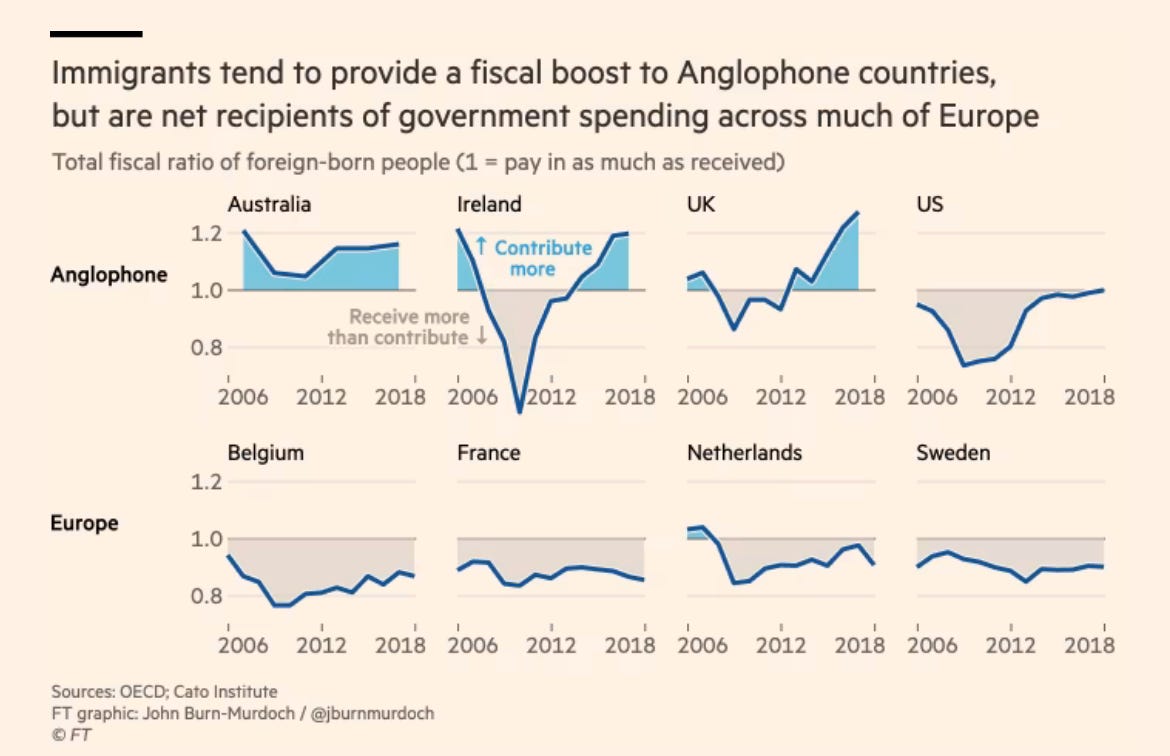
America is also much, much better at cultural assimilation.
In the United States, the children of immigrants do well in school (despite often not speaking English at home); their reading test scores on the international PISA exam are only a few points below the test scores of Americans whose parents are not immigrants (506 versus 511). In France, the children of immigrants score more than 40 points worse (444 versus 486). In the U.S. and Canada, the children of immigrants outperform the native-born average; in most of Europe (though not Italy or Spain) they still underperform it, men by a larger margin than women.
America’s boring secret
The classic account of what is afoot here is culture. America has a welcoming culture, from the Statue of Liberty in New York Harbor to the fact that most of us Americans are ourselves descended from immigrants. A significant fraction of the West was part of Mexico at one point; the Mississippi used to be France. America was never an ethnostate.
Much of the difference, though, might be much more mundane.
The most important reason why immigration is more successful in the United States is the simplest: Europe makes it structurally much harder for immigrants to work.
Rigid employment protection, sector-wide collective bargaining, and high effective minimum wages create insider-outsider dynamics that hit newcomers hardest.
Leonhardt framed Denmark’s success as a story about reducing numbers — and, sure, if what you’re doing isn’t working, do less of it. But the most that can get you is “not making things worse,” and America does better than that as an engine of global prosperity. But Denmark is also, by European standards, unusually flexible in its labor market — which means its relative success within Europe is explained by the very mechanism that explains America’s success globally.
Most European countries ban asylum seekers from working for six to nine months after filing their claims, often longer in practice. The intent is often explained as discouraging people who are entering for economic reasons from making spurious asylum claims. But about 1 million applications for asylum are filed each year despite this discouragement, and most of those people then become dependents of the state — or participate in the illegal economy — at least for the first while.
What employment bans actually produce is lasting economic scarring: People lose skills, lose contact with employers, and get pushed into informal work or dependency. The negative employment effects persist up to a decade after arrival. And by design, the bans feed the very dynamic of immigrants as a fiscal burden that fuels public backlash.
The United States, for all its dysfunction, lets most immigrants start working almost immediately. And the results are dramatic. The U.S. is a global outlier: refugee employment rates are comparable to those of economic immigrants from arrival. In Europe, it takes refugees a decade or two to narrow that gap.
Using Balkan refugee flows as a natural experiment, economists found that rigid labor markets amplify negative employment effects. A study of Denmark found something more hopeful: low-skilled refugee arrivals actually pushed native workers into less manual-intensive occupations. But Denmark’s labor market is unusually flexible by European standards, which is precisely the point.
The downstream consequences go beyond wasted human capital.
In the U.K., asylum seekers banned from working increased property crime; EU workers with labor market access did not. Using Italian legalization as a regression discontinuity, Paolo Pinotti estimated that granting legal work status reduced immigrant crime by roughly 50%.
The United States also bars asylum seekers from working for 180 days. So why does it still outperform? Because until recently, most humanitarian immigrants to the U.S. were resettled refugees who received work authorization on arrival, not asylum seekers subject to the waiting period.
When the recent southern border surge changed that, the results looked more European.
In reaction, New York City spent billions housing people barred from earning a living. This is the closest the U.S. has come to running the European experiment on its own soil, and it produced exactly the outcomes Leonhardt attributed to immigration itself rather than to the policy regime surrounding it.
A labor market can absorb far more people than a welfare state can, and few people resent hardworking coworkers. But most people will predictably regret (and observe that their communities can’t sustain) a large population receiving benefits.
Who shows up matters
The second related factor is selection.
The U.S. immigration system benefits from low geographic distance to culturally more proximate countries and institutional filters that select for employability.
Getting to the United States from the Middle East typically requires a university admission, an employer sponsor, or an established family network. Getting to Europe from the same region more often means an asylum claim or family reunification from earlier guest-worker flows.
The most telling comparison involves the same cultures of origin under different policy regimes. Iranian-Americans hold bachelor’s degrees at a rate of 65% and earn median household incomes around $100,000, many descended from professionals who left after the 1979 revolution and entered through university or employment channels.
Iranians in Europe arrived more often through asylum, with different class and educational profiles. Pakistani-Americans earn median household incomes above $100,000 and hold bachelor’s degrees at rates well above the national average; British Pakistanis have among the lowest employment rates of any ethnic group in the U.K.
Turkish-Americans are solidly middle class; Turks in Germany were recruited as guest workers from rural Anatolia, and their descendants still face some of the widest educational gaps in the OECD. Same regions of origin, different selection and policy regimes, radically different results.
In this respect, the United States also benefits from a structural advantage Europe cannot replicate: English. Immigrants selected through American universities and employers arrive already speaking the lingua franca of global commerce, media, and technology. That head start compounds over time through cultural exposure, professional networks, and children’s schooling.
The third factor is integration infrastructure. We should note upfront that this is where cross-country causal identification gets hardest. Still, the pattern is hard to ignore. What Americans often call “cultural openness” to assimilation is itself largely a product of institutional design.
The Reagan line that anyone can become an American describes an outcome, not an explanation — the outcome of birthright citizenship, anti-discrimination enforcement, and a labor market that lets newcomers prove themselves quickly.
That enforcement matters: A meta-analysis of 97 field experiments found that hiring discrimination against nonwhite applicants is actually worse in France and Sweden than in the United States. Americans are not necessarily less biased because of better character — the U.S. has stronger institutional monitoring.
Researchers exploiting the quasi-random outcomes of Swiss citizenship referendums showed that naturalization causally increased immigrant earnings by roughly $5,000 per year, with the largest effects for the most marginalized groups. Citizenship is not a reward for integration; it is a cause of it.
Sweden is the instructive failure case.
No country in Europe has invested more in integration services, language classes, and social support. Yet Swedish integration outcomes have been among the worst in the OECD. The lesson is that integration effort does not equal integration design.
You cannot integrate people into a labor market that will not hire them, and spending generously on language courses while maintaining employment bans and rigid hiring practices is the policy equivalent of teaching someone to swim and then barring them from the pool.
The three mechanisms suggest three fixes:
European countries might benefit from eliminating employment bans for asylum seekers and investing in credential recognition. This is the lowest-hanging fruit: a pure policy choice defended by no constituency other than bureaucratic inertia.
Expanding skill-based immigration channels alongside humanitarian obligations could help. Germany’s Skilled Immigration Act is proof this is politically feasible even in a country with deeply contentious immigration politics.
Making citizenship accessible, funding language acquisition, and enforcing anti-discrimination law would address the integration gap. But sequence matters: Integration spending or anti-discrimination enforcement without labor market access is wasted money.
The U.S. advantage here is real, but it is institutional, not cultural. Labor market access, selection mechanism, and citizenship determine whether immigration works far more than how many immigrants a nation admits.
The current administration seems intent on testing whether the American advantage can be dismantled; it would be a mistake for liberals to make the same category error. Immigration is good when we do it well; we must do it well, and we must understand that we will get bad results if we do it badly and take seriously our responsibility to avoid doing that.
Europe and the United States may be learning this from opposite directions: one by watching what happens when you deny immigrants access to the labor market, the other by finding out what happens when you start.
Recommended reading:


The U.S. intentional homicide rate is about 5.8/100,000, whereas it is 0.9 in Germany, 1.3 in France, 1.1 in Sweden, and 0.8 in Denmark. The U.S. immigrant intentional homicide rate is somewhere in between, perhaps around 3.8/100,000, meaning those people coming to America lower our crime rates but would increase Europe’s. So that’s part of the story. But it’s not the whole story; in Sweden, for example, the homicide rate among immigrants and children of two immigrant parents is 10/100,000 (my attempted calculation from these figures that are broken out by age cohort), which would be extremely high in the U.S. too.

It’s ironic that the rigid employment environment which should protect the native born population from competition with immigrants also serves to generate negative sentiment about immigrants.
I feel like a conservative would argue that the US having a less generous welfare state plays a big part here.
The types of immigrants you attract when you can simply live on the dole in your new country is likely a very different population than those who know they’ll have to be self-reliant to survive.
“Come here and work hard and maybe you’ll strike it rich” is a very American sensibility. “Come here but it’s unlawful to work but also we’ll give you free welfare and healthcare” sounds cartoonishly European.