


Welcome to The Closing Argument, our verdict on the news, plus everything The Argument published and appeared in this week.
The Verdict, by Jerusalem Demsas
In the summer of 1816, it snowed in New England. Across the Atlantic, Europeans still reeling from the end of the Napoleonic Wars saw their continent descend into a science-fiction nightmare.
“The inhabitants of Taranto, in southern Italy, were terrified by red and yellow snowflakes in a place where even normal snow was a rarity. Brown, bluish, and red snow fell in Maryland in April and May. Everywhere, the dust hung in a dry fog,” recounted anthropologist Brian Fagan in 2000.
Writing in 1984, NASA scientist Richard Stothers described the root cause of the bizarre climatic event: a volcanic eruption in Indonesia that exceeded “any other known eruption, historical or otherwise, during the past 10,000 years.”
The ash that blanketed the globe caused the mean temperature in the Northern Hemisphere to drop between 0.4 and 0.7 degrees Celsius. To put this into context for our climate-conscious readers: the Tambora eruption temporarily reversed, in a single year, the equivalent of roughly one-third to one-half of all the warming humanity has caused since the Industrial Revolution.1
I thought back to this 200-year-old atmospheric event on Friday, when I walked outside and breathed in a lungful of smoke.
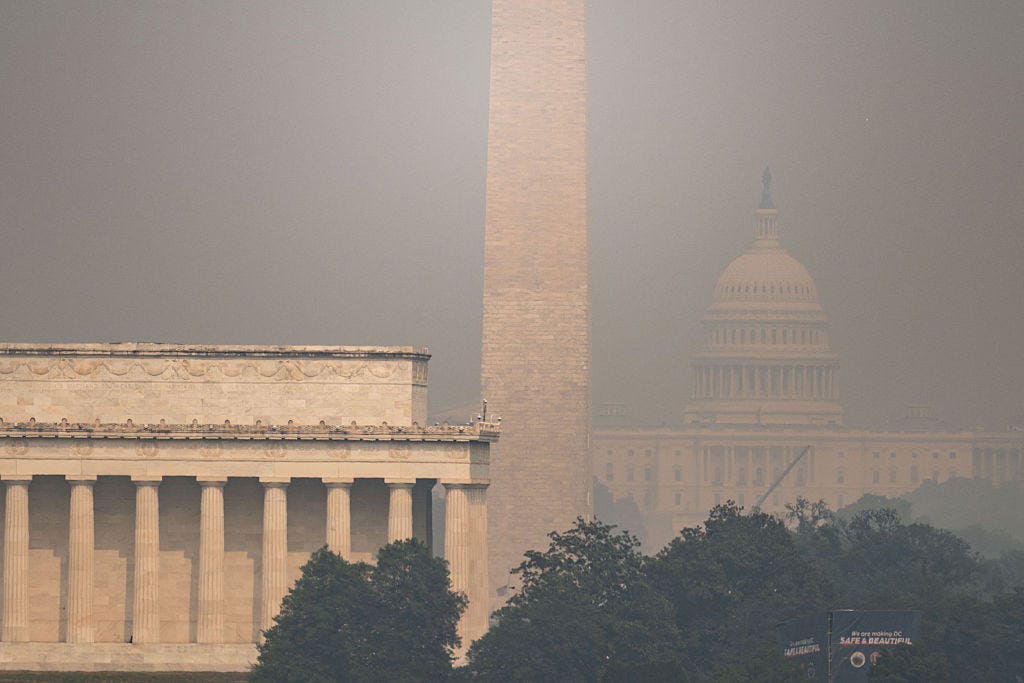
It’s nice to live in a time when what can only be described as an apocalyptic haze is quickly explained by dozens of scientists and newspapers. Unlike our unfortunate 19th-century ancestors, we know what’s going on; they instead were forced to bandy about batty theories about sunspots blocking sunlight, wind patterns, and the amount of gunpowder discharged during the Napoleonic Wars.
The proximate causes of our modern apocalyptic haze are the hundreds of fires blazing across Canada, many of which are in “remote, northernmost reaches of Ontario, where there are no highways, roads or people.”
Smoke inhalation is often an ancillary part of a broadly pleasurable activity — at a campfire, while cooking a meal indoors, or as a vehicle for imbibing nicotine or marijuana. It can be easy to ignore the fact that you are slowly reducing your life expectancy.
It’s almost hard to believe the current state of the research, because if you take it at face value, you’re forced to conclude that it’s impossible to overrate the importance of air quality. According to a report by Founders Pledge, “Air pollution is the fifth largest risk factor for mortality” worldwide, responsible for nearly 7 million deaths every year. The report added that 99% of the world’s population lives in areas with poor air quality.2
Beyond the mortality impacts, poor air quality makes you dumber, poorer, and maybe even more depressed (though the evidence here is more mixed). Time and again, research on air quality reveals its myriad negative impacts:
Economists found that when the wind blows pollution from refineries, corn milling facilities, and foundries into specific Chicago neighborhoods, crime goes up. They found that air pollution increases violent crime but not property crime, “consistent with research from biology and medicine linking air pollution and aggression.”
During the pandemic, there was a brief surge of concern about air quality: The U.S. portable air-treatment market grew 57% in 2020. Honeywell’s 2023 survey of workers in large buildings revealed 93% of respondents said their expectations for workplace air quality were higher than they were three years earlier.
But when I looked at survey data about the salience of air quality, I could barely find any evidence that COVID-19 — which was basically an indoor-transmission problem3 — had happened.
Since 2000, with a brief blip in 2005, Gallup has been asking Americans how much they personally worry about a variety of environmental problems, including water pollution, animal extinction, tropical rainforest survival, and air pollution. Air pollution, despite being the best-documented direct harm to humans, has basically always lagged the other concerns, but I was surprised how little the global pandemic seems to have affected views.
In 2019, 43% of Americans expressed a great deal of concern about air pollution, which went up to 48% in 2020 and then dropped to 41% in 2021 (which is exactly when we all figured out how important indoor transmission was!). By 2023, concern about air pollution was down to 38%.
Now, a virus isn’t colloquially understood to be pollution — though the EPA explicitly includes viruses among “biological pollutants.” So, perhaps respondents would have answered differently if primed to understand the question as including viruses.
This all forces me to revisit my initial condescending attitude to our ancestors, who struggled to understand the root causes of the year without a summer. After all, modernity may have given us the ability to explain our world’s problems in exquisite detail, yet we remain surprisingly casual about addressing them.
Top stories this week, by Kobe Yank-Jacobs
As we grow, I want to make sure you see everything we’re doing without flooding your inbox with dozens of emails. But for the real libs, you can get every post as it drops by opting into The Mag here.
Big week at The Argument — Jeremiah Johnson made his debut as our newest staff writer. In his opening bid, he discussed how the new film Obsession fits within the prestige horror genre. “Anxieties are increasingly not about horrible monsters or alien forces tearing society apart,” he writes of the past decade in horror film. “They’re about what we’re doing to ourselves.” Read on for the full analysis:

Meanwhile, Eli Richman corrected the record: No, 2.8 million Americans were not induced to scream and vomit from overuse of marijuana. Somehow, a single bad study from 2018 fooled The Washington Post and The New York Times, muddying the debate on the effects of legalization. Get the real scoop right here:

Finally, Kelsey Piper took on superstar public intellectual Jonathan Haidt, who is on a campaign to age-gate the internet. She worries that age verification will threaten free speech and thinks that we should consider more balanced measures. “It’s ironic that the writer who gained prominence with a strong case for free speech is now in denial about what his second act’s political project seeks to do,” she writes of Haidt.
Read on for the full take:

🌟Abundance Wins of the Week🌟
This week, San Francisco lowered its inclusionary-housing mandate from 15% of new units to 5%.4 An April memo by the city controller’s office had previously concluded that anything significantly higher than 0% could unduly slow housing construction, but hey, progress is progress.
San Diego’s regional planning agency applied California’s SB 79 — a new law that upzones transit-adjacent areas — to 17 additional bus stop locations, overruling city officials who had identified only four. Estimates say this will add capacity for around 100,000 more units.
The House Subcommittee on Energy advanced six nuclear energy permitting bills to the full Energy and Commerce Committee. These bills would focus regulatory efforts, cut down the number of hearings required for nuclear projects, and more.
Worth watching...
I sometimes wonder how many times Sen. Bernie Sanders has said the word “billionaire” in the past decade. Through sheer repetition, he has almost single-handedly popularized the notion that we live in an “oligarchy,” and recently, he’s been stumping with Rep. Alexandria Ocasio-Cortez on a Fighting Oligarchy tour. But do we actually live in an oligarchy?
While billionaires don’t literally coordinate to get their way, they do have tremendous influence as a class. This week, Jerusalem and Matt clash over this question. Watch them untangle the debate below:
Kristen Soltis Anderson is one of the top right-of-center pollsters in the country and an expert in the youth vote. This week, she was a special guest on a Substack live conversation with our director of political data Lakshya Jain. Alongside VoteHub’s Zachary Donnini, they try to explain why the youth vote has swung so wildly in the past several election cycles.
Are zoomers becoming Democrats again? Or just doomers? Click below to find out:
What’s News with The Argument
The Argument recommends, by Kobe Yank-Jacobs
Jeremiah Johnson, The Argument’s new staff writer, has decided to plant a flag. He is dedicating his first appearance in this section to a single bold assertion: Carly Rae Jepsen’s E*MO*TION is the greatest pure pop album of the last 25 years. Apparently, even the bonus tracks, like “Cut to the Feeling,” are required listening.
I will be assessing his claims on my commute home, with one eyebrow raised.
Meanwhile, Eli Richman told me he “must have walked around the museum room for over an hour” when he saw Laurie Anderson’s Four Talks at the Hirshhorn last weekend (not because he was lost but because he was absorbed).
For more than two weeks in 2021, Anderson spent 10 hours a day painting this room in a full stream of consciousness — no sketches beforehand — filling it with COVID-era reflections, dark jokes, expressions of modern anxiety, and more. I’m sold, Eli.
After years of declining recommendations to watch Couples Therapy, Maibritt Henkel binged a whole season this week.
“It sounds banal, but it’s such a good reminder that finding the language to describe how you feel and why you feel that way is a universally difficult skill,” she said.
Some people eventually do find words for this task, but others capture it in a novel artistic form. Video producer Justin Zuckerman saw Dry Leaf on Friday, a three-hour Georgian film about a father searching for his daughter in a vast, picturesque landscape. The entire film is shot on a 2008 cell phone.
“I’m excited because it’s presenting a story in a challenging way that I haven’t seen in cinema before,” Justin told me before seeing the film. “Even the trailer suggests something intimate and alive.”5
Speaking of intimacy, I saw The Invite in theaters last weekend. The film is about a double date that eventually reveals unspoken dimensions of the participants’ sex lives and preferences. It would have been easy to play it all for laughs, defusing every embarrassed tension with a joke, but the script deftly managed the line between humor and seriousness. It left me laughing and thinking in quick succession.
Finally, as Ontario sends wildfire smoke to D.C., Jerusalem is jamming out to a much better Ontarian export: Alanis Morissette's Jagged Little Pill album, which can be surprisingly repurposed to rage at a continental atmospheric transport event.
We have merch!
We have quarter-zips, keychains, hats, and stickers. Each one is a great conversation starter in its own way. Buy them here.
More to read:
Shakespeare saw Andrew Tate coming

Four centuries before podcasts and 4chan and red-pilling, Shakespeare recognized that paranoid misogyny does not actually serve the interests of men.
Death hoaxes, Messi conspiracies, and Lego drama

Every week, The Weekly Scroll will sift through social media so you don’t have to, collecting the most notable trends, memes, and online dramas in one place.
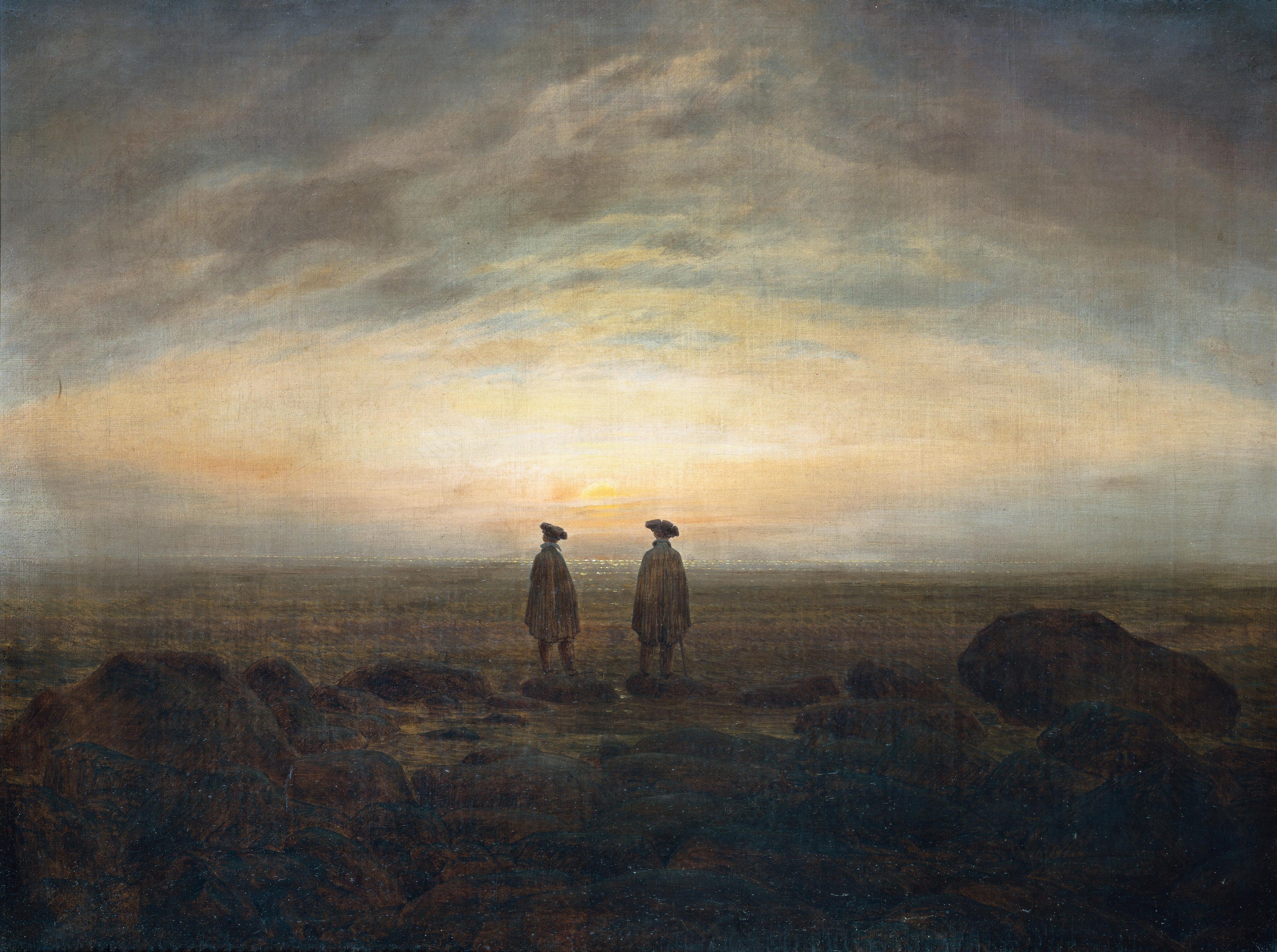
Correction: An earlier version of the image caption misstated 1816 as 2016. We regret the error.
There were potentially other contributing causes to this bizarre climatic event: other volcanic explosions and something called the Dalton Minimum, which was a "period of reduced sunspot activity that occurred between roughly 1790 and 1830" (notably this effect is very different from the incorrect contemporaneous theory that dark spots on the sun were literally blocking the light).
As measured by the World Health Organization.
HEPA air cleaners can remove up to 99.97% of infectious aerosolized SARS-CoV-2. Mechanically ventilated classrooms had at least 74% lower student infection risk than those relying on natural ventilation.
With an exception for the Mission District — my once and future home neighborhood— where the limit is now 8%.
Justin Zuckerman has since reported that this is one of the best films he’s ever seen, and he went to film school. “It was like watching an impressionistic painting evolve live.”
I am deadly serious in my efforts to convert The Argument readers to Carly Rae Jepsen stans. E*MO*TION is unmatched brilliance.
It's a little charming to learn that people 200 years ago were sophisticated enough to understand that extraordinary weather patterns weren't supernatural in origin, but then rationally concluded that the cause must be enough soldiers firing muskets in Europe to blot out the sun.