


Antisemitism, however you measure or define it, is on the rise.
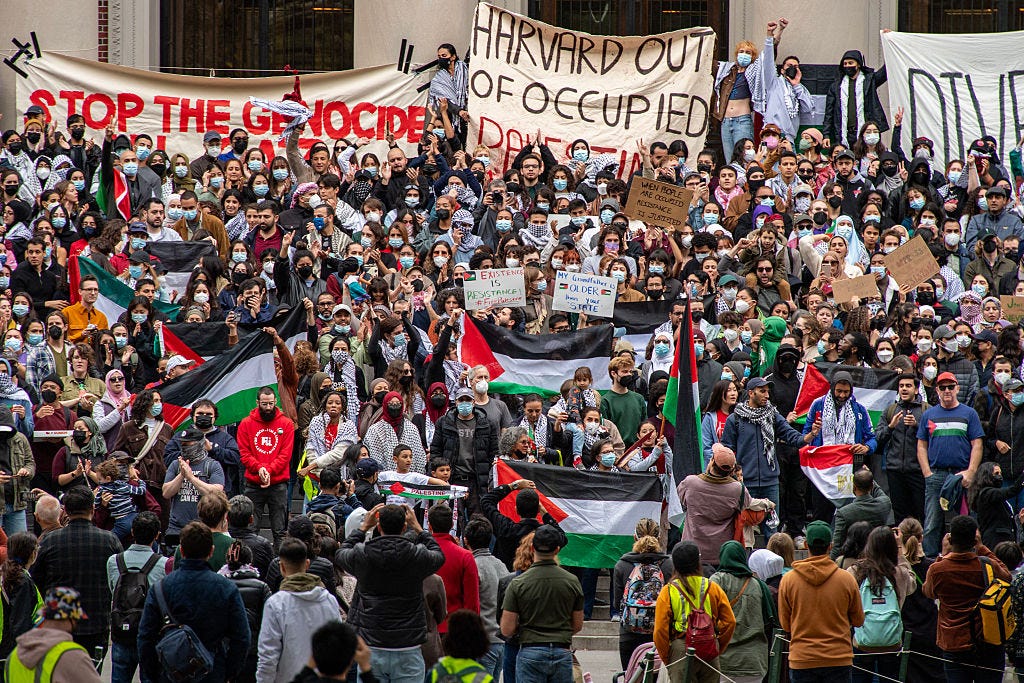
The conventional wisdom in political science is that antisemitism behaves as a “horseshoe,” increasing in prevalence as you move toward both the far left and the far right. After Oct. 7, many narratives have homed in on left-wing antisemitism, both real and perceived, particularly among young people in the context of campus protests about Israel.
But is this conventional wisdom correct?
To try to answer this question, the Yale Youth Poll1 has conducted two large national surveys of registered voters over the last year (with oversamples of young voters). In both surveys, we included questions designed to gauge the extent to which voters hold antisemitic beliefs, as well as the extent to which these voters are similar or distinct from those who hold anti-Israel beliefs. We also drew on polling by The Argument, in combination with our own data, to look at whether social media use might be driving either set of views.
Our data tells a story that doesn’t quite align with the conventional wisdom. Our findings are threefold:
Antisemitic views are more prevalent among younger people.
The young people who are most likely to agree with antisemitic statements are on the political right.
Anti-Israel views are more common on the political left.
Which Americans are most likely to hold antisemitic views?
To measure antisemitism, we asked respondents whether they agreed or disagreed with the following three statements, which are commonly considered to be antisemitic. These three statements were drawn from a similar battery used in a series of papers published between 2022 and 2023 by political scientists Eitan Hersh and Laura Royden.2
“Jews in the United States are more loyal to Israel than to America.”
“It’s appropriate to boycott Jewish American-owned businesses to protest the war in Gaza.”
“Jews in the United States have too much power.”
By aggregating data from the fall and spring surveys, we obtained a sample size of N=6,855 registered voters, including N=4,021 voters under 35 (it is, after all, a youth poll).3
Among all voters, just under one-third agreed with at least one antisemitic statement, but specific subgroups of the population displayed wide variation.
Unsurprisingly, Jewish voters were much less likely to agree with antisemitic statements than non-Jewish voters.4 Women were also notably less likely to hold antisemitic beliefs than men.
Nonwhite Americans were more likely to agree with antisemitic statements on average than white Americans. Among white respondents, 29% agreed with at least one antisemitic statement, compared to 37% of Hispanic respondents, 41% of Asian respondents, and 43% of Black respondents.
In the overall population, there was very little evidence of an education gradient or political trend with regard to antisemitic beliefs. The shares of Harris and Trump voters who agreed with at least one statement were nearly identical, as were the shares of respondents with a graduate degree and of respondents with less than a high school diploma.
What’s most notable is the sharp age gradient. In our data, 40% of respondents aged 18 to 22 agreed with at least one antisemitic statement, compared to just 26% of respondents over 65.
As you can see in the chart, the relationship between age and the prevalence of antisemitic beliefs looks like a smooth curve — nearly the same shape that you see in polling of explicit antisemitic attitudes5 from Blue Rose Research.
The locus of youth antisemitism is on the political right
Thanks to our large sample of just over 4,000 voters under 35, we can take a detailed look at which types of young people were the most likely to hold antisemitic beliefs.
First, as with the overall population, men were more likely to be antisemitic than women, though the gender gap is slightly larger among young people.
Second, among younger voters, we do observe an education gradient (which we don’t see among voters overall). Young people with a high school diploma or less were about 10 percentage points more likely to agree with at least one antisemitic statement than those with a graduate or professional degree.
Third, we still observe racial gaps among younger voters, though they differ slightly from the overall population. Among voters under 35, Hispanic voters were most likely to agree with at least one antisemitic statement (49%), followed by Black voters (43%), Asian voters (40%), and white voters (36%). Younger white voters were seven points more likely to agree with at least one antisemitic statement than whites overall, while younger Hispanics were 12 points more likely than Hispanics overall. There was essentially no age gap between younger Black and Asian respondents and the overall Black and Asian sample.
Finally, there is a massive partisan and ideological gap among young people. That is not the case among the general population.
Half of Trump 2024 voters under the age of 35 agreed with at least one antisemitic statement, compared to just 32% of Harris voters.
When looking at self-reported ideology, the gap is even more stark. Almost half of young people who call themselves “slightly conservative” or “conservative” agreed with at least one antisemitic statement. But, most strikingly, nearly two-thirds of “extremely conservative” young people agreed with at least one antisemitic statement. It bears emphasizing: No other demographic group in our entire survey expressed levels of antisemitism nearly as high as this.
On the other hand, young people who self-identify as liberals were among the least likely groups in their cohort to agree with the three antisemitic statements we tested: 32% of young people who call themselves “liberal” agreed with one or more statements (with almost the same figure, 33%, for self-identified “extremely liberal” young voters), compared to 41% of young people overall.
In short, young people who voted for Trump, have lower educational attainment, or call themselves conservative were among the most likely to agree with at least one antisemitic belief. And young voters who identify as “extremely conservative” hold the most antisemitic views by far.
The relationship between antisemitism and anti-Israel views is complicated
In our second survey, fielded from March 3 to March 23 this spring, the Yale Youth Poll asked respondents whether they agreed or disagreed with a variety of statements about Israel, ranging from extremely supportive to extremely critical.
“America should end the slavish surrender to Israel, its wars, and its demands for foreign aid.”
“The Bible says that those who bless Israel will be blessed, and those who curse Israel will be cursed, so America should stand with Israel.”
“America needs Israel for national security. They are the tip of the spear when it comes to defeating terrorism.”
“Israel is a sanctuary for historically oppressed people, minority rights, and democracy in a region where no others exist.”
“Israel is a democracy and the safe haven of the Jewish people, but they have a moral obligation to ensure humanitarian treatment of Palestinian civilians.”
“Israel is an apartheid state, engaged in racist oppression against Palestinians.”
The statements were, in order, paraphrased from Nick Fuentes, Ted Cruz, Nikki Haley, Ritchie Torres, Chuck Schumer, and Rashida Tlaib.
What we see in our data is that young people, more educated people, and those on the political left were more likely to agree with the harshest contemporary left-wing critique of Israel that we tested — that “Israel is an apartheid state, engaged in racist oppression against Palestinians.”
However, people who scored highly on our measure of antisemitism were also more likely to agree that Israel is an apartheid state.
But while antisemites were indeed more likely to have extremely negative views about the state of Israel, many of the groups that were most critical of Israel, at least according to this measure — people with graduate degrees and those who identify as “extremely liberal” — were the groups least likely to express more explicit antisemitic beliefs (i.e., those unrelated to Israel).6
This matches a pattern you see in polling from the United Kingdom, where supporters of left-wing parties have an extremely negative perception of Israel’s treatment of Palestinians but were also generally less likely to express non-Israel-related antisemitic views than supporters of right-wing parties.
There is, of course, significant disagreement about the point at which views about Israel veer from criticism of the Israeli government’s actions toward antisemitism.
Take, for example, opposition to Israel’s existence as a Jewish state.
Under mainstream definitions of antisemitism (e.g., those used by the International Holocaust Remembrance Alliance or the Anti-Defamation League), this view is inherently antisemitic because it means denying the Jewish people the right to their own state when other ethnic groups have this right. And, indeed, in our fall 2025 survey, we found that voters who self-identified as extremely liberal (25%), liberal (37%), and slightly liberal (37%) were much less likely to say that “Israel should exist as a Jewish state” than those who described themselves as slightly conservative (49%), conservative (66%), or extremely conservative (72%).
Still, other definitions of antisemitism (e.g., the Jerusalem Declaration on Antisemitism and the Nexus Document) would consider this statement acceptable, arguing that it targets a specific political ideology, rather than explicitly targeting the Jewish community itself.
But wherever the boundary between political and antisemitic views on Israel lies, based on our data, it is more common for voters on the political left to agree with statements that plausibly cross the line from anti-Israel to antisemitic than those on the political right. This is true even though it is simultaneously the case that, in our surveys, young conservatives were more likely to agree with explicitly antisemitic statements than young liberals.
Is this all downstream of social media?
What’s driving this increase in antisemitic and anti-Israel views among young people? One possible explanation is social media.
If you’ve spent time on Instagram Reels in the last year, there’s a chance you’ll have seen something about “the Big Yahu,” “goyslop,” or an Agartha edit, as well as plenty of content about Israel’s conduct in Gaza and the war in Iran.
To investigate the relationship between antisemitism and social media, we included a question on our second survey asking respondents which platforms they get their news from.
We find that antisemitic beliefs were more prevalent among voters who get their news from social media. For example, 41% of respondents who get their news from TikTok agreed with at least one antisemitic statement, compared to 33% of all respondents.
There’s less of a clear-cut relationship between preferred news sources and perceptions of Israel as an apartheid state. People who get their news from Reddit and (to a lesser extent) from TikTok, Instagram, or podcasts were more likely than average to agree that “Israel is an apartheid state, engaged in racist oppression against Palestinians,” but so were those who get their news from newspapers and broadcast television.
And it’s not clear if either of these relationships is causal. If people who get their news from social media skew younger, then we might just be seeing an age effect filtered through news consumption patterns. Or perhaps social media is the underlying source of increased agreement with antisemitic statements, which partially explains the age gap described above. And, of course, those with a preexisting belief that Israel is (or is not) an apartheid state may be motivated to seek out content that confirms their priors.
Because we used the same news source question that The Argument uses in their polling, we were able to check the age distributions of each news platform in The Argument’s aggregated polling data. Indeed, we can see that the news-consuming audiences of social media platforms skew younger (except for Facebook).
Viral antisemitic and anti-Israel content on social media may be shaping young people’s views. But that content is also created because there’s a demand for it. It’s not immediately obvious how much of one is causing how much of the other.
And that’s true of much of our data. While there are some clear takeaways — both antisemitic views and negative perceptions of Israel are more common among younger voters — the situation is still really complicated. Some young voters may be driven toward anti-Israel beliefs by their preexisting antisemitic beliefs, and some young voters may adopt antisemitic views as a result of preexisting anti-Israel views or of conflating Israel with the Jewish diaspora. Some young voters are deeply critical of Israel but are not antisemitic, and some young voters may be antisemitic but are not so critical of Israel.
Our poll cannot clearly distinguish between these four types. The rise in antisemitism and anti-Israel views among younger generations may come from a variety of different factors, which warrant further research.
Recommended reading:
The fox in liberalism’s henhouse

Critical Race Theory and related identitarian ideas fooled many of us into thinking it was just a new, strange version of liberalism.
The Tinder-ization of the job market

AI may not have collapsed unemployment, but it has turned job seeking into a modern dating nightmare.
An undergraduate-run polling organization with which we are both affiliated.
The statements are, respectively, aimed at gauging whether people believe in the “dual loyalty” trope, whether they hold all Jews accountable for Israel’s actions, and whether they believe in conspiracies about Jews controlling powerful institutions.
For the full combined sample, the margin of error is ±1.2 percentage points; for the youth subsample, it’s ±1.6 percentage points.
There were a total of N=385 Jewish respondents in the combined sample (including those who said they were religiously “atheist,” “agnostic,” “something else,” or “nothing in particular” but identified as culturally Jewish).
Explicit measures of prejudice are generated by asking people something like “do you feel favorably or unfavorably toward Jewish people?” This is what Blue Rose did. The risk with explicit measures of prejudice is that social desirability bias may cause you to underestimate the true extent of prejudice, as some people will be uncomfortable expressing their real (or subconscious) views even in an anonymous survey. Indirect measures of prejudice, like the ones we use in this analysis, aim to get around that.
One further wrinkle is that it’s possible that the notion of political correctness is more ingrained on the left than on the right, which might make young liberal voters less willing to express agreement with an explicitly antisemitic statement even if they hold more implicit biases against Jewish people.
The idea that you have to believe every ethnic group deserves its own state or you are racist against them is low key insane - as if China or India or numerous African states are all just ethnostates. Even a lot of European identities are sort of manufactured - Spain has more than one ethnicity for example.
Would be curious to see what would happen to the data if you replaced the word “Jews” with “Zionists” in the Hersh poll. My guess would be that a lot more young and liberal folks would agree with at least 1/3 statements. This is relevant because while many people seem to identify prejudice against Jews as bad, there seems to be less of a taboo against discriminating against “Zionists” in liberal spaces.