

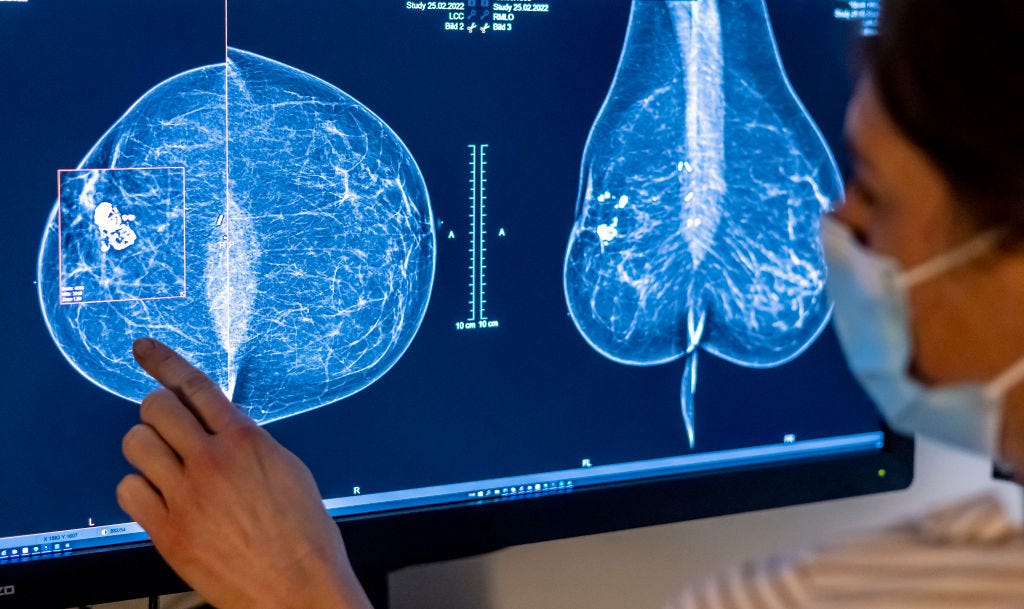
We’ve had to put up with a lot when it comes to AI: From taking people’s clothes off on Twitter to helping kids cheat on tests to producing fruit dramas we can’t help but watch (just me?). But if AI could cure cancer, the holy grail of biotech, would it all be worth it? And would an AI that was powerful enough to cure cancer be an AI we would even want to live alongside?
Now, the bar for a normal business being net positive isn’t “provides a major medical breakthrough.” As staff writer Kelsey Piper recently explained at The Argument’s San Francisco debate: “I see a billboard. It’s like ‘Here’s cloud infrastructure balancing.’ Is cloud infrastructure balancing going to cure cancer? No, but it’s good… The world is good because of lots of things that are small and make something a little bit better.”
Sure, but AI companies carry very different risks from other types of businesses. I’m less convinced than Kelsey by the arguments for potential human extinction, but even if we limit ourselves to potential destabilizations to labor markets, educational institutions, and the very core of what it means to be human, AI has greater risks than any other technology.
All major technological breakthroughs are disruptive, but what makes them worth it is they improve living standards. If the risk of AI is truly as great as its creators believe, then the potential rewards better be worth it.
After reporting on AI’s scientific capabilities, I found myself becoming cautiously optimistic on the ability of AI to help scientists make major step changes in addressing cancer. AI excels at pattern matching, and that’s one of the main ingredients to diagnosing, treating, and ultimately curing cancer.
For example: The five-year survival rate for localized breast cancer is nearly 100%. However, if the cancer metastasizes, it’s around 33%. If AI made us better at catching many types of cancer early, we would already be well on our way to curing it, at least in the way viewed by epidemiologists.
What it means to “cure cancer” isn’t totally straightforward. Does it mean the possibility of remission is eliminated? That the five-year survival rate for cancer survivors is indistinguishable from the non-cancer-having population?
When Google’s Demis Hassabis says AlphaFold will one day cure cancer, he’s referring to AI tools that can speed up protein prediction and drug discovery. AlphaFold doesn’t work like the typical LLMs or promise a magic cancer-curing pill, but it could allow us to gradually develop therapeutics.
OpenAI’s Greg Brockman, meanwhile, shared a story about a man who treated his dog’s cancer, claiming it was cured with a personalized vaccine developed with assistance from ChatGPT. ChatGPT didn’t actually make the drug or cure the dog, but it was able to help the dog’s owner find the right people, machines, and techniques to treat his pet and extend its life.
And when Anthropic’s Dario Amodei talks about curing cancer, he’s relying on recursive self-improvement: a model that trains a better model until you have something so capable it solves everything.
When I talked with Kelsey about all this, I was surprised to find that for all her optimism (pessimism?) about AI’s transformational impact, she was skeptical about its application in cancer research. Her bottom-line argument is that while LLMs are good at verifiable tasks, the goal of “curing cancer” is full of unverifiable ones.
So, we decided to debate it live at our first event in San Francisco, where a crowd full of experts could help us figure it out. Listen to us — and them — discuss.
Watch or listen wherever you get your podcasts.
The Argument. Libbing out.
(Illustration by The Argument, photo by Mariah Miranda Photography)
The transcript will be after the paywall in this post for paying subscribers.
New episodes post every Thursday.
For an ad-free version and full transcript, subscribe at TheArgumentMag.com.
Subscribe: Apple Podcasts | Spotify | YouTube | Overcast | Pocket Casts
Corrections:
Around 13:00, Kelsey says “something like 25% of adults are up on all of their recommended cancer screenings.” This is inverted; researchers found that in 2021, around 25% of adults were not up to date with breast, cervical, and colorectal cancer screening recommendations, according to the 2021 National Health Interview Survey.
Around 22:00, Jerusalem says the survival rate for breast cancer that has metastasized is around 38%. The figure is closer to 31% to 33%.
Around 48:00, Jerusalem says X “stopped letting” users create deepfakes and other nonconsensual images through Grok. But an NBC News investigation revealed it is still happening, despite the company’s pledge to stop.
Show notes:
AI boosters discussing the promise of AI in cancer treatment:
Interior Secretary Doug Burgum promising that “curing cancer” would be among the “wonderful things that can come from AI”: The Hill article
Burgum promising AI will “not only gonna cure cancer, but it’s gonna eliminate all kinds of drudgery, repetitive jobs”: Gizmodo article
Energy Secretary Chris Wright promising that AI could help turn “most cancers, many of which today are ultimate death sentences, into manageable conditions”: Fortune article
Demis Hassabis, CEO of Google DeepMind, saying AI can be used to “cure all disease,” including cancer: 60 Minutes broadcast
Greg Brockman boosting story about man who used ChatGPT to help create a personalized vaccine to treat his dog’s cancer: Tweet, The Australian article, Decrypt article
“Machines of Loving Grace,” document by Dario Amodei describing using recursive self-improvement to solve various long-term problems, including curing cancer: Dario Amodei essay
Coverage of AI data centers (among other things) driving up electricity costs: Bloomberg article
Coverage of AI enabling students to cheat: Education Week article, The Guardian article, UC Berkeley study
Example tweet contrasting AI promises of curing cancer with observed use-cases of sexualizing women: Tweet
Coverage of Grok making sexualized images of real people at users’ request: The New York Times article, The Guardian article
Coverage of oddly common AI-generated dramas featuring animated fruits on TikTok and Instagram Reels: The Conversation article
2022 study claiming to show that around half of AI researchers believe AI has at least a 10% chance of causing human extinction: AI Impacts survey
Article criticizing the AI Impacts survey for having a low response rate and lack of peer review: AI: A Guide for Thinking Humans article
Coverage contrasting cancer treatments today to the effective death sentence the disease represented 50 years ago: NIH Medline Plus article, Cancer Research UK article, AARP article
Explanation of “statistical cures,” or cancer epidemiologists considering cancer “cured” if, after five years, people who had it are statistically indistinguishable from the population: BMC Medical Research Methodology article
Study showing 25% of adults are not up to date with breast, cervical, and CRC screening recommendations in 2021: Preventing Chronic Disease article
Policy options to increase the number of preventative screenings performed:
Organized screening programs: Cancer article, Best Practice & Research Clinical Gastroenterology article
Invitation letters and reminders: BMC Public Health article
Patient navigation: Asia-Pacific Journal of Oncology Nursing article
Financial incentives: JAMA Network Open article
Coverage of cancer treatments gaining accelerated approval at higher rates than other specialties: The Lancet Oncology article
Coverage of Firefox making several security-related changes after being informed of vulnerabilities by Claude Mythos: Mozilla blog article, TechCrunch article
Coverage of Novo Nordisk using Claude to create a platform to help cut down on the paperwork necessary for clinical trials: Anthropic customer story, The Wall Street Journal article
Coverage comparing breast cancer’s 99% survival rate if it’s caught before it’s metastasized, versus 31% to 33% if it reaches stage 4: National Breast Cancer Foundation overview, National Cancer Institute (NCI) page
Coverage of AI analyzing screenings better than human doctors:
Mammograms: Breastcancer.org article, Diagnostics article
Lung cancer: Healthcare article, Northwestern Medicine article
Cervical cancer: NCI release
Coverage showing most cancer-associated genes present in a large portion of the population have already been discovered: Nature Reviews Cancer article
Research showing that around 85% of proteins are not druggable: Pharmacology & Therapeutics article, Cancer Research UK article
Coverage of data becoming more valuable as we’ve discovered more AI-related use cases: Forbes article
Coverage showing around 40% of research labs’ work is spent on operations, not science: Research Management Review article, AAAS blog
Coverage of C-Myc and p53, two proteins researchers have been unsuccessfully trying to drug for decades: Nature Reviews Drug Discovery article, Creative Diagnostics article, International Journal of Biological Sciences article, Cancer Research UK article
Coverage of hepatitis C having a 95% cure rate if patients take direct-acting antivirals: CDC page, Antiviral Research article
Coverage of two-thirds of hepatitis C patients not getting proper treatment: CDC page, Gastroenterology Advisor article, Hep article
Coverage of Medicaid cuts happening next year: The Commonwealth Fund article
X statement promising to crack down on Grok creating nonconsensual sexualized images of real women: Statement
Coverage showing Grok deepfakes are still happening: NBC News article
“Are you there Grok? It’s me, Margaret,” article by Jerusalem Demsas about the potential for AI to serve as a centralizing technology, restoring some shared truth between fractured communities: The Argument article
“@Grok Is This True? LLM-Powered Fact-Checking on Social Media,” study showing Grok has proved valuable to spreading real facts on Twitter: Study
“Do AIs think differently in different languages?” article by Kelsey Piper discovering whether AIs would provide different responses if asked in languages other than English: The Argument article
Polls showing a plurality of Americans are more concerned than excited about AI: Pew Research Center article
Coverage of OpenAI Foundation investing in Alzheimer’s disease research: OpenAI Foundation article, TODAY interview
Coverage of MASAI trial that found the use of AI detection software contributed to a 12% reduction in interval cancers: ScreenPoint Insights article