

Happy Presidents Day! I hope you’re savoring the long weekend, because this is the last one until Memorial Day in late May. Perhaps a world of AI abundance will usher in four-day-workweeks-for-all, but probably we’ll all just develop a taste for personal chefs and work almost as much to afford the luxury.
The Argument takes a recess on national holidays—which we have not always observed faithfully—but this time we are bringing a piece out from behind the paywall. Since we published it in early December, I’ve received repeated requests to make it available to free subscribers.
I’ve often been asked what abundance and liberalism have to do with one another, and my answer is twofold: First, unless liberals are able to deliver significant economic gains to the public, they will abandon us, and second, scarcity of key resources produces a zero-sum mindset that makes people hostile to outgroups.
If you enjoy this post, I hope you’ll consider becoming a paid subscriber.
American politics is increasingly organized around a simple conviction: There’s only so much to go around. Only so many good jobs, decent homes, and slots in the social hierarchy. If someone else starts doing better, that’s a threat—it means someone else (maybe you) is getting screwed.
The throughline of MAGA politics is this zero-sum worldview.
Whether it is immigrants taking all the good jobs or other nations developing domestic manufacturing at the expense of American industry or even women’s advancement in the workplace coming at the expense of men, the story is the same: When someone else wins, you lose. You are in a fight over scarce resources, and you have to protect your own.
Now, of course, many interactions are zero-sum: If someone passes you before the finish line of a race, their gain comes directly at your expense. But many other interactions and games are or can be positive-sum. For instance, if more kids know how to read, that’s better for everyone; it doesn’t necessarily come at another person’s expense.
But are the most important economic, political, and cultural questions more like the 50-meter dash or childhood literacy?
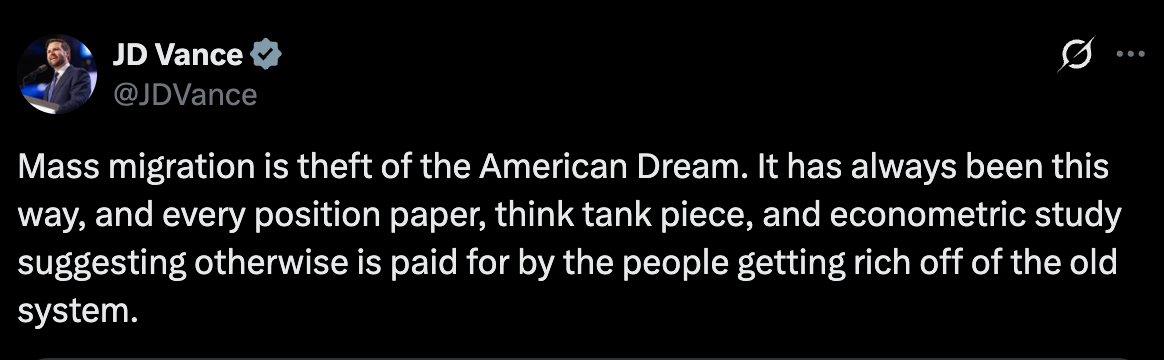
Zero-sum thinking is a self-fulfilling prophecy. If you think every extension of opportunity to one group necessarily hurts another, you’ll oppose immigration, trade, new housing, and eventually basic rights for anyone who isn’t already inside the circle. Eventually you get a politics of permanent siege, where every reform is framed as an attack on “heritage” Americans. That doesn’t just leave the country poorer; it makes it almost impossible to sustain a liberal society where people believe rights and prosperity can expand rather than being rationed.
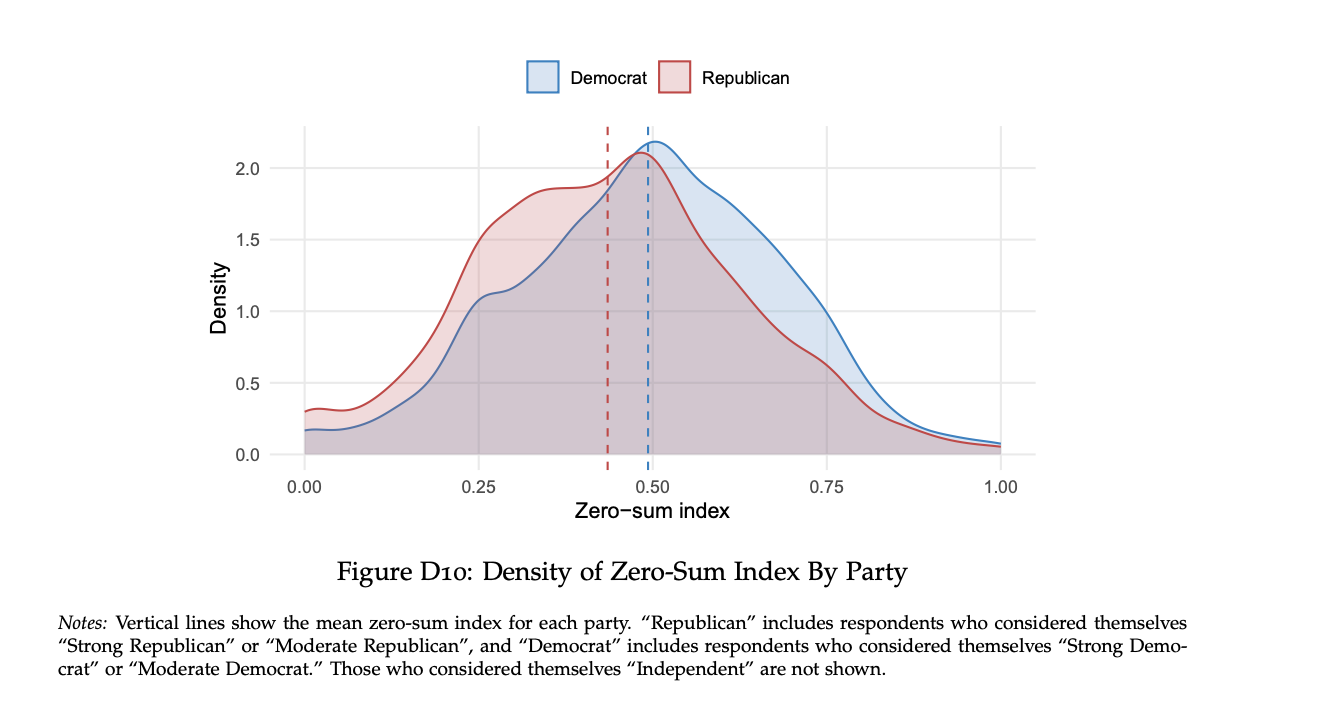
But this isn’t a story about right vs. left. Zero-sum thinking cleaves both parties, and in fact Democrats are more likely than Republicans to hold such views. In a new paper, economists Sahil Chinoy, Nathan Nunn, Sandra Sequeira, and Stefanie Stantcheva ran a massive survey of 20,400 U.S. residents to investigate the roots of zero-sum thinking.1
Their analysis reveals that people who exhibit zero-sum thinking are more likely to support more restrictive immigration policies, yes, but also redistribution and affirmative action. The logic of this is that people who believe that some groups are behind because of other groups are more likely to support policies that rebalance that.
Quick caveat here that you can support redistribution, affirmative action, and restrictive immigration policies without holding zero-sum views. For instance, I support redistribution because I think poverty is bad and society is better off when people have a basic standard of living. I don’t think my gains have come at the expense of a homeless person in California, but I do think I should be taxed to help house them.
The crucial difference is that I see these transfers as part of a bigger positive-sum project making the country richer, safer, and more stable — not as payback in a never-ending war between groups. Zero-sum thinkers see only the war, and they vote and govern accordingly.
Zero-sum mindset isn’t irrational
In a 1965 article, anthropologist George Foster developed a model called the Image of Limited Good that helped explain the behaviors of various peasant societies. Foster himself had embedded in Tzintzuntzan, Michoacán, Mexico, in the late 1950s, but he also drew from the work of many other anthropologists in societies the world over.
The Image of Limited Good cropped up in a bunch of different contexts.
In parts of Guatemala, it was believed that there was a finite amount of blood in the human body — which made some people reluctant to give it up for transfusions. In villages in Michoacán, women’s beauty was treated as zero-sum too: a woman with long, luxurious hair was expected to be “thin and wan,” unable to have vigor and strength. In Indian peasant communities, sexual moderation was urged on the grounds that there was “only so much sexual pleasure…allotted man.”
Modern zero-sum thinking also isn’t restricted to economics. Trump similarly exhibits bizarre zero-sum thinking about health: he reportedly refuses to exercise because he believes that energy is finite and so unnecessary depletion may rob him of vitality.
To his credit, Foster does not treat the rural peasants he studied as hopelessly irrational or in need of an Economics 101 lesson. Instead, he recognized that the zero-sum peasant “is usually very near the truth.”
Peasant societies, which are largely agricultural economies that have rarely, if ever, seen mass productivity gains or technological improvements, are zero-sum. Farming techniques, weaving, pottery-making, wood-working, and building have remained unchanged for hundreds or even thousands of years.
As a result of these very real scarcities, peasant societies construct belief systems that police ambition. As Foster argues, “since there is often uncertainty as to who is losing—obviously it may be ego—any significant improvement is perceived, not as a threat to an individual or a family alone, but as a threat to all individuals and families.”
For instance, Foster described peasant fiestas — from baptisms and marriages to deaths — as expensive affairs. The cost of the food, fireworks, music, and other party supplies are “a redistributive mechanism” which ensures surplus is spent on community benefit. As a result, “it makes all men rich in sacred experience but poor in earthly goods.”
Equality, of a sort.
Economists have recently tried to formalize and empirically test Foster’s model. They find that in zero-sum environments, effort-suppressing beliefs emerge and spread as an adaptive societal tool to prevent wasteful competition.
In one kind of complicated experiment set in the preindustrial city of Kananga, the Democratic Republic of the Congo (DRC), researchers allocated money to participants either based on the relative rankings of a test or from drawing marbles from a basket (with replacement). The former is straightforwardly zero-sum.
Players were then isolated and given the option to pay in order to increase or reduce another player’s payoff. People who saw money allocated based on the zero-sum test rankings were more likely to spitefully pay in order to reduce the winner’s payoff.
But the U.S. is not a preindustrial society. So what explains the persistence of zero-sum views?
Experiences of economic stagnation and declining mobility are pretty persuasive arguments for zero-sum thinking. In a slow-growth region or time, most of what people notice are relative shifts. Large gains look less like new wealth being created and more like someone grabbing a bigger slice of a barely-growing pie. Since the 1970s, that’s been the story for big chunks of the country.
In the postwar decades, progress was unmistakable. New homes, new suburbs, new highways and new household technologies remade ordinary life within a single generation. Growth and widespread prosperity was visible to all. Since the 1970s, many of the biggest advances have happened in software and communications, while the physical landscape that most people interact with every day has changed far more slowly. The worst of both worlds: Construction everywhere, yet everything looks basically the same.
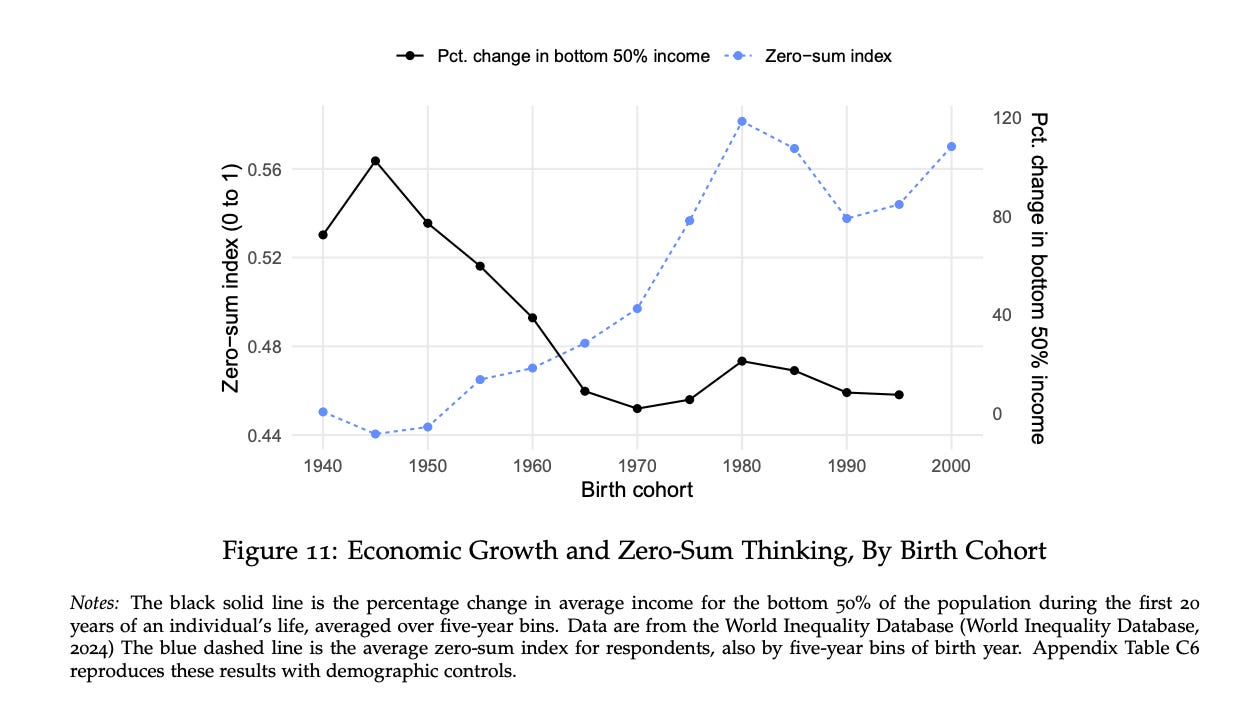
Chinoy’s paper finds that older respondents, who lived through periods of greater economic growth, tend to be less zero-sum than younger respondents born in the 1970s through the 1990s. In the DRC paper, the economists similarly found that respondents from villages that saw higher rainfall during their youth perceived the world as less zero-sum (rain is good for farming).
Chinoy et al also find that if you have a family history of upward economic mobility (children doing better than their parents) you’re less likely to hold zero-sum views. Unsurprisingly, immigrants exhibit the least zero-sum thinking.
Histories of exploitation push in the other direction. Black Americans with a family history of enslavement were more likely to be zero-sum. So are people with a family history of internment, indentured servitude, and experiences with the Holocaust. People for whom intergroup conflict has meant extreme losses on one side are understandably skeptical of a positive-sum outlook. Depressingly, they are often the very same people who will suffer from the policy consequences of a zero-sum political regime.
Liberalism’s scarcity problem
Liberalism is a bet that rights and prosperity can expand together. Zero-sum politics tells people that bet is insane, that any gain for immigrants, minorities, or newcomers must be stolen from “heritage” Americans. If one group’s gain comes at another group’s loss, then it would be masochistic or, at best, extremely altruistic to fight for the political or economic rights of another group.
Not all scarcities are like rainfall, some are choices. Land-use regulations that choke off housing supply are policy-created scarcities that make it rational to fear “competition,” and they keep zero-sum intuitions alive even in a rich country. Research shows that these regulations have limited regional and economic mobility, slowed economic growth, and reduced worker wages. All ingredients for creating a zero-sum society.
Sometimes people will make fun of my obsession with zoning regulations and other constraints on housing supply in productive cities and suburbs. Of all the things going on in the world, why would you focus on this? But I don’t think it’s an accident that Vance is obsessed with the talking point that immigrants are to blame for America’s housing crisis.
When politicians choose policies that manufacture scarcity, especially in housing, they make the zero-sum story feel true. And when the zero-sum story is true, a liberal, open society starts to look suicidal.
I wrote about this at the time, but Vance’s argument was landing on fertile ground. In liberal Massachusetts, which has been a hotbed of anti-growth political activism for more than a half-century, housing supply has lagged behind population growth. As a result, prices have skyrocketed and newcomers really are competing for a fixed pool of homes with existing residents.
In a poll, a plurality of Massachusetts residents (47.2%) agreed with the statement that “Migrants are taking up affordable housing that should go to Americans first.”
Zero-sum politics does not actually offer an alternative to liberalism. At least, not one that can actually provide the economic benefits and freedoms that people desire. What it does offer is a safe haven in a scary world. Don’t be stupid, it says, you have to fend for your own. Zero-sum politics turns newcomers into strangers and neighbors into competitors. It offers no way out of scarcity and fear, just a cynical reassurance that this is just the way the world is.
In order to measure the extent to which respondents’ hold zero-sum views, they asked four questions and constructed an index from the responses:
“In the United States, there are many different ethnic groups (Blacks, whites, Asians, Hispanics, etc.). If one ethnic group becomes richer, this generally comes at the expense of other groups in the country.”
“In the United States, there are those with American citizenship and those without. If those without American citizenship do better economically, this will generally come at the expense of American citizens.”
“In international trade, if one country makes more money, then it is generally the case that the other country makes less money.”
“In the United States, there are many different income classes. If one group becomes wealthier, it is usually the case that this comes at the expense of other groups.”
The defect in the logic of both sides, here, is the unspoken belief that every curve must be a straight line. Some things, like the impact of the number of immigrants on the housing prices of less-expensive housing in a given place, are not large as the number of immigrants rises from zero, until they ARE quite large indeed, as the number of immigrants becomes too large for the community to handle. This is not a complicated or difficult concept, and it is disturbing that so many on each side of so many issues just don't "get" it. Most phenomena are neither inherently zero-sum nor positive-sum. They change from one to the other as situations change.
I appreciate you staying on this theme (the podcast, this piece). But one thing I think this story misses is _intent_. Specifically, what do people in power _want_ to do with that power with respect to distribution of benefits.
Imagine that you knew that, whatever you produced, the powers in charge would take as much as they could to give it someone else? This would not strictly be zero-sum. The more you did, the more others would get, and in principle, they would produce more that could flow back to you. But you know, from the stated intentions of those in power, that this not going to happen. Or rather, that those in power will try to make it not happen, because they see one group — your group — as not deserving of benefits. So it’s not the system that’s zero-sum, it’s the way the system is managed that makes it effectively that way.
Now look at the rhetoric of the MAGA right and the progressive left. Look at how they indicate that some groups are supposed to receive benefits at the expense of others.
So I agree with abundance as an essential ingredient to getting out of zero-sum thinking, but I don’t think it’s enough. It needs to be married with a policy agenda that is non-preferential. We’re going to be build more housing, and anyone can have it. Not a little bit more that has to be given out carefully, but A LOT MORE so that we don’t have to give it out carefully.