


Welcome to The Closing Argument, our verdict on the news, plus everything The Argument published and appeared in this week.
The Verdict, by John Thomason
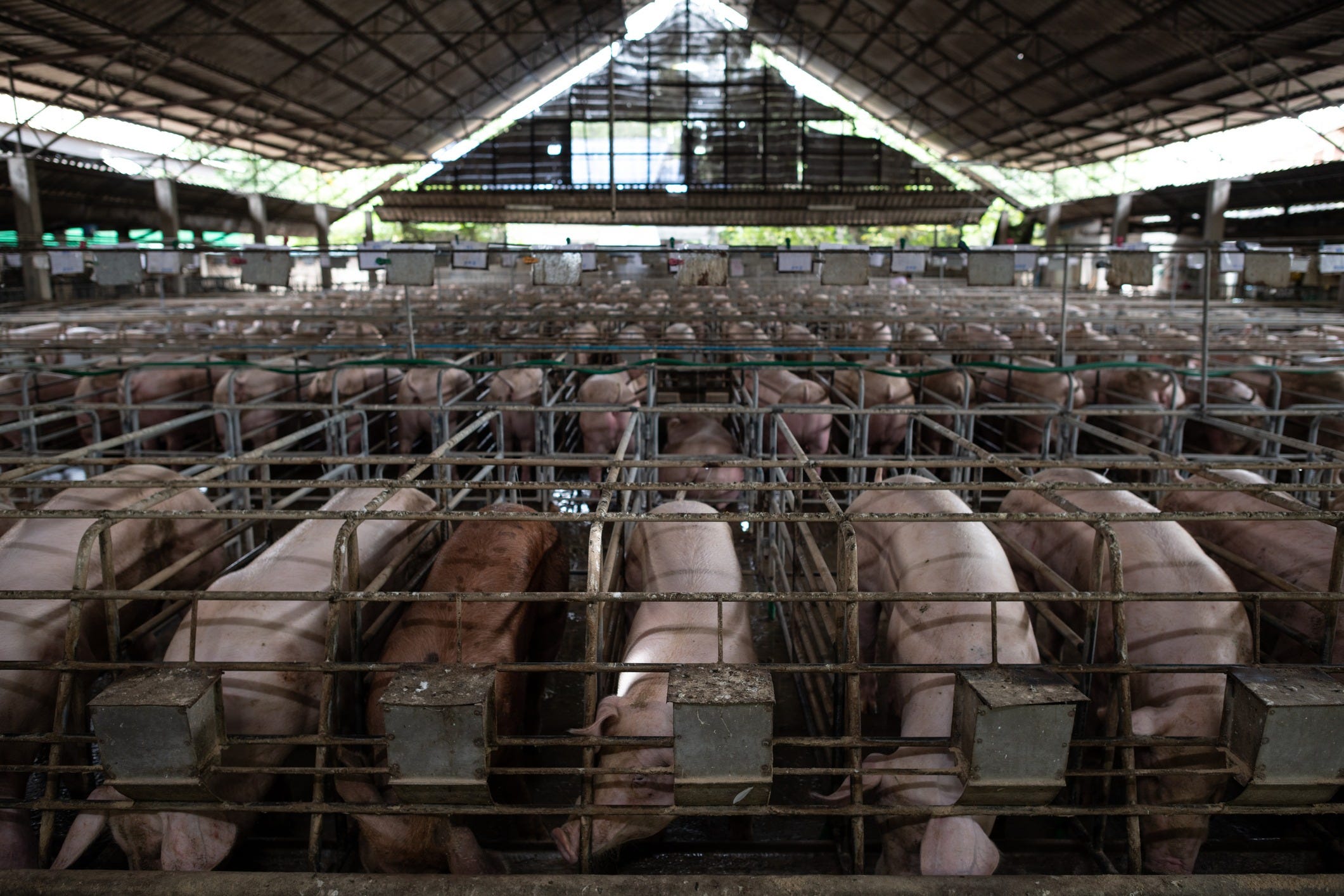
Americans, we keep learning, are obsessed with the price of groceries. At the same time, many of them seem very uncomfortable with one of the ways that meat producers make groceries cheap: by cramming livestock so close together that they can’t even turn around.
When you pose this problem to voters a kind of commonsense decency can sometimes win out: Healthy majorities in Florida, Arizona, Massachusetts, and California have voted in favor of raising confinement standards over the last 25 years.
You might notice that none of those are major pork-producing states.
But because the initiatives in California and Massachusetts limited not just what their farmers could do, but also what sorts of animal products could be sold within their borders at all, the animal welfare implications were immense, amounting to perhaps the most substantial protections for farmed animals in U.S. history. The 2018 passage of California’s Proposition 12 meant that, if hog farmers in Iowa want to sell whole cuts of pork to Californians (which they very much do), they have to abide by Golden State standards.
All of that was almost thrown out over the course of this spring and summer.
The Farm Bill is a sprawling document that covers everything from food stamps to irrigation programs — an ideal vehicle for a policy change to escape public notice. That seems to be at least in part what the proponents of the Save Our Bacon Act were hoping for. The provision, championed by members of Iowa’s congressional delegation, would have preempted state-level reforms like California’s and Massachusetts’s, making it impossible for states to bar the sale of pork from pigs whose mothers couldn’t turn around or extend their limbs during pregnancy (so long as those farms’ states allow it).
Farm-state Republicans lined up behind the provision, while food safety groups, animal rights groups, and most of the Democratic Senate caucus were against it. (The pork industry is actually split between those who have not yet complied with strict standards and those who have already invested in compliant practices.) The latter appeared to be winning out in June, when the Senate decided not to include the provision, apparently over the controversy it had engendered. But that doesn’t mean Save Our Bacon is dead. The Farm Bill stalled in the Senate Agriculture Committee on Thursday, over a dispute on an entirely different issue, with the committee now in recess until the fall. The Save Our Bacon Act is likely to get a second wind at that time.
If we’re being honest, the vast majority of the nation didn’t just miss this drama — they probably wouldn’t have cared all that much if they’d known.
It’s common to hear political junkies talk about “high salience” and “low salience” issues. The cost of pork is high salience — something voters will definitely notice and express their dissatisfaction about at the polls — while the welfare of the pigs who suffered to keep prices down is low salience, the purview largely of those who in some sense have made a choice to care about it.
With high salience issues, the will of the voters is clear enough and the cost of ignoring it is losing elections. But on low salience issues, democracies count on elite political actors reaching some sort of reasonable agreement that is in the best interests of the public.
The conflict over Save Our Bacon unsettles the idea that low and high salience issues are cleanly separable.
First of all, which “will of the voters” should be honored in this situation? That of the median 2024 voter, angry about the price of groceries, or those of the actual majorities in multiple states who voted for farm animal protections? (Even Iowa voters appear to reject the Save Our Bacon Act, though the poll in question was commissioned by an advocacy organization.)
Still, asking people to improve pigs’ lives is one thing; asking them to pay a lot more for bacon, let alone give it up entirely, is another. Ending farm animal suffering would require the latter. If animal rights become high salience, animal rights groups lose. If it stays low salience, then they never even get a shot at winning. Such is the fate of those with unpopular convictions in a democratic society.
No country for moral fanatics?
Four years ago, a very small dog wandered into my life, and it changed my politics forever.
I had always been a little judgy about people who dote on their pets, yet there I was, realizing that I might find myself in tears if this ornery creature had so much as a hangnail. It no longer made sense to me to care so much about the welfare of this one animal without caring about others who seemed just like him.
Most market hogs are mutilated without anesthesia, spend their lives on bare slats above their own manure, and never go outdoors until slaughter. If we did any of this to dogs we’d call it torture. None of this was exactly news to me, I’m ashamed to say, but for the first time I actually felt that it might be impossible to live with myself if I knew that, while I doted on this dog, creatures just like him were being put through hell on earth for me.
In a political climate where we’re constantly being told that the moral stakes are higher than ever — that, as former President Obama lamented in 2015, “those who disagree with us are not merely wrong but bad” — contemplating the fate of livestock induces a kind of vertiginous loneliness, precisely because it’s not a matter of public controversy. Quite the opposite: Per-capita meat consumption has never been higher, and all either party can talk about is making that consumption cheaper. Meanwhile, more than 80 billion farm animals are slaughtered worldwide every year after the sort of lives I described above.
But different people have dramatically different moral red lines. Many of my fellow citizens think that we’re living through a genocide of unborn children. Others think that we should strip private property rights from anyone with one too many 0’s in their net worth. I don’t agree with either of them, and most of them don’t agree with me. We have to live together anyway. A certain amount of moral loneliness — the kind that could keep you up at night, aghast at the evil that people will tolerate — is the price that every zealot pays to live in a democratic society. At least I know they won’t hang me for it.
It’s uncomfortable to realize you’re part of a moral minority. What options do you have, besides the despair of accepting majority will, or the tireless fanaticism that characterizes groups like PETA?
It’s here that I take some solace in the weird indeterminacy of representative democracy. If you put the actual question I care about before voters — would you give up meat as you know it to end farm animal suffering? — it would lose. If you put the question purely to elite power brokers, it would also lose.
In a majoritarian society, moral minorities will never be entirely satisfied. Ninety-nine percent of the time this brings me great relief: I don’t want anti-abortion zealots dictating health policy by fiat. Yet I too believe that egregious moral crimes are being committed daily and, yes, I would impose my preference for stopping these crimes on everyone else if I could. If only I could.
But of course I don’t want to be imposed upon myself. For all its backsliding, the American system still does a pretty good job of ensuring that. And the very fragmentation that helps shore up this freedom — the separation of powers, the strategic veto points, the uneasy coalitions — also gives radicals of every stripe avenues to pursue their goals. It’s not such a lonely place for a fanatic after all.
Top stories this week, by Milan Singh
Starting off the week, Kobe Yank-Jacobs wrote about the popularity of different AI labs in The Argument’s polling. OpenAI is the most popular lab — even among regular AI users and those especially concerned about existential risk.

For the first time ever, more people are employed by remodeling companies than by single-family and multifamily developers combined. Economics writer Joey Politano highlighted the surge in home renovations: Rather than building new units, Americans are increasingly renovating existing homes. Unfortunately, renovations alone aren’t enough to fix our housing supply problems.

Have you ever seen a 2-year-old learn the commutative property of addition? Staff writer Kelsey Piper, who recently welcomed her fourth child, explains how certain aspects of modernity have made parenting harder, even as life has gotten better. Come for the precocious 2-year-old; stay for the meditation on Baumol’s cost disease.

🌟Abundance wins of the week🌟
The feds closed a $489 million loan to add 220 megawatts of batteries to Puerto Rico’s grid, capable of providing backup electricity to more than 100,000 customers during shortages, thus avoiding millions of customer interruption hours. Puerto Rico’s notoriously unreliable grid certainly needs it!
Wayne County, Michigan, is doing state-capacity praxis. On Tuesday, a supermajority of voters approved a plan to bring 17 previously opted-out communities into the single countywide system, filling longstanding gaps in the region’s public transportation network.
Because of Texas’ new statewide preemption, the Nacogdoches City Council unanimously changed its zoning code. HUD-code manufactured homes, for the first time in over 20 years, will be buildable by right in a residential zoning district.
Worth watching…
This week on the podcast, Matt and Jerusalem discussed the #MeToo movement. Jerusalem thinks it didn’t go far enough, a somewhat troll-y way of saying that the work of feminism is not yet finished. Matt strikes a more skeptical tone, arguing that the movement lacked a clear set of policy “asks,” which makes it difficult to even evaluate its successes.

Lakshya Jain and VoteHub’s Zachary Donnini discussed counting mail-in ballots with Nevada Secretary of State Cisco Aguilar. You can’t run elections cheaply, accurately, and quickly, Aguilar said; you have to pick two of the three. If you’ve ever wondered why California takes so long to count votes, this is for you.
Kobe Yank-Jacobs went live with JS Denain, a senior researcher at Epoch AI, to discuss recursive self-improvement (RSI). The big labs are very bullish on RSI’s ability to speed up the pace of AI development, but Denain argued that AI’s potential to actually make useful research contributions is more limited than boosters let on.
What’s News with The Argument
The Argument recommends, by Milan Singh
Both Editor-in-Chief Jerusalem Demsas and Staff Writer Kelsey Piper recommend you pick up A Trade of Blood, the recently released third book in Robert Jackson Bennett’s fantasy series.
“For those who haven’t read it, the first book, The Tainted Cup, is a fantastic book about the murder of an imperial officer that is part Sherlockian mystery and part meditation on the running of an empire,” Jerusalem explained.
“I think the murder mystery format is weirdly well suited to the meditations on empire,” added Kelsey. “If you read British mystery novelists (Doyle, Christie, Heyer, le Carré) you can kind of watch the empire exhaust its case for itself and collapse in the background, and Bennett is clearly wrestling with American empire — notwithstanding the extremely wild biopunk sci-fi setting.”
Senior Editor John Thomason has been listening to Don DeLillo’s White Noise while commuting into the office: “Something about the folksy narration — from veteran stage actor Michael Prichard, who grew up on a farm himself and absolutely nails the chapter on the most photographed barn in America — is making me see DeLillo’s novel less as the landmark of postmodern lit that I remember from college and instead as surprisingly faithful to the 19th-century realist tradition, or maybe a kind of pastoral.”
Gender and culture writing fellow Maibritt Henkel watched the millennial classic 13 Going on 30: “While it is a very silly movie, I would say two things in my defense: (1) it belongs to Mark Ruffalo’s complete works and should therefore be considered part of the cinematic canon, and (2) considering your life and your morals from the perspective of your 13-year-old self is a pretty profound exercise.”
Editor Eli Richman has been going back and forth between reading the Dungeon Crawler Carl books and watching the new season of House of the Dragon. “I worry [House of the Dragon] is catching The Boys syndrome, where the need to have things go badly for the protagonists overwhelms the need for the story to make sense,” he said. “Dungeon Crawler Carl is unironically fantastic, ping-ponging between absurdly silly and very real without missing a beat.”
Finally, I personally do not recommend being hit by a car. The adrenaline rush is something else, but it hurts quite a bit.
We have merch!
We have quarter-zips, keychains, hats, and stickers. Each one is a great conversation starter in its own way. Buy them here.
More to read:
Who supports free trade? Everyone.

In our most recent poll of 3,000 registered voters, fielded nationally between July 20 and July 26, support for free trade was remarkably widespread. College-educated respondents supported free trade by a wider margin, but noncollege respondents overwhelmingly supported the policy as well.
The many delusions of Jason Arday

This week, staff writer Jeremiah Johnson dives into the Jason Arday plagiarism scandal, the death of a CancerTok star, the state of Substack, and narco-influencers.
Lab meat can solve this! Just like solar and self-driving and zoning reform, lab meat is a technology that has the potential to create material and moral abundance. Right now opposing lab meat is more popular than allowing it. It remains low salience because it’s unsettling and expensive but like many other abundance projects, I suspect it’s just a matter of sustained effort to change both.
There's a couple things to do when you're in a moral minority. The first is to try to persuade more people to see your position as morally correct. The second is to change the world such that your moral position also becomes the convenient one. This is what's happened with solar energy. I'm assuming we could get there with meat engineering eventually.