

Welcome back to The Argument’s poll series, where we survey Americans on the issues everyone’s fighting about. Our full crosstabs are available for paying subscribers at the end of this post. You can see every single poll published by The Argument here. Our full methodology can be read here.
Republicans used to be the party of free trade. From Gerald Ford all the way to George W. Bush, Republican presidents vocally supported lowering barriers to international commerce. Ronald Reagan said that there were no losers, only winners from trade, and the elder George Bush negotiated NAFTA while his son said that free trade helped make America into a global economic power.
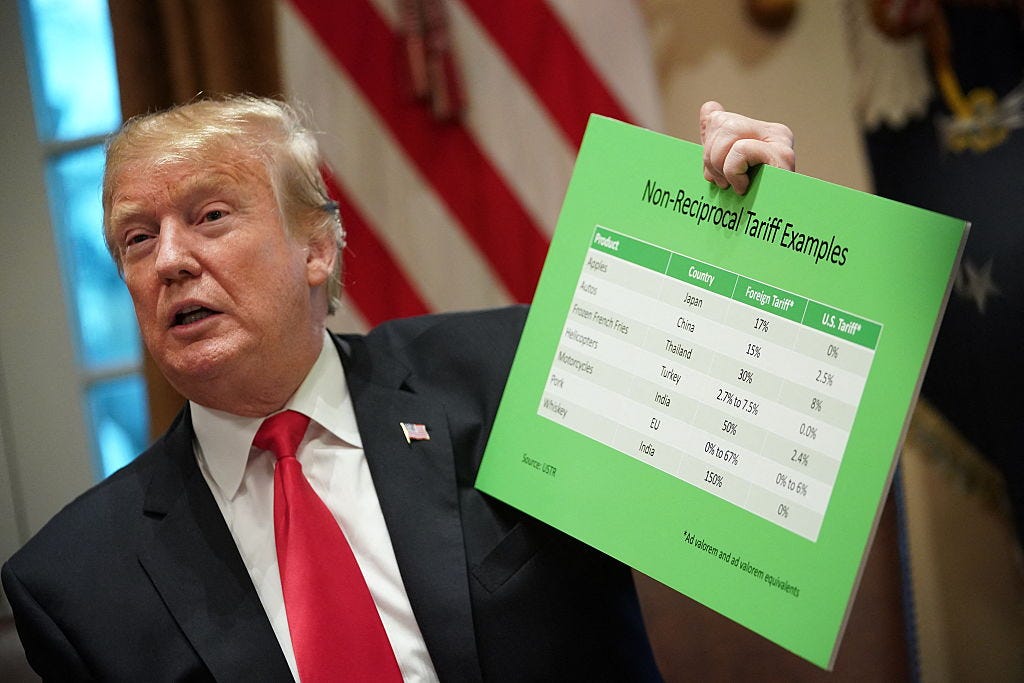
Donald Trump put an end to that. Trump’s crusade to slap tariffs on an astonishingly wide range of imported goods is one of his defining policies, and economists broadly agree it’s been a disaster. One analysis showed that Trump’s tariffs increased the Consumer Price Index by 0.8 percentage points by October 2025, and a study from the Federal Reserve agreed.
Economic analyses from the Tax Foundation, Penn Wharton, and the Peterson Institute all agreed that tariffs are weakening U.S. economic growth.1 The Cato Institute’s Scott Lincicome told me that adding new tariffs is like chopping off your own fingers: It’s unlikely to kill you and you can probably live a normal life afterward, but you’re causing yourself pain for no real benefit.
Though voters consistently rank cost of living as one of the most important issues facing the country, Democrats have not exactly seized the mantle of free trade.
While most rank-and-file Democrats oppose Trump’s tariffs, Joe Biden shared many of Trump’s protectionist instincts and kept many of his tariffs in place, even expanding specific tariffs on China. And prominent senators like Elizabeth Warren couched their opposition to Trump’s tariffs in terms like, “tariffs are an important strategic economic tool, but Donald Trump’s desire to start and stop random trade wars will not protect jobs.”
Prominent Democrats often seem to leave tariffs completely out of their messaging against Trump. For example, neither Kamala Harris nor Alexandria Ocasio-Cortez has tweeted the word “tariff” once this year, and Sen. Bernie Sanders has tweeted it just one time. And I used ChatGPT to scrape the congressional record for tariff mentions and analyze their sources, finding that neither AOC nor Sanders had mentioned tariffs in Congress at all this year.
But, according to new polling data from The Argument, Democrats may be leaving a golden opportunity on the table. Free trade is wildly popular with Americans.
This result is consistent with other polls that asked specifically about Trump’s tariff policies. Navigator Research found that 59% have an unfavorable view of tariffs while only 29% are in favor. An ABC News/Washington Post/Ipsos poll found that 64% of the public disapproved of Trump’s handling of tariffs, while a YouGov poll found that 72% think tariffs lead to higher prices. (Only 3% think they decrease prices.)
In our most recent poll of 3,000 registered voters, fielded nationally between July 20 and July 26, support for free trade was remarkably widespread. College-educated respondents supported free trade by a wider margin, but noncollege respondents overwhelmingly supported the policy as well.

In every income bracket measured, the support-to-oppose ratio was more than 4-to-1.
Free trade is popular with Republicans, Democrats, and independents. And among Democrats, it’s wildly popular with both voters who approved of the Democratic Socialists of America (DSA) and those who disapproved.
Free trade’s popularity is remarkably consistent across virtually every demographic and political split we measured. Indeed, our results showed that traditional economic liberalism more generally is favored by a majority of Americans — for instance, 79% of respondents opposed government ownership of most businesses, and a majority also opposed government ownership of utilities and railways.
Why did protectionism become so popular?
The intellectual climate around trade shifted dramatically after economists David Autor, David Dorn, and Gordon Hanson released their 2016 paper “The China Shock.” Their research claimed that increased trade with China led to greater job losses than economists had previously assumed and that those losses were particularly concentrated in regions with economies built around manufacturing. The findings, which showed many workers never fully recovering, shook both left and right because they appeared to confirm that globalization’s costs had been badly underestimated.
The losses from the China Shock were also concentrated in electorally important states. After Trump swept the Rust Belt states of Pennsylvania, Ohio, Wisconsin, and Michigan in 2016, many politicians concluded that free trade was electoral suicide and began embracing protectionist policy more openly. It was easy to do so by romanticizing manufacturing jobs as “Real America,” the type of honest work that carried more cultural legitimacy than white-collar or service-industry jobs.
But the lessons from the China Shock were overlearned. More recent research has called into question the scale of the shock. One paper from Lorenzo Caliendo, Maximiliano Dvorkin, and Fernando Parro found that only 16% of the decline in manufacturing employment from 2000 to 2007 could be traced back to the China Shock, while other research emphasized that when you examine all employment sectors, increased trade with China may have led to net job gains.
And even the authors of the original paper emphasized that their findings were primarily focused around local shocks and didn’t dispute the overall benefits of free trade. The New York Times reported that David Autor, “like most economists, is still persuaded of the long-established benefits that global trade confers on the economy as a whole.” He believes the benefits are large and widespread but diffuse, while the losses are painfully concentrated.
The authors are also deeply skeptical that more tariffs can fix any of this. Gordon Hanson wrote that “China’s rise, although disruptive for many workers, has nevertheless benefited the U.S. economy” and rejected protectionism, instead calling on the U.S. to rejoin the Trans-Pacific Partnership. Trump’s barrage of new tariffs in his second term has not led to a manufacturing renaissance, with the U.S. continuing to lose manufacturing jobs since he took office.
Importantly, the political momentum that led to increased support for protectionism has stopped. Trump’s use of tariffs has been so lawless, so haphazardly implemented, and so offensive to so many of America’s traditional allies that the public has clearly turned against tariffs and back toward free trade.
Of course, it’s entirely plausible that voters approve of free trade in the abstract while specific trade liberalization deals, with all their inherent messiness, are more likely to attract disapproval (especially once interest groups, such as particular unions that benefit from the status quo, get to have their say).
But the good news is that Democrats don’t have to negotiate a new NAFTA or a new Trans-Pacific Partnership to champion free trade. They can just promise to undo Trump’s newest tariffs with a stroke of the pen when they retake the presidency.
If free trade is so popular, what’s stopping Democrats from attacking Republicans more vigorously on the issue?
One theory is that Democrats are worried about losing support from unions and other interest groups that have a vested interest in tariffs. But capitulating to unions on protectionist policy isn’t working.
Joe Biden was the most pro-union president in generations. The American Rescue Plan bailed out the Teamsters union — providing approximately $35.8 billion to keep the Central States pension plan solvent and protecting over 350,000 participants from benefit reductions of roughly 60% — and the Teamsters still didn’t endorse Biden or Harris in 2024.
Democrats may simply be so used to catering to unions that it’s hard to break the pattern. But the time will never be better to overcome the old protectionist muscle memory and come out forcefully for free trade.
Recommended reading:
The unraveling of Trump's 2024 coalition

While Trump has lost ground with virtually everyone, this is especially magnified with nonwhite voters and noncollege voters.

The Penn Wharton model analyzed a specific moment in time early in the second Trump administration, the Peterson Institute looked at a range of plausible tariff scenarios, while the Tax Foundation model has been continually updated with each new tariff that is added or struck down by courts. But each still reached the same conclusion, broadly.
Speaking strictly for myself:
1) I question whether “net jobs gain” is the right framing. That says nothing about the quality of the job in question. It is easy enough to imagine someone going from a moderately well paid factory worker to a poorly waiter or barista, yet that shows up as no jobs lost. (To be clear, I have no idea if that is what happened. It is just the obvious thing that jumps out at me)
2) In general, I am a bit tired of people conflating pro-union policies with pro-labor policies. Bluntly, most workers aren’t in unions. While bailing out union pension funds obviously helps union members, it is not obvious to me how it helps the working class more broadly. Nothing that I can remember from the Biden admin was aimed at *growing* the unions. It was all just handouts to people who were already in unions.
I think a couple things are going on. First, on the right, Trump’s stranglehold on the party coupled with his Neo-Peronist brand of Big Government Conservatism has detonated any dissension from within Republican ranks, which contributes to a normative environment wherein the issue seems up for legitimate contention. Second, on the left, increasingly in adoption an explanatory model grounded in *rank lack of understanding of economic models*.
The reason is straightforward: I have had probably two dozen conversations this year with folks on the left where “trickle down economics” have been conflated with “capitalism” as well as “high stock prices”, “affordability,” and “corporate profitability”. Notably, something like “low corporate taxes” *would* more or less be interchangeable with “trickle down,” but tax policy seems to be less salient.
Then, the device is to point to the (legitimate) failure of ‘trickle-down’ to argue for the fundamental unsustainability of e.g. “capitalism” - even by non-DSA types. So why I think this is relevant here is that the same omni-conflation prevents distinction-parsing arguments like “well tariffs drive up prices” or “actually it’s good to be able to buy what you want,” since the latter erroneously gets conflated with a Reaganite position.
The *normative* baseline in Dem-leaning culture, in other words, tacitly presupposes a by-default anti-market skew.