

On today’s episode of The Argument podcast, Matt Yglesias and I cancel and uncancel some historical figures. Paid subscribers can watch or listen to the episode ad free here or read the transcript at the end of this post. Free subscribers can watch the episode on YouTube here or listen wherever you get your podcasts.
Subscribe: Apple Podcasts | Spotify | YouTube | Overcast | Pocket Casts
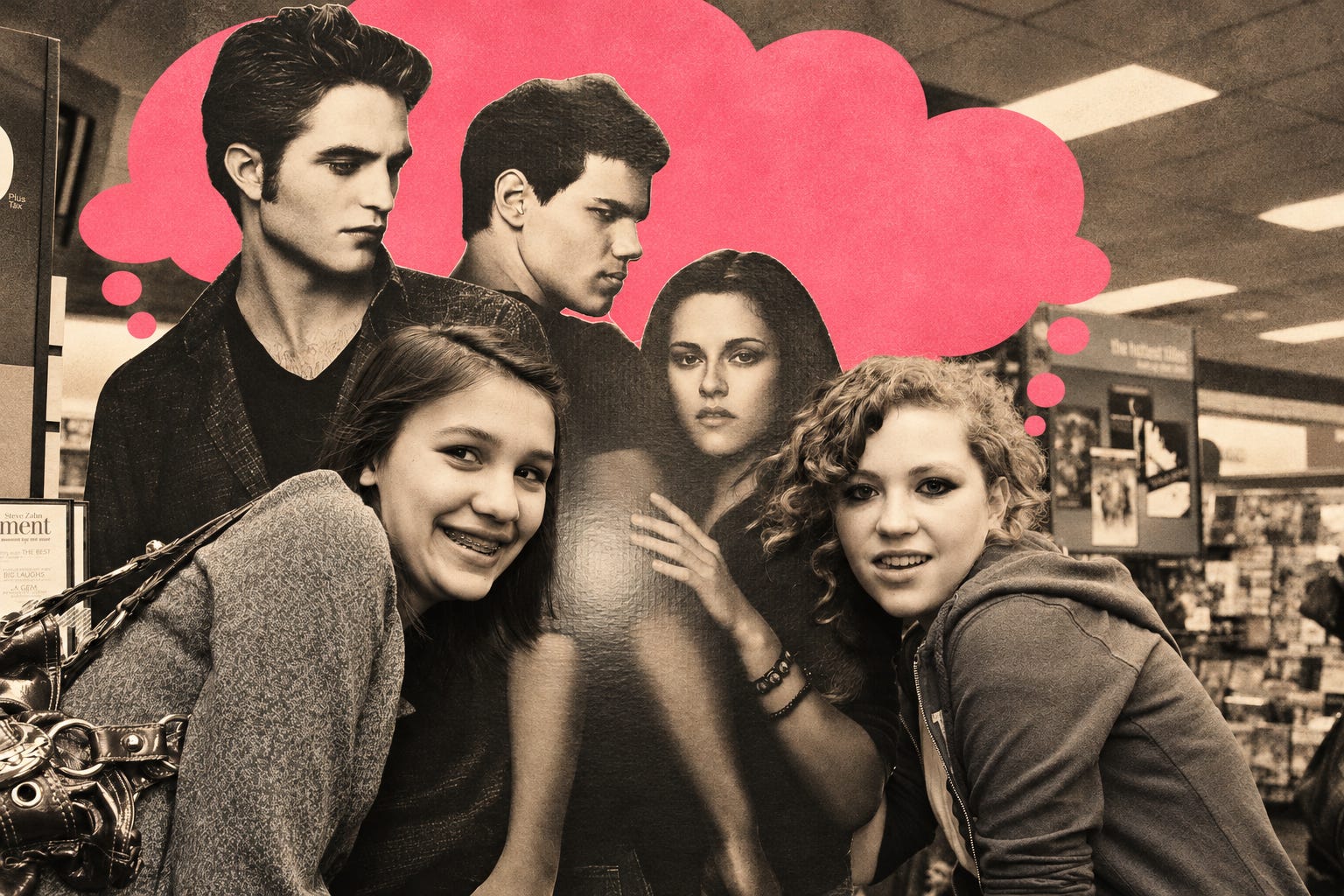
Like many girls of my generation, I read Twilight in middle school. One thing that was notable about the book was author Stephenie Meyer’s reticence to provide her main character, Bella Swan, with many distinguishing physical descriptors. In the novel, she is generically described as “slender, but soft somehow” as well as pale with brown hair. This wasn’t just poor writing, it was, the author claims, a deliberate choice.
At the time, Meyer published an FAQ about the book on her website. One question asked, “What does Bella look like?” Here’s her answer:
“I left out a detailed description of Bella in the book so that the reader could more easily step into her shoes…Bella’s looks are open to interpretation.”
Meyer then gives a “detailed” description of what Bella looks like to her:
“In my head, Bella is very fair-skinned, with long, straight, dark brown hair and chocolate brown eyes. Her face is heart-shaped —a wide forehead with a widow’s peak, large, wide-spaced eyes, prominent cheekbones, and then a thin nose and a narrow jaw with a pointed chin. Her lips are a little out of proportion, a bit too full for her jaw line. Her eyebrows are darker than her hair and more straight than they are arched. She’s five foot four inches tall, slender but not at all muscular, and weighs about 115 pounds. She has stubby fingernails because she has a nervous habit of biting them.”
Robert Pattinson, who would go on to play Edward Cullen, Bella’s love interest, in the Twilight movie, said in a 2008 interview that “When I read it I was convinced Stephenie was convinced she was Bella.”
Meyer herself appeared in the film adaptations of two of her books: as a cafe customer in Twilight and a wedding guest in Breaking Dawn Part 1. A cameo offers another way into fiction: Perhaps you can’t become the heroine but you can at least be a part of her world.
What looks like an inconsequential episode of authorial self-insertion belongs to a long tradition of treating fiction as a vehicle for wish fulfillment. We can become someone more desired or extraordinary, or simply find a place in a world more exciting than our own. But when finding that place becomes a requirement of enjoying a book, a protagonist’s difference starts to look like a defect in the story. Her tastes, desires, and choices become obstacles to our participation and we lose one of fiction’s greatest pleasures: becoming absorbed in someone else’s life without needing that life to accommodate our own.
Main character energy
I flashed back to my Twilight years after watching Twitter debate a book content creator’s viral provocation about whether readers self-insert as the protagonist or a side character:

Both answers assumed I needed a part in the story, but I thought being the reader was enough. I could care desperately about what happened to a character, sympathize with her struggles or be furious at her choices, without ever imagining myself a part of any of it. (It’s also not the first time this type of discourse has taken off.)
Some of this seems to be downstream of the growing influence of fanfiction over traditional publishing. For decades now, “reader-inserts” have proliferated on public writing sites like Archive of Our Own.
The term “reader-insert” refers to a genre of fanfiction that places the reader in the story, often using “Y/N” as a stand-in for your name rather than a protagonist’s name. These stories are typically written in second person, and sometimes writers will even leave room for readers to put in their own hair color, eye color, or other distinguishing characteristic.
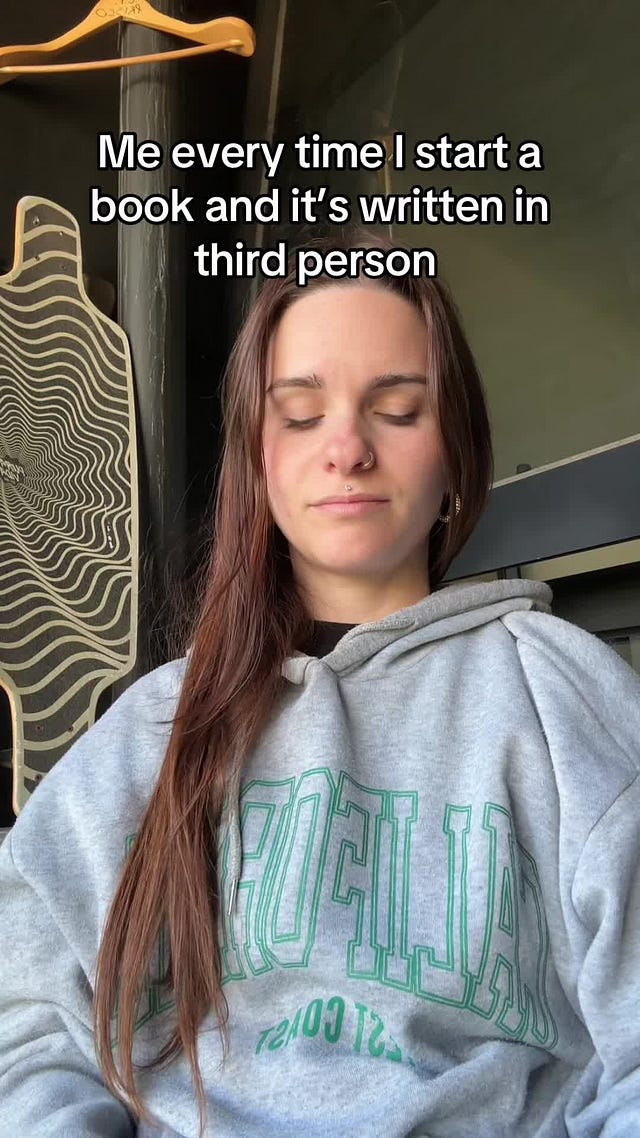
Y/N is the extreme case, but you don’t need a blank for your name to read this way. Many readers demand first-person perspectives in order to insert themselves more easily into the story. For a reader who has confused herself with the heroine, third person is a constant reminder that someone else actually is — and it turns out a lot of readers experience that distance as a flaw.
In March of this year, Luke Winkie wrote a piece in Slate about romance fiction readers who refuse to read books in third person. As Winkie documents, readers’ stated reasons for preferring a first-person point of view include a desire for escapism and identification and also the baffling revelation that some readers find third person harder to read: “readers mourn their own self-diagnosed ineptitude; they’d like to savor the richness of third person, they say, but, for whatever reason, are unable to wrap their minds around the vantage point.”
One romance author tells Winkie that she has had readers come up to her at book signings “and say, to my face, ‘I won’t read this book of yours because it’s in third person.’”
 Tiktok failed to load.
Enable 3rd party cookies or use another browser
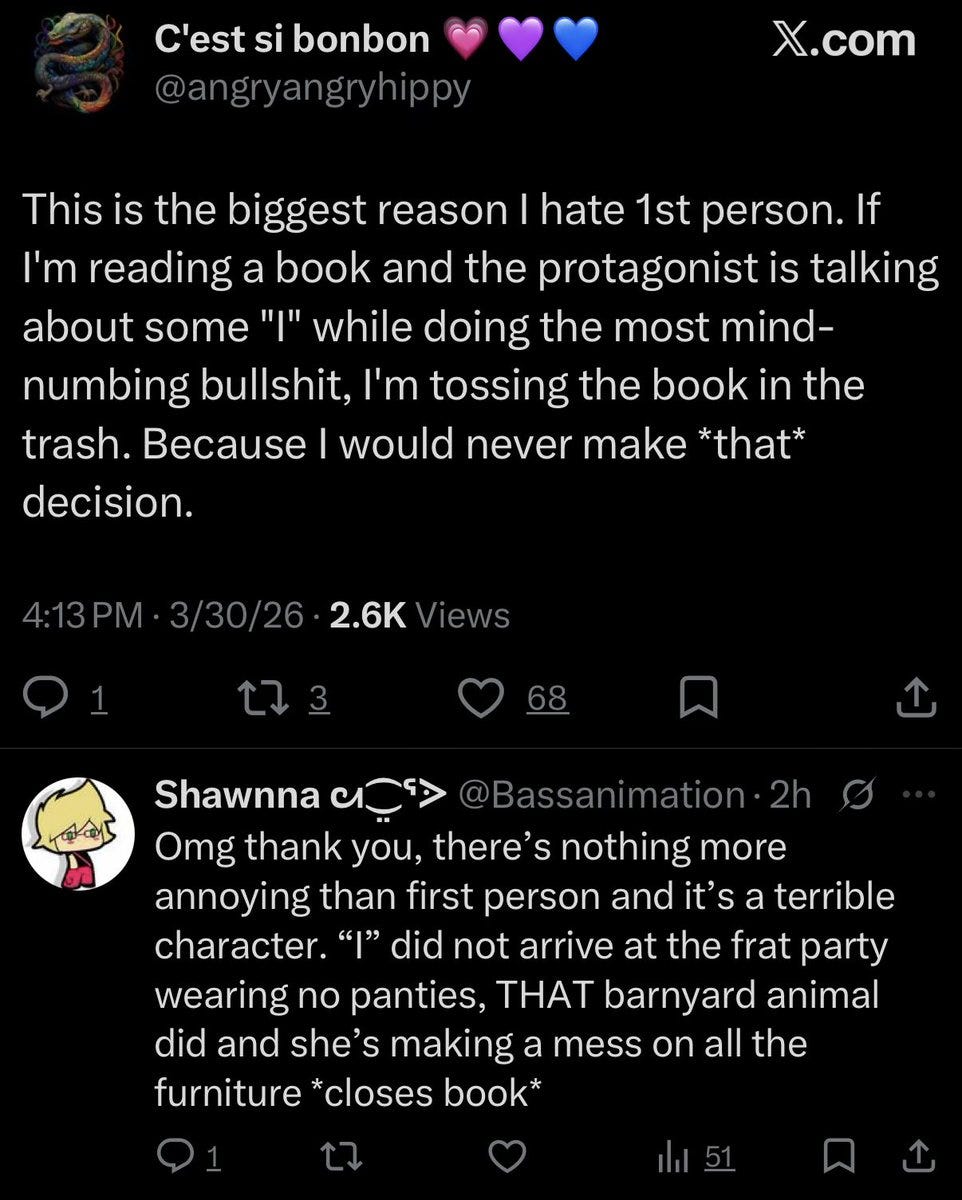
Some readers have the opposite opinion and hate first-person because they find the narrator’s behavior or thinking different from their own:
In her 2014 New Yorker article “The Scourge of Relatability,” Rebecca Mead derides those who demand art act as “a selfie: a flattering confirmation of an individual’s solipsism.” She goes on to argue that readers who demand this are lazy consumers of art: “to reject any work because we feel that it does not reflect us in a shape that we can easily recognize—because it does not exempt us from the active exercise of imagination or the effortful summoning of empathy—is our own failure.”
When novelist Claire Messud was interviewed about her then-latest book by Publishers Weekly, the interviewer said of her main character: “I wouldn’t want to be friends with Nora, would you?” Messud responded with disgust:
“For heaven’s sake, what kind of question is that? Would you want to be friends with Humbert Humbert? Would you want to be friends with Mickey Sabbath? Saleem Sinai? Hamlet? Krapp? Oedipus? Oscar Wao? Antigone? Raskolnikov? Any of the characters in The Corrections? Any of the characters in Infinite Jest? Any of the characters in anything Pynchon has ever written? Or Martin Amis? Or Orhan Pamuk? Or Alice Munro, for that matter? If you’re reading to find friends, you’re in deep trouble. We read to find life, in all its possibilities. The relevant question isn’t “is this a potential friend for me?” but “is this character alive?”
That readers have strong preferences is nothing new. Some readers are precious about whether they will read hardcovers or paperbacks, others refuse to read genres like magical realism or think that dialogue without quotation marks is an unforgivable affectation. But those are preferences about the book, whereas a demand for perfect identification with the main character is something else — it’s a demand that the author have nothing to say or communicate that is outside of a reader’s own experience.
The appeal of reader-inserts is comprehensible. A story can give us the pleasure of being desired, admired, or unusually important or talented. If I can take the place of a brilliant artist or ingenious politician, it allows me to pretend I have those traits as well. But what room does that leave for someone whose desires we don’t share? Whose decisions frustrate, stun, or disgust us? How about a reader whose life we would never want?
What I’m worried about is twofold: First, that people will fail to develop the capacity to find value in the experience of another person without needing it to feel indistinguishable from their own; second, that authors are willing to degrade their own art to meet this longstanding reader preference.
You are living in a fantasy (pejorative)
The desire to become the heroine predates the internet. So does the fear that readers might lose something by doing so.
In 1773, John Trumbull, a lawyer and satirical poet, mocked readers who imagined themselves as romantic heroines in his satirical narrative poem The Progress of Dulness: “For while she reads romance, the Fair one Fails not to think herself the Heroine…Thus Harriet reads, and reading really Believes herself a young Pamela.”
Trumbull’s aim was to show that women’s deficiencies arose from a lack of education; his worry was that this sort of self-identification would lead to an excess of self-flattery and that women would expect life to follow the script of unrealistic romances.
The concern that self-identification can cash out into false expectations is dramatized in Gustave Flaubert’s Madame Bovary: Emma Bovary interprets her own life through the romantic heroines of the novels she reads. After Emma begins her affair with Rodolphe, Flaubert writes that “She became herself, as it were, an actual part of these imaginings.”
Discerning readers will note the strain of paternalistic condescension toward female readers that is laced through much of this criticism, from Trumbull to the present. But charging critics with condescension doesn’t change the fact that this habit harms readers themselves.
These examples describe fears that readers will treat fiction-reading as wish-fulfillment. But a reader can understand perfectly well that a romance is a fantasy and still approach every character as a potential substitute for herself. The bigger question is if we can expect novels to teach us about something other than ourselves.
Vladimir Nabokov’s lecture that opened his Cornell literature course, “Good Readers and Good Writers,” engages directly with this question. In it, he recalls a short quiz he gave students at a “remote provincial college” about which of the following definitions made a good reader:
The reader should belong to a book club.
The reader should identify himself or herself with the hero or heroine.
The reader should concentrate on the social-economic angle.
The reader should prefer a story with action and dialogue to one with none.
The reader should have seen the book in a movie.
The reader should be a budding author.
The reader should have imagination.
The reader should have memory.
The reader should have a dictionary.
The reader should have some artistic sense.
This is what passed for survey evidence in Nabokov’s day unfortunately. He reports that “the students leaned heavily on emotional identification, action, and the social-economic or historical angle.”
For his part, Nabokov thought that “the worst thing a reader can do” is “identif[y] himself with a character in the book. This lowly variety is not the kind of imagination I would like readers to use.” Instead, he exhorts us to “remain a little aloof and take pleasure in this aloofness while at the same time we keenly enjoy—passionately enjoy, enjoy with tears and shivers—the inner weave of a given masterpiece.”
Take Nabokov’s most celebrated novel, Lolita, which is a first-person account of a very charismatic pedophile. Humbert Humbert is a cultivated, self-justifying creep who worms his way into the life of a 12-year-old American girl so he can abuse her, but the process of the reader discovering his true character and the unreliability of his own perspective is the point. Lolita lets us into Humbert Humbert’s head but the experience of horror as you recognize his evasions, resist his justifications, and wrench yourself away from appreciating the prose to confront the horror of his actions is what makes the first-person perspective valuable.
The tension is what makes his perspective so powerful: we are immersed in his account while struggling to preserve our own judgement. The “I” on the page belongs to Humbert. Nabokov leaves no room for wish fulfillment, and no one could wish to see themselves reflected in this narrator; the novel’s brilliance is its ability to put us into intimate contact with someone we have absolutely no wish to become.
What is the point of reading fiction?
The incentives here are quite bad for fiction. Meyer’s goal of making it easy for readers to pretend themselves to be Bella resulted in erasing the characteristics that made her a particular person. The risk is that the details that make a character distinct, that is human, come to seem like obstacles to the reader’s enjoyment. Elsewhere in her FAQ, Meyer explains that Bella is listening to Linkin Park in chapter seven, but that she omitted the band’s name because she worried it might no longer be cool by publication. But why would we want Bella’s taste to conform to the reader’s own? (Recently, readers noticed that the Kindle edition of Pretty Little Liars was quietly changed to modernize references from 2006 — a Fear Factor reference became a TikTok challenge, references to Snapchat, Instagram, Adele, and Billie Eilish also cropped up).
If every potential source of distance becomes a reason to withhold a detail, we lose opportunities to encounter someone whose tastes and attachments are her own. Which is, I contend, one of the best things about fiction.
In one of my favorite books, Never Let Me Go by Kazuo Ishiguro, I remember being furious with the narrator, Kathy. Raised to surrender her organs until the donations kill her, she never fights back or stages the rebellion I kept wanting from her. Why didn’t she fight? Why didn’t she refuse? She was dying anyway. I was certain I would have.
The distance between me and Kathy forced me to ask harder questions about what caused those distinctions. Was it really just that I was more courageous than her or was it that I had not been raised to accept my own eventual dismemberment? How much of what I understood as free will depended on possibilities I had been taught to imagine?
Making Kathy behave as I wanted might have given me a more satisfying rebellion but it would have prevented me from engaging with the questions the author was raising.
The most self-flattering explanation for my disinclination for inserting myself wholly into the novels I read is that I had sophisticated literary instincts even as a child. I doubt it. I read plenty of books for the ordinary pleasures of suspense, romance, and escape.
More likely, there was just no way I was going to confuse myself with the narrators or the characters of the books I was reading. I wasn’t ivory-skinned like Bella, heir to a planetary dynasty like Paul Atreides, or an Englishwoman whose financial future depended on marrying well, like Elizabeth Bennet. And I certainly wasn’t being raised to surrender my organs like Kathy. These characters’ circumstances bore little resemblance to mine, and nevertheless I found myself absorbed in their hopes, furious at their choices, and devastated by their defeats. I didn’t need to be a part of their world to make them a part of mine.
Recommended reading:
Shakespeare saw Andrew Tate coming

“You don’t ask a fish how to fish; you ask a fisherman,” is the manosphere’s most important sales pitch.
The most popular book of the year has nothing to say

Yesteryear, which promised to be a “satire of women everywhere,” can’t really tell us about women anywhere
No! I am not Prince Hamlet, nor was meant to be;
Am an attendant lord, one that will do
To swell a progress, start a scene or two,
Advise the prince; no doubt, an easy tool,
Deferential, glad to be of use,
Politic, cautious, and meticulous;
Full of high sentence, but a bit obtuse;
At times, indeed, almost ridiculous—
Almost, at times, the Fool.
I never thought I was John Ames. But I would have liked to have attended his church and heard some of his sermons.