


Depending on what state you live in and what employer you work for, today is either Columbus Day or Indigenous Peoples Day (congratulations to our international readers spared from this discourse).
On national holidays, The Argument brings out a popular piece from behind the paywall for our free subscribers. If you find this one valuable, please join thousands of other readers in becoming a paid subscriber; it’s how we afford to publish writers like Slow Boring’s Matthew Yglesias.
Published last year, “The fox in liberalism’s henhouse,” is Matt’s most popular piece for this magazine. In it, he argues that two illiberal ideas have wormed their way into liberal institutions: First, that groups rather than individuals should be the real subjects of politics and second that neutral rules are merely a cover for domination. Neither of which liberals should accept.
It’s not just a reader favorite, it’s one of mine. Let us know what you think in the comments!
-Jerusalem Demsas, Editor-in-Chief
There are many open, full-frontal assaults on liberalism. Conservatives, fascists, and communists have all attacked different aspects of liberal values to different ends — from free markets to individual rights to freedom of expression to democratic self-government. In the postwar era, liberalism came out on top. But there are no permanent victories.
Modern liberalism was experienced at fending off challenges that announced themselves at the front door, but one of the most successful anti-liberal challenges crept through the side gate. Critical Race Theory and related identitarian ideas fooled many of us into thinking it was just a new, strange version of liberalism. These ideas fooled us in part because they were so poorly understood even by those arguing for them.
In this essay, I’m using “liberalism” in the philosophical sense: the view that the basic unit of moral concern is the individual; that institutions should be governed by general, neutral rules; and that rights and due process are core to justice. The illiberal ideas I’m critiquing, on the other hand, treat groups — particularly racial, gender, and sexual identities — as the real subjects of politics, see “neutral” rules as a cover for domination by whites and men, and redefine justice as rebalancing power between groups rather than protecting the freedoms and rights of all individuals.
What I’ve come to see in retrospect is that we were witnessing large-scale entryism of a deeply and explicitly anti-liberal program into liberal spaces. But it happened in a genuinely confused and confusing way.
Most of the people spouting these phrases and churning out the takes had no more familiarity with the source texts than I did. They were giving us a copy of a copy of a Tumblr post paraphrasing a summary of something Kimberlé Crenshaw wrote, not faithfully reconstructing the core ideas in their original context.
And these disembodied memes represented themselves to a somewhat older cohort of progressives as natural extensions of basic liberal commitments to tolerance and human equality, rather than the challenge to liberal individualism that they genuinely are.
One of the signature developments of the new woke discourse was the sentiment that “it’s not my job to educate you” and that asking probing questions was a form of trolling called “sealioning,” so it was often difficult to press people advancing novel claims with unusual vocabulary exactly what they meant. But it is actually my job to educate you, so when conservative activist Christopher Rufo launched his crusade against what he characterized as “critical race theory” in American institutions, I thought it might be good to read about it.
How the fox got in the henhouse
A few times a year, I get asked where I’m from. The question usually comes from a working-class Hispanic person, who is curious about my Spanish surname, fair skin, and lack of foreign-language capability. So I was more confused than anything else when I first started to read essays about how racist it was to ask people, particularly Asian people, “where are you from?”
It’s indelicate phrasing, and certainly not how I would put a question about a person’s ethnic background, but it seemed normal enough to me that a white person might be able to tell that they were talking to someone of East Asian ancestry and be curious whether their family is Chinese or Korean or Japanese or some other ethnicity.
But I also didn’t want to be too argumentative. I’m not Asian, I can’t speak to how this question makes other people feel, and I sincerely think it is bad to be racist and to make members of minority groups feel unwelcome in this country.
The articles posited that this question was a distinctive burden falling on Asian Americans, and that it perpetuated a “Perpetual Foreigner” stereotype that in turn was part of “Systemic Racism Against Asian Americans.” Systemic racism itself was another big and not-totally-familiar idea to me.
Soon, ideas I was vaguely aware of like “intersectionality” became mainstream — even Hillary Clinton was tweeting about it. Others, like “microaggressions,” were completely unfamiliar to me until I was in my thirties, even though I like to think of myself as a well-read and well-informed person.
The big change that led to the proliferation of all these ideas was social media. During Barack Obama’s second term, the media ecosystem shifted dramatically.
For a brief window of time, it was possible to obtain extraordinarily large amounts of web traffic via articles going viral on Facebook. And for five years or so, whatever algorithmic wizardry Mark Zuckerberg and co. were cooking up reliably delivered big numbers to pieces about how Friends was problematic and other bits of heavily politicized cultural commentary.
Extremely simplistic arguments like the idea that white people attending selective colleges at a higher rate than African Americans is proof of “white privilege” were much easier to generate than detailed analysis of the entire educational pipeline.
Concepts like microaggressions — which expanded the scope of troubling behavior to include everything from truly egregious misbehavior to something as minor as mistakenly assuming an Arab American was Muslim — meant there was more to write about. But this was also an era of ubiquitous quizzes and widespread self-affirmations that encouraged reductive content about “Awkward Moments Only Latinos Understand.”
Most of this was fairly lowbrow content that does not explicitly reference big theoretical concepts. But churning out these takes replaced conventional reporting-focused entry-level journalism jobs, and the people who were most adept at bigotry-spotting were generally fluent in social justice Tumblr jargon.
The objective incentive structure was not to diagnose big social problems accurately or write in a nuanced way about American life, but to have the most fine-grained racism detector imaginable the better to feed the machine. These writers certainly had something to teach us not-so-young-anymore policy bloggers about how to squeeze more traffic juice out of the content tree, so maybe they were onto something with their big ideas too.
But what they were onto wasn’t what I thought at first glance.
What does the fox say?
When I actually fired up my Kindle and ordered Critical Race Theory: An Introduction by Richard Delgado and Jean Stefancic, I was taken aback to read right on Page 3 that “critical race theory questions the very foundations of the liberal order, including equality theory, legal reasoning, Enlightenment rationalism and neutral principles of constitutional law.”
I also found that it was true that the new (to me) vocabulary was well-represented in this book summarizing earlier legal scholarship. Here the “microaggressions,” “institutional racism,” “white privilege,” and “intersectionality” that were largely absent from my undergraduate education were littered throughout.
I also learned that “crits [proponents of critical race theory] are suspicious of another liberal mainstay, namely rights” (I think rights are good) and also imbibed a decent amount of crackpot economics like “a globalizing economy often includes free trade agreements, like NAFTA, which can decimate the economies of a weaker nation such as Mexico.”
As an actual liberal and believer in free speech and broad-mindedness, I don’t mind these ideas being taught. I think a well-rounded person ought to understand the main critiques of liberalism whether from a socialist or communitarian or integralist perspective or whatever else.
But it is also important to understand these things as what they are. The idea that a person could do something offensive or hurtful to another person in a somewhat minor way, and that these incidents might pile up is a broad observation about the human experience.
But the “microaggression” concept is part of a larger ideological construct aimed at undermining core liberal values — rights, reason, and the concept of neutral legal principles — and not just the newest update or extension of liberal commitment to human equality. It does this by treating the subjective experience of offense as decisive and demanding that neutral institutions police free expression. It demands we abandon equal procedural rules when a member of an oppressed group accuses a member of a dominant group of asking them where they are from.
What appeared to many of us as a call for better manners ended up fueling a politics of intergroup conflict and empowering workplaces, schools, and civic organizations to become obsessed with enforcing speech codes.
The core problem is that in case after case, main pillars of the liberal worldview were undermined not from without but from within. Many liberal organizations, including ones as large as the New York City public school system in the later years of Bill de Blasio’s administration, started using Tema Okun’s work on “white supremacy culture” as part of their anti-racism praxis.
Okun, in her 14-point explication of white supremacy, defines both “individualism” and a belief in growth as aspects of white supremacy. She implicitly negatively stereotypes nonwhite people as lacking a sense of urgency, but then turns this upside down to say that possessing a sense of urgency — like perfectionism and a belief in the importance of writing skills — is an aspect of white supremacy.
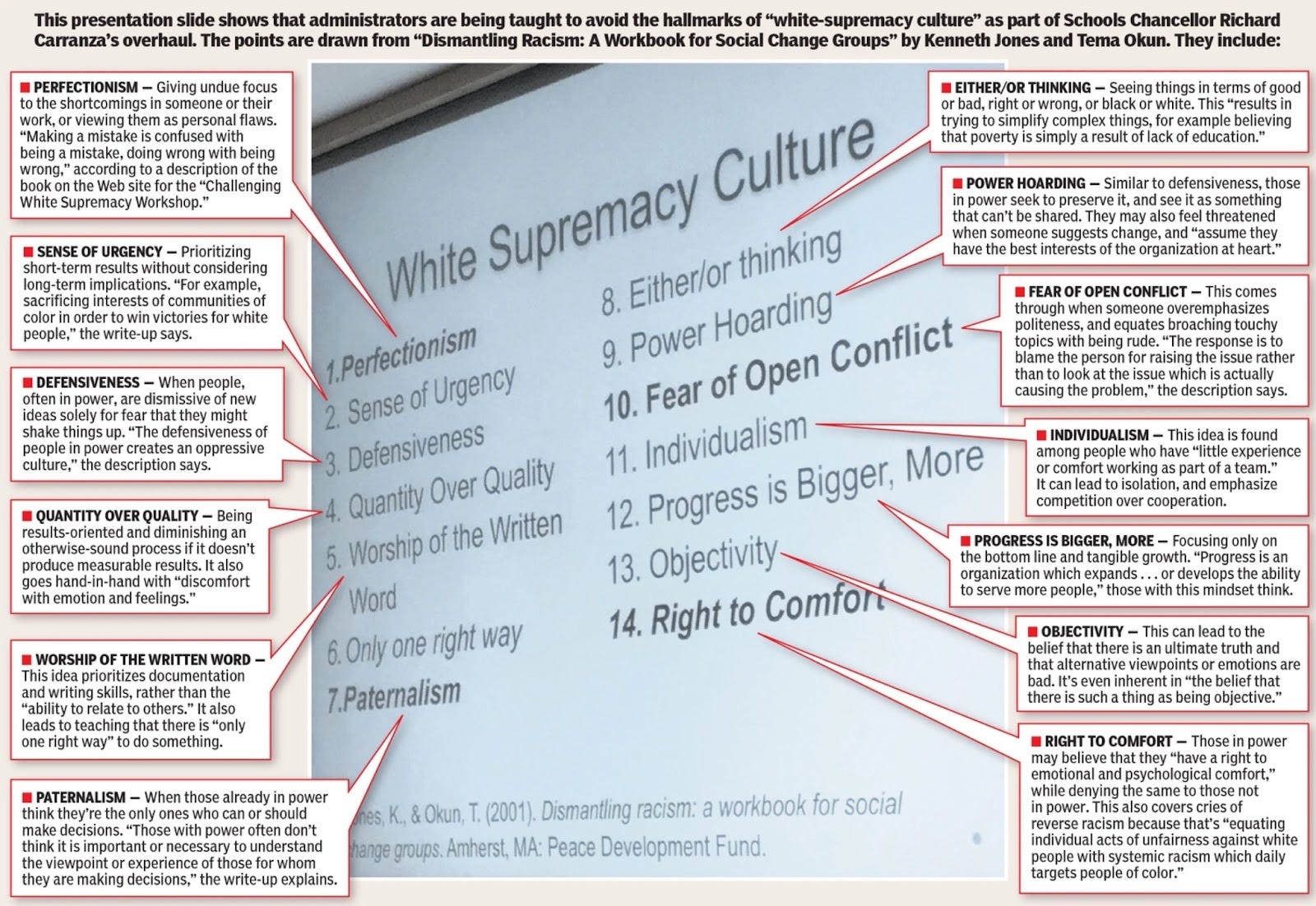
This kind of material is not teaching better manners to help people get along in a diverse workplace. It’s a frontal assault on core tenets of liberalism.
Okun, for example, objected to the notion “that there is such a thing as being objective or ‘neutral’” and said it’s bad for white people to see themselves or ask “to be seen as an individual and not as part of the white group.”
It is, of course, challenging in practice to be truly objective, to formulate neutral principles, or to see people truly and authentically as individuals, but these are the regulative ideals of liberal society and constitutional government. To dismiss them all as white supremacist fantasies is a huge leap into dangerous territory.
But it has been challenging for progressive liberals to note and confront that reality in part because unlike communists or the avowedly anti-liberal national conservative movement, the postliberal identity left does not have a name for itself. When in November of 2021, the influential Roosevelt Institute announced the need for a “new paradigm” that would move beyond “the twin failures of neoliberalism and racial liberalism,” I was briefly optimistic. I thought that the opponents of liberalism were prepared to stand their ground and have a proper debate about the wisdom of abandoning the principles that gave us the Civil Rights Act in favor of a new ideology grounded in the ideas of “the Black Power movement and the Black Panthers in the 20th century” and “the rising prison abolition movement” in order to start “taking seriously … group rights” and pursuing “greater community control.”
Instead, the paper vanished without a trace, despite being coauthored by Roosevelt’s influential then-president. And so the politics of entryism continue, as ideas grounded in a fundamental critique of liberalism continue to float unrecognized in the broadly progressive milieu.
Once you accept (even half-consciously) that groups, not individuals, are the basic units that matter, that “neutral” rules are just tools of oppression, that justice is about rebalancing power between groups rather than individual rights, you’ve already stepped outside the liberal project, whether you admit it or not.
Taking on the postliberal left
Liberal principles are worth fighting for, in ways that the current hysterical climate on the American right should make clear. Helen Andrews wants to drive women en masse out of professional workplaces on the basis of broad stereotypes and generalizations about sex differences. This is a terrible idea, but it’s hard to explain why it’s a terrible idea without recourse to old-fashioned ideas like judging people on their own merits rather than as manifestations of groups. People appalled by the rise of “groyper” sentiments on the right should also think hard about the possibility that it was not a great idea to frame politics as a zero-sum contest between racial groups.
Beyond narrow questions of political backlash, progressive politics is now awash in misguided specific ideas that are downstream of this illiberal turn. Criminal justice reform moved with alarming speed from the righteous argument that young African-American men shouldn’t be subject to collective punishment via “stop-and-frisk” policies on the basis of statistical inference to the unsound view that active policing is harmful and racist unless arrest rates are uniform across ethnic groups.
“Defund the police” has been left in the dust, but the misguided crusade against advanced math classes that Kelsey Piper dissected for The Argument earlier this month springs from the same impulse to judge equality in terms of group rather than individual impacts.
Jerusalem Demsas, in her pan of Karine Jean-Pierre’s bizarre memoir, argued that the former press secretary’s constant invocations of her identity miss “that the whole point of that representation is to improve outcomes for people. It’s not an end in and of itself.”

It’s a good take, but it’s also incumbent on liberals — especially those on the more left end of the liberal spectrum — to acknowledge that it’s a contested point. Is elite representation an instrumental good designed to make institutions function better?
I think it ought to be. But I don’t think that goes without saying.
My lived experience of institutional dialogue around diversity is that it has tended to reify fairly arbitrary ethnic categories in some deeply illiberal ways. I recall meetings where important issues turned on questions about whether Filipinos count as Asian or Hispanic and whether a person of Iranian origin could qualify as a “woman of color.”
Was it acceptable for African Americans and Latinos to be underrepresented on a team if white people were also underrepresented? Was the relevant denominator the general population of the country or the population of graduates from selective colleges, given our employment practices?
A relaxed, instrumental approach to diversity can sidestep or elide these questions. But they end up getting asked because the demands of postliberal racialism really do elevate group membership over individuality and thus require hard and fast answers to questions about who belongs to which groups. It also leads to cringeworthy spectacles like former President Joe Biden preannouncing, before Ketanji Brown Jackson was selected to serve as a Supreme Court justice, that he was only considering Black women for the job — an absurdity that did a disservice to her as much as to anyone else.
Liberals also need to squarely confront the damage that cargo cult equity has done to institutions where left-wing people hold sway. While schools in Texas have improved Black and Hispanic enrollment in honors math classes by adopting automatic enrollment for high-testing kids, it’s still the case that this system has them enrolling at a lower rate than their white or Asian peers. More progressive jurisdictions have been inclined to address these gaps in performance by eliminating testing, eliminating advanced classes, or otherwise attempting to stymie any effort to objectively measure how students are doing.
The former is an effort to help Black and Hispanic kids as individuals, to rescue them from opt-in systems that used to disadvantage them due to stereotyping or parental ignorance of the system. The latter is an effort to levelize group outcomes that does not actually make any specific person better off.
These kinds of disagreements play out in dozens of discrete ways across hundreds of American institutions. But it’s time for liberals, especially progressive-minded ones, to acknowledge that we are not really talking about thousands of separate instances of small-bore technical disagreements. There is a very real and consequential issue of values and goals across these domains.
It’s largely forgotten now, but in the winter of 2020 to 2021, there was a push to deprioritize the elderly in line for COVID-19 vaccinations in the name of racial equity, even though this would lead to the deaths of more people of all races — a reminder that the same basic bad idea can recur in an infinite range of settings and will keep popping up in new contexts until we talk people out of it.
Recommended reading:
The core anti-Pangram constituency is phony writers

A lot of people hate AI for drowning the internet in slop and displacing human creatives. You might think that these people would be thrilled by a program that can identify and flag AI-generated work.

Great to reread this! One thing it got me pondering... I do have doubts that the individual is the best unit for most analyses. Group identities are incredibly important. But I don't think they are exclusively ethnic or racial, and people have many identities, some stronger and some weaker.
I think a lab-perfect liberalism might underestimate the group identity impact.
Missed this article the first time around, thanks for the repost.