

Welcome back to The Argument’s poll series, where we survey Americans on the issues everyone’s fighting about. Our full crosstabs are available behind the paywall at the end of this post. Our last surveys have asked about elite perception, AI, crime, gender issues, and much more.
You can see every single poll published by The Argument here.
Our full methodology can be read here.
Before any politician makes a major policy change, they may want to ask themselves one simple question: Who are we helping with this?
Had Donald Trump asked himself that question before launching a war with Iran, he could have prevented what’s likely to become the biggest electoral cataclysm a political party has seen in a generation. New polling from The Argument shows that the conflict is even more toxic than George W. Bush’s war in Iraq, with only 33% of voters thinking it was right to enter, versus 55% saying it was wrong.
It’s not that the American electorate is reflexively opposed to military conflict. Our latest national poll found that a majority of registered voters think the U.S. would be justified in going to war in a variety of hypothetical cases — including one where the goal is to prevent a hostile country from obtaining a nuclear weapon. (That, of course, was the justification the administration gave for going to war with Iran.)
But voters are not OK with this war. In fact, the conflict in the Middle East has been so disastrous for Republicans that it’s allowed Democrats to open up a 6-percentage-point lead in voter trust on foreign policy. That’s the biggest lead the party has held in the year we’ve been tracking this metric, and it’s up from the 1-point deficit it faced on this issue in May, before the ceasefire with Iran collapsed.
I could come up with any number of explanations for why this is the case. Memories of the Trump campaign’s vows to stay out of “forever wars” still ring fresh, and it seems likely that the anger Republicans face is the natural consequence of broken promises.
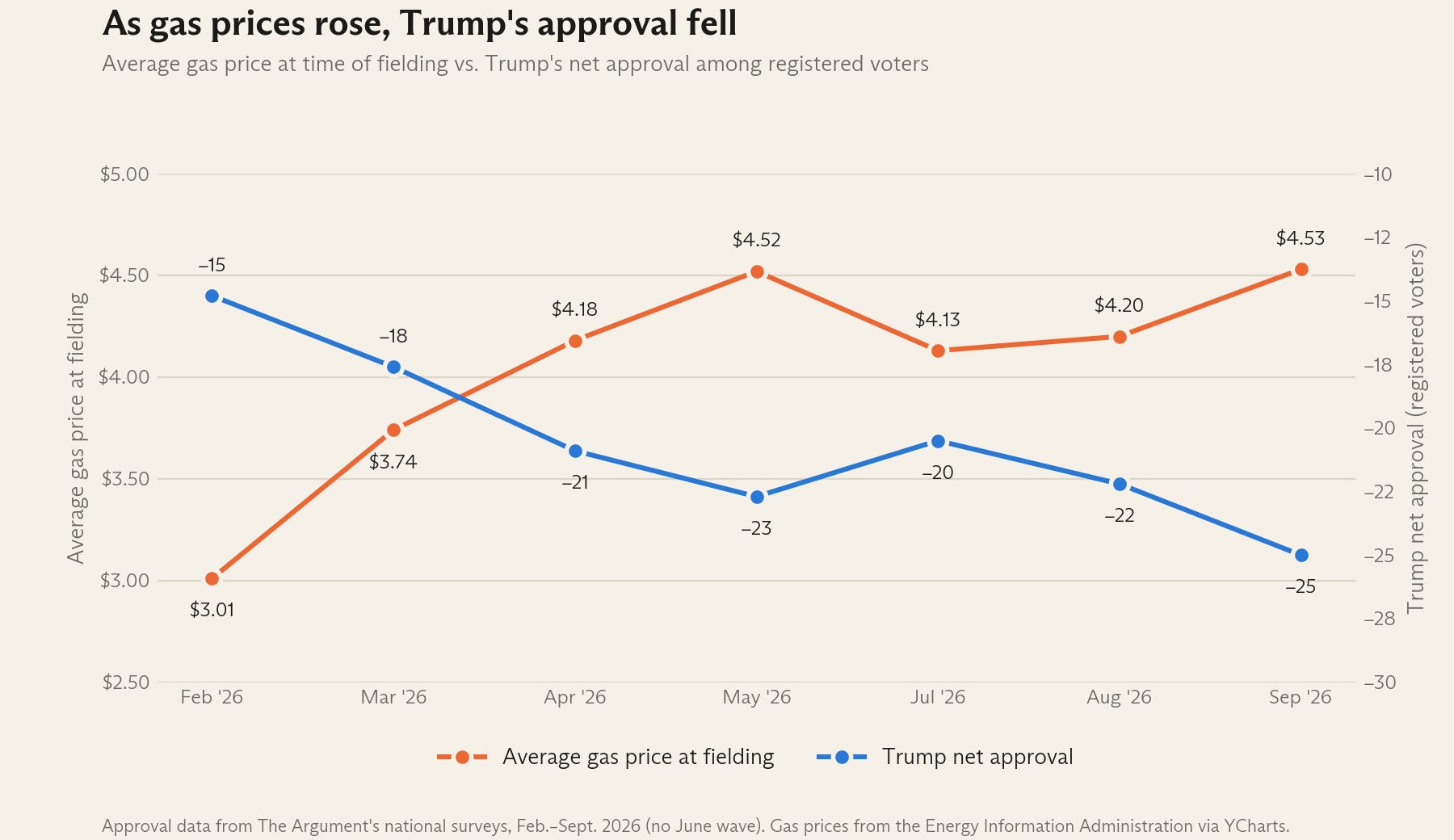
But fundamentally, I think Americans hate this war so much because of what it’s doing to their pocketbooks. It’s hard not to notice the inverse correlation that Trump’s approval rating has with gas prices. (It’s also important to point out that though this tracks with the empirical literature on the correlation between gas prices and approval, Trump is probably paying an outsized penalty because the price shock was a direct result of his specific actions.)
By itself, the deepening quagmire in the Middle East would be an unwelcome headache. But when it’s combined with a spiraling cost-of-living crisis, an unpopular trade war, and a chaotic and toxic immigration enforcement agenda, the picture is nothing short of disastrous for Republicans heading into the midterm elections. In fact, among likely voters, trust in Republicans now trails trust in Democrats on every single issue except crime.
There simply isn’t much good news for Republicans anywhere in our latest national survey. The president’s net approval sits 25 points underwater with registered voters and 26 points underwater with likely voters. These numbers make for an extraordinarily ugly contrast with 2018, when his net approval was “just” -9 in exit polls.
Though Democrats won the popular vote by 7 points and retook the House of Representatives in that election, today’s situation looks far more likely to yield a disaster for the Republican Party. Although the party “only” trails by 5.6 points with registered voters, this gap expands to 9 points with the likely 2026 electorate. (In some ways, I suppose Republicans are lucky it’s not even uglier, considering Trump’s approval is so much worse today than it was back then.)
It’s worth focusing on those generic ballot numbers for a second. If you were just to focus on the registered voter numbers, Republicans would actually be doing a bit better than they were in 2018. But not all of these people are going to vote, and considering the demographics, voting history, and self-reported enthusiasm of each voter allows us to more precisely estimate the population that is actually likely to vote. After factoring that in, Democrats open up a gaping lead on the congressional ballot, bolstering their advantage by more than 3 points.
In other words, though persuasion is a critical part of the story, the thing that takes this from a “blue wave” to a “blue tsunami” is the significant enthusiasm gap between the two sides.
For a while, Republican leaders have hoped that Democrats would be dragged down by perceptions that the party is too far to the left. As recently as this summer, in fact, they might have been justified in this expectation. Republicans were actually perceived as less extreme than Democrats in our July poll. Back then, 47% of likely voters said the Democratic Party was too far to the left, while 45% said the Republican Party was too far to the right.
But now the environment has deteriorated so badly for Republicans that this is no longer true.
In a stark reversal from our results a year ago, the Republican Party is now also considerably more unpopular than the Democratic Party.
As a result, Democratic odds of taking the Senate have never looked better, with deep-red states like Iowa, Kansas, and Nebraska moving into play as Republican strength in the Midwest evaporates. Combined with a rebellion among Hispanic voters and a polling lead that Mary Peltola continues to hold in Alaska, Republicans find themselves outright underdogs in the Senate for the first time in the cycle.
This was unthinkable a year ago, given that Democrats have to flip at least two seats in states Trump won by double digits in 2024.
Pundits and analysts alike have a tendency to overdetermine results after they have happened and tell the story of an election with far more confidence than that story really deserved. But let me be clear: The current unpopularity of the Republican Party is the result of a series of entirely avoidable actions taken by the president. Trump entered office as popular as ever, and he has proceeded to summarily squander that popularity through a sequence of unforced errors.
It was a choice to deploy Immigration and Customs Enforcement to Minneapolis, kick-starting a needless firestorm after three poorly trained agents shot two innocent Americans dead. It was a choice to levy incredibly unpopular tariffs and start an inflationary trade war during a cost-of-living crisis. And it was a choice to attack Iran and send gasoline prices skyrocketing during a time when Americans already felt stretched financially.

Our survey isn’t without glimmers of hope for Republicans. It’s still possible for them to keep the Senate if a systematic polling error happens. Polls in 2020 and 2016 far overstated the Democratic margin due to a systematic undersampling of low-propensity voters. Though we employ a lot of sophisticated survey guards to ward against this very thing (like including respondents who begin taking our surveys but drop off before completing them, a far less Democratic-swinging group than the other respondents), we can’t ever fully rule out the possibility of an error.1
If the war ends, gas prices dip, and the Republicans’ considerable cash edge begins to dent the image of Democratic candidates, it is conceivable that the party could claw back some of the ground it lost throughout this process. But that would require a series of actions that the president has not expressed interest in taking.
Without a serious and sudden reversal in fortune, Trump is about to send his political party off of an electoral cliff.
METHODOLOGY NOTE
Our poll was fielded between Sept. 16 and 21, 2026. We surveyed 1,603 registered voters across the nation; 1,533 completed the survey, while 70 partial responses completed at least until the generic congressional ballot question, where they were asked which party’s candidate they intended to vote for in November.
The sample was weighted to be representative of the universe of registered voters in the United States by race; age; gender; education; census region; race by gender; age by gender; race by education; modeled presidential partisanship by age, education, and gender; and 2024 vote choice. Questions up until the generic congressional ballot were weighted including partial interviews, and then questions after the generic ballot were weighted separately to the same parameters, but using only the complete interviews.
The margin of sampling error was plus or minus 2.5 percentage points. The design effect of the survey, which measures the loss of statistical precision due to weighting and design, was 1.22. Accounting for the design effect, the full margin of error was plus or minus 2.7 percentage points.
This iteration of The Argument’s national survey produces estimates of both registered and likely voters for the 2026 midterm elections. The likely voter screen takes every respondent’s demographic and voting history and calculates a probability that they will vote in 2026. It then aligns this with probabilistic turnout scores from self-expressed vote likelihood and rakes this to the likely 2026 electorate, calculated via historic demographic turnout data from a Catalist voter file sample, in order to estimate their likelihood of voting.
This survey was designed and weighted by The Argument. Data collection was performed by Verasight, and voter file data and weighting targets were obtained from Catalist. A full methodology statement is available on the last page of the survey PDF. A detailed explanation of how our surveys work is available here.
Thanks to Josh Kalla, Amanda Iovino, Guy Molyneaux, Charlotte Swasey, and Carroll Doherty for reviewing this month’s polling language. As part of The Argument’s polling advisory committee, these experts have provided comments to ensure the rigor and objectivity of this polling project. They are not responsible for the ultimate language choices made by The Argument, and all errors are our own.
Recommended reading:
Four things I changed my mind on after a year of polling

Issue polling is dominated by interest groups. We wanted to do something different.
The unraveling of Trump's 2024 coalition

Democrats are making the biggest gains with lower-propensity and nonwhite voters, which is a complete reversal of the political trends we’ve seen over the last several years.
That said, the bulk of the recent errors were seen in presidential elections when Trump was on the ballot. Low-propensity voters tend to turn out less in midterms.
And remember that both Vietnam and Iraq took a while to become unpopular, because it took time for it to be clear that they wre going badly. With Iran, the disaster was clear almost immediately.