

The Argument is thrilled to announce that John Thomason is joining our growing editorial team as our senior editor.
John comes to us from Grist, the leading independent climate and environmental magazine, where he spent more than five years as the features editor on a team that won a 2023 National Magazine Award for general excellence. There, he commissioned long-form enterprise stories and argument-driven analysis, led much of the publication’s news coverage, and edited features recognized by a Sidney Award, a Murrow Award, and inclusion in The Best American Science and Nature Writing anthology, among other honors. Before joining Grist, he ran the fact-checking desk at The Intercept.
At The Argument, John will commission and edit essays, reported features, and cultural commentary; guide writers in sharpening their arguments; and write a regular column of his own. He will help set our editorial priorities, expand our contributor network, and mentor our junior staff and fellows, carrying forward the standard that defines us: sharp, rigorous arguments that confront the illiberal drift in our politics.
To support The Argument’s mission of revitalizing liberalism through public, rigorous debate, please consider becoming a paying subscriber. It’s how we bring on talented new writers, commission original polling, and produce fantastic audio and video content.
Join us. We’re Libbing Out.
- Jerusalem Demsas, editor-in-chief
Climate policy is trade-offs all the way down. That’s because we’re trying to balance the harms of global warming with the benefits of modern energy and industry. If the only thing we wanted to do was eliminate carbon emissions, we would find a giant “off” button for the global economy and press it as fast as possible.
The closest we’ve come to realizing this hypothetical was in the spring of 2020. Daily global emissions plummeted by more than 15%, compared with average 2019 levels, as the nascent COVID-19 pandemic shut down large swaths of commerce, travel, and education. Ultimately, nobody thought this trade-off — which involved unemployment, learning loss, and delayed or forgone health care — was worth the dip in pollution, so nobody has seriously proposed hitting the “off” switch again.
What the COVID experience revealed is that, whether environmentalists admit it or not, every climate policy implicitly involves what’s called a cost-benefit analysis — an effort to tally up all the gains and losses of a potential policy and figure out which sum is larger.
Cost-benefit analysis gets a bad rap among progressives because the Reagan administration made a big show of mandating the procedure for major new regulatory actions. But that doesn’t mean cost-benefit analysis is necessarily a right-wing framework; it’s all about how you use it. One could just as easily use the method as a check on the deregulatory zeal of a conservative administration.
The principles of cost-benefit analysis are useful for those of us who are climate-concerned because they force us to ask, as a very first step: Are our actions likely to reduce carbon emissions, relative to the counterfactual?
As obvious as that sounds, this interrogation happens less often than you might think.
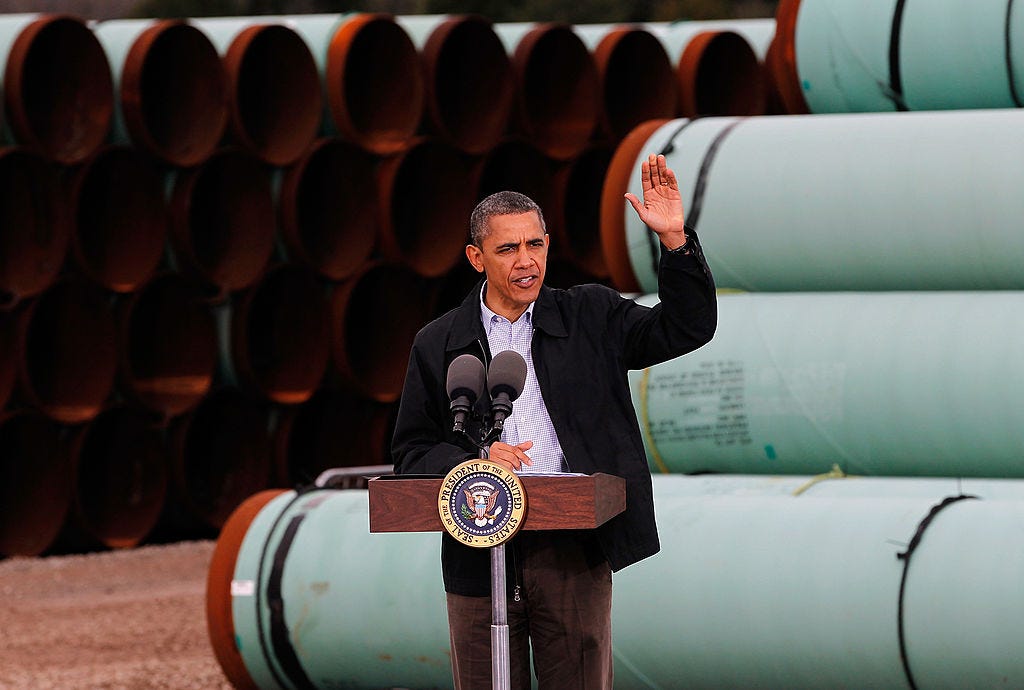
Consider Obama’s cancellation of the Keystone XL pipeline, which environmentalists heralded as one of the defining climate wins of the 2010s. This is despite the fact that Obama’s own State Department, headed by noted climate hawk John Kerry, found that killing the pipeline would not lead to a reduction in global carbon emissions. That’s because the Canadian tar sands oil in question would still reach the global market by rail. (In fact, emissions associated with transporting the oil might well increase in this scenario, as would the risk of spills given the very real possibility of train derailments.)
While subsequent academic research has challenged the State Department’s claim — it projects some global demand destruction due to higher prices commanded by oil without the pipeline — even these researchers admit that there is no way to know if blocking the pipeline reduced global emissions. Compare that unknown (at best) emissions benefit to the millions and millions of philanthropic dollars expended — not to mention the countless hours devoted by smart, committed activists — on the campaign to block Keystone.
Even actions that do clearly reduce emissions can benefit from the context of a cost-benefit analysis. One of the primary policies that U.S. states have used to decarbonize electricity generation is so-called renewable portfolio standards, or RPS. These standards require that a certain portion of states’ energy needs be met with renewable resources like wind and solar — in other words, that emissions-intensive forms of energy are directly substituted with carbon-free alternatives.
The good news is that the most comprehensive academic research on RPS found that the policies worked: States that instituted the standards saw an 11% to 24% drop in emissions after seven years and a 25% to 41% drop after 12.
But to figure out whether this was worth the cost, you have to first do some other math to figure out how costly those carbon emissions actually are. And that’s the really hard part.
All disagreements about climate policy are disagreements about the relative balance of costs and benefits
Because costs and benefits come in many different forms — when it comes to climate change, the costs alone might involve lives lost, labor forgone, damaged infrastructure, ecosystem destruction, and much more — the standard approach is to convert everything into dollar costs that can be measured against each other. Beginning during the Obama administration, all of these harms got tallied together into one big number called the social cost of carbon (SCC).
A larger SCC will counsel larger and more dramatic interventions, so a lot rides on just how big you think the costs of climate change are.
Obama set this number at $43 per ton, and when Donald Trump took office, his administration dropped the number to under $10. Biden then proposed bumping the figure up to nearly $200. (Last year, Trump ditched the metric entirely.)
Think about the multiples involved here. The Biden administration’s claim was that the first Trump administration was underestimating the harms of climate change by a factor of at least 20, and it planned to make changes across federal policy to account for that.
Suppose the Environmental Protection Agency was considering a regulation that would cost businesses and consumers $1 billion but prevent 10 million tons of carbon emissions — the equivalent of well over 1 million U.S. homes’ annual energy use. Under the first Trump administration, the rule would produce at most only $100 million in climate benefits and therefore fail the cost-benefit test. Under the Obama-era estimate, it would produce $430 million in climate benefits but still fail.
Under the Biden administration, however, it would produce $1.9 billion in benefits and would therefore be justified.
Now we can look back at the apparently successful renewable portfolio standards — the state-level rules that led to big drops in emissions — and see how they fared under these frameworks. The cost per ton of emissions avoided was $86 to $211, which exceeds the Obama administration’s SCC (and perhaps even Biden’s) and is much higher than abatement costs of other policies proven to reduce power sector emissions, like the Regional Greenhouse Gas Initiative, a carbon pricing framework that many Northeast and mid-Atlantic states participate in.
This suggests that, at worst, RPS policies may have caused more harm than they produced in climate benefits. And, at best, they were probably a worse use of resources than alternatives like cap and trade.
Climate advocates sometimes chafe at this sort of analysis when it cautions against their side’s policy aims, but they implicitly buy into it all the time. For instance, Greenpeace called the Green New Deal a “bargain” because of the estimated $500 billion in annual climate damages the organization suggested the policy would prevent. Climate Power published an entire report arguing that climate change “could cost the U.S. economy $14.5 trillion and result in a loss of 900,000 jobs annually by 2070.” And it’s a staple of climate journalism to explain new projections of the economic cost of climate change.
If you’re going to sound the alarm about a future decline in GDP, you can’t justify ignoring the way the very remedies you’re proposing entail GDP losses in the present. But this is standard in environmentalist discourse.
John Kerry’s State Department estimated that completing Keystone XL would contribute $3.4 billion to the U.S. GDP. That doesn’t necessarily mean it was worth it, but it is a fact that is worth considering in the “costs” column — and comparing to the campaign’s negligible and uncertain benefits.
Luckily, there are plenty of ways to reduce emissions that also happen to be economically efficient — where it’s the cost side of the ledger that is negligible, rather than the benefits. In fact, there are so many options here that you can really let your personal passions guide your final choice.
Mad about bipartisan Sinophobia and distressed about saber-rattling toward China? You could campaign to legalize imports of the world’s cheapest electric cars. Are you an urbanist who hates personal car ownership? Why not ask your city council to welcome all-electric Waymos?
If you’re disgusted with the fossil fuel industry, you could electrify your home. If you agree with Bill McKibben that it’s time for environmentalists to get out of the way of new clean energy projects, you could call your representatives and ask them to support federal permitting reform.
But while it’s true that many of these avenues could reduce emissions while contributing to overall economic growth, it’s not quite true to say that they don’t have costs. Cheap electric cars will disadvantage U.S.-based automakers. Waymos will put taxi and Uber drivers out of work and cut into the business of car dealerships. And permitting reform will erode the veto power of U.S. landowners.
I personally think these are costs worth bearing for the future benefit of all of humanity. An open question, however, is whether or not liberals think any interest groups are worth disadvantaging in pursuit of climate victories that are real rather than symbolic.
Have you heard the good news about global warming?
Two fundamental facts about climate change counsel against despair. The first is that the problem is global in the deepest sense: The climate does not care where emissions come from. One ton of atmospheric carbon emitted in Alberta has the same effect as a ton emitted in Jakarta, which has the same effect as a ton emitted in Dubai.
As a large, rich country that uses a lot of energy, U.S. emissions matter a great deal — but they won’t come even close to being the primary determinant of the world’s climate trajectory from this point on. (And on the global front, recent years have brought quite a bit of hope as renewable energy begins to crowd out fossil fuels.)
The second relevant fact is that the problem is fundamentally incremental. What matters for global warming is the total volume of carbon that accumulates in the atmosphere. More carbon is worse, and less is better.
The same logic applies to global average temperature: Just as 2 degrees Celsius of warming is “better” than 2.1 degrees, 2.1 is better than 2.5, and 2.5 is better than 3. And because the impacts of climate change don’t scale linearly with warming, each tenth or hundredth or thousandth of a degree avoided is a big, big win.
There are no thresholds we need to avoid. We just need to eliminate as many emissions as possible.
Everyone who’s spent any amount of time on the issue knows these facts, but following their implications entails a dramatically different approach to climate activism than what dominates today. Long-shot efforts at systemic change — be it to abolish the fossil fuel industry or capitalism itself — do not present a clear path to reducing emissions. By far the most useful thing you can do as a climate-concerned citizen is push for the most efficient emissions reductions possible in whatever sphere you can influence.
But when it comes to climate change, “most efficient” is a tall order. So don’t get too hung up on every single number in the cost-benefit ledger. If you are reasonably confident that 1) emissions will actually go down and 2) the social costs are negligible, then get to work.
Recommended reading:
Voters don't care much about climate change — they're right

Even as global warming has persisted over time, American death rates from natural disasters have declined, agricultural productivity has increased, and economic growth has continued to reach new heights.
Jon Stewart has become his own worst nightmare

Stewart has conflated the entire field of economics with a half-remembered, left-wing caricature of capitalism.
It's interesting that every instance of cost-effective carbon reduction you list involves deregulation: Allow import of cheap electric cars, allow Waymos to operate, allow new renewable infrastructure to be built and connected to the grid. I suspect many progressives would chafe at these suggestions as they see deregulation of any sort as right-wing.
Your mileage may vary, but I see ending car dealerships and homeowner veto power as very good things.