

Worst Take of the Week is an occasional column where the author will rant about something we found stupid, annoying, bad, and/or irritating. While the title of this column was necessary for palindromic reasons, we cannot promise that entries will come out weekly or that each piece will literally be the worst take that week; this column would be boring and repetitive if each week we explained why genocide is bad in response to Twitter user @Nazi1488LoveHitler.
What if we could solve the housing crisis simply by instructing the federal government to construct beautiful fourplex apartments based on midcentury designs by Frank Lloyd Wright?
Such is the contention of Vanderbilt law professors Christopher Serkin and Daniel Sharfstein, who recently published an op-ed in The New York Times arguing that we should look to World War II-era housing policy in order to resolve the 4 million to 20 million home shortfall facing the contemporary U.S.
Current housing policy, they have argued, is afflicted with “policy myopia.” Instead of thinking big, pro-housing reformers have been excessively fixated on getting rid of the regulations that make it difficult or impossible to build housing, particularly in our highest-cost cities. They believe the federal government should step in as the authors contend it did during World War II, when it “directly built housing itself.”
Serkin and Sharfstein paint a utopian picture. Not only did the government experiment “with prefabricated construction techniques to reduce building costs and speed production” — they point to bubble houses built by spraying balloons with a concrete mixture that “went up quickly and minimized the use of scarce war material” — but it also worked with famed architects like Frank Lloyd Wright to create artistically pleasing quadplexes.
The problem with the authors’ exhortation to “remember” these lessons from the World War II housing crisis is that they are themselves refusing to learn them. Serkin and Sharfstein dwell on cherry-picked, unrepresentative examples of idyllic housing projects that were never built at scale, and they suggest that the government’s improvised construction of substandard housing for migrant workers is a model for the 21st century.
What ever happened to Frank Lloyd Wright’s cloverleaf public housing project?
In both the Times op-ed and in the 71-page report the essay is based on, the authors wax poetic about a proposed “cloverleaf” project in Pittsfield, Massachusetts, designed by famed architect Frank Lloyd Wright1:
“These attached four-apartment structures were arranged in geometric patterns to create both privacy and community, with rooftop sun decks, play spaces for children, and garages tucked into the center of each building. The unusual design also allowed for shared building systems that were more efficient. From above, the cloverleaf homes looked almost organic and were an alternative to the single-family houses that private developers were primarily building,” they wrote in the op-ed.
So is it possible to visit this gorgeous paragon of publicly developed housing? No, because it doesn’t exist. According to Wright’s own account, Massachusetts architects were so annoyed at having been passed over for the project that they complained to their federal representatives. Unwilling to turn over his work to other architects, Wright then refused to sell his plans to the government and the Pittsfield project was never built.
This is not an accident of history. Indeed, the dynamic that killed the project is the very same kind of interest group protection that turbocharges NIMBYism to this day. Years later, Talbot Wegg, who was chief of the Defense Housing Division’s Planning Section, confirmed Wright’s story, recalling that then-House Majority Leader John W. McCormack took the agency to task for hiring out-of-state talent and “keeping Massachusetts architects from making a living.” A Senate hearing from 1941 reveals that the American Institute of Architects (AIA) explicitly pushed requirements that architects residing near a project should have preference over those far away. That same year, a Massachusetts Board of Housing official put it even more starkly: “New England wants local control.”
To this day, chapters of the AIA can sometimes act as NIMBY groups. AIA California opposed a bill that would have allowed eight units by right on certain lots; it opposed another that would have established a plan for 1.2 million social housing units, including 200,000 for extremely-low- and very-low-income households; and it opposed the creation of a California Housing Authority empowered to develop and acquire state-owned social housing. Local AIA chapters in Colorado, and Washington state have also opposed the removal of barriers to housing construction. These groups have also supported various pro-housing policies, my point is not to cast them all as NIMBYs but just to say that the politics of interest groups are an important barrier to overcome the U.S.’ housing supply crisis.
Not only did the cloverleaf project fail in its time — you most likely couldn’t build one today even if you wanted to. According to the National Zoning Atlas, quadplexes are legal to build on just 12% of residential land in the United States. If a developer — be it public, private, or even a nonprofit affordable housing developer — would like to take the extra time, money, and effort to ask for special permission, they are welcome to do so. They will almost certainly fail.
Let’s turn to Nashville, Tennessee, where Serkin and Sharfstein both live. To my knowledge, neither Serkin nor Sharfstein made any public comment in support of Nashville’s years-long attempts to make it easier to build the multifamily housing they say they crave. In fact, in 2022, Serkin argued that there was “very, very, light zoning in Nashville” as part of an argument that regulation was not a large obstacle to addressing the area’s housing shortage — all this despite the fact that just 8% of Nashville’s residential land is zoned to permit multifamily housing.
Wright’s design also doesn’t conform to modern building codes. I took a look at Pittsfield’s existing laws as well as the building code and found the following potential violations: It’s lacking automatic sprinklers and separation between units; its stairs are too compact; its bedrooms need escape windows; its roof decks need modern guards; and its wall, window, and roof construction would not comply with energy performance needs.2 (There are probably others I don’t know about because I am not a housing developer.)
But the core thing to understand is this: Just because the government is the developer of housing doesn’t mean you can ignore the fact that local opposition, zoning restrictions, building regulations, and environmental rules exist. The government is, if anything, more restricted by these laws and the inevitable costs they impose on development, plus additional strictures like prevailing wage requirements that it imposes upon itself. (Consider, for example, New York City’s decade-long quest to build 123 affordable senior apartments on city-owned land: A neighborhood garden association sued the city under environmental regulations, and after 11 years of tribulation, the city ultimately won in 2024 but the project was ultimately abandoned due to local opposition.)
Anyone actually serious about reviving public developers would not hand-wave away the difficulties associated with overcoming localism and red tape — they would be obsessed with them.
The wrong wartime lessons
In their War Housing report, the authors paint a picture of a federal government that quickly and competently constructed almost 1 million homes: During the war, “the government built approximately 900,000 new housing units and private developers built or converted over 1,000,000.” To be clear, despite the authors’ derision of the private market, all the public housing in question required private market contractors to actually build the housing, and only in some cases did the government actually identify the sites, purchase the land, provide the financing, and manage the properties itself.3
Moreover, the vast majority of the housing built by the government was temporary shelter, unsuited to long-term use. Take the approximately 900,000 units built by the government during the war that they call evidence of “what is possible when the government gets serious about increasing housing”:
The source they are pulling from actually counts 837,000 provided or under development by the end of 1944, roughly 70% (579,700) of which were temporary. We’re talking light wood framing and plywood with communal toilets and kitchens, intentionally “below acceptable standards for permanent, peacetime dwellings.” I’m all for legalizing very cheaply made homes, but let’s not kid ourselves about whether the housing crisis could be solved with homes like these:
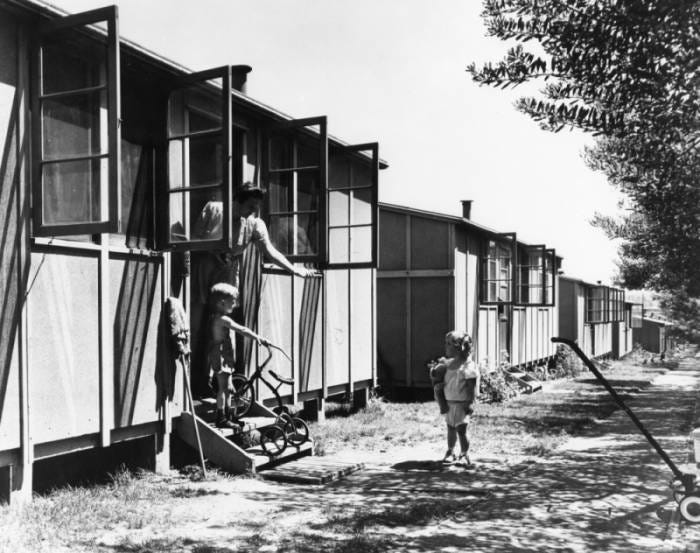
Wartime housing shortages were created by the rapid movement of workers into a relatively small number of industrial locations: Shipyards, ammunition plants, aircraft factories, and military installations suddenly needed tens of thousands of workers, often in places that had nowhere for those workers to live.
Where a community could permanently absorb new homes, the government looked first to privately-financed construction. Where demand was tied to a temporary war facility, the government financed housing itself and contracted with private firms to build it.
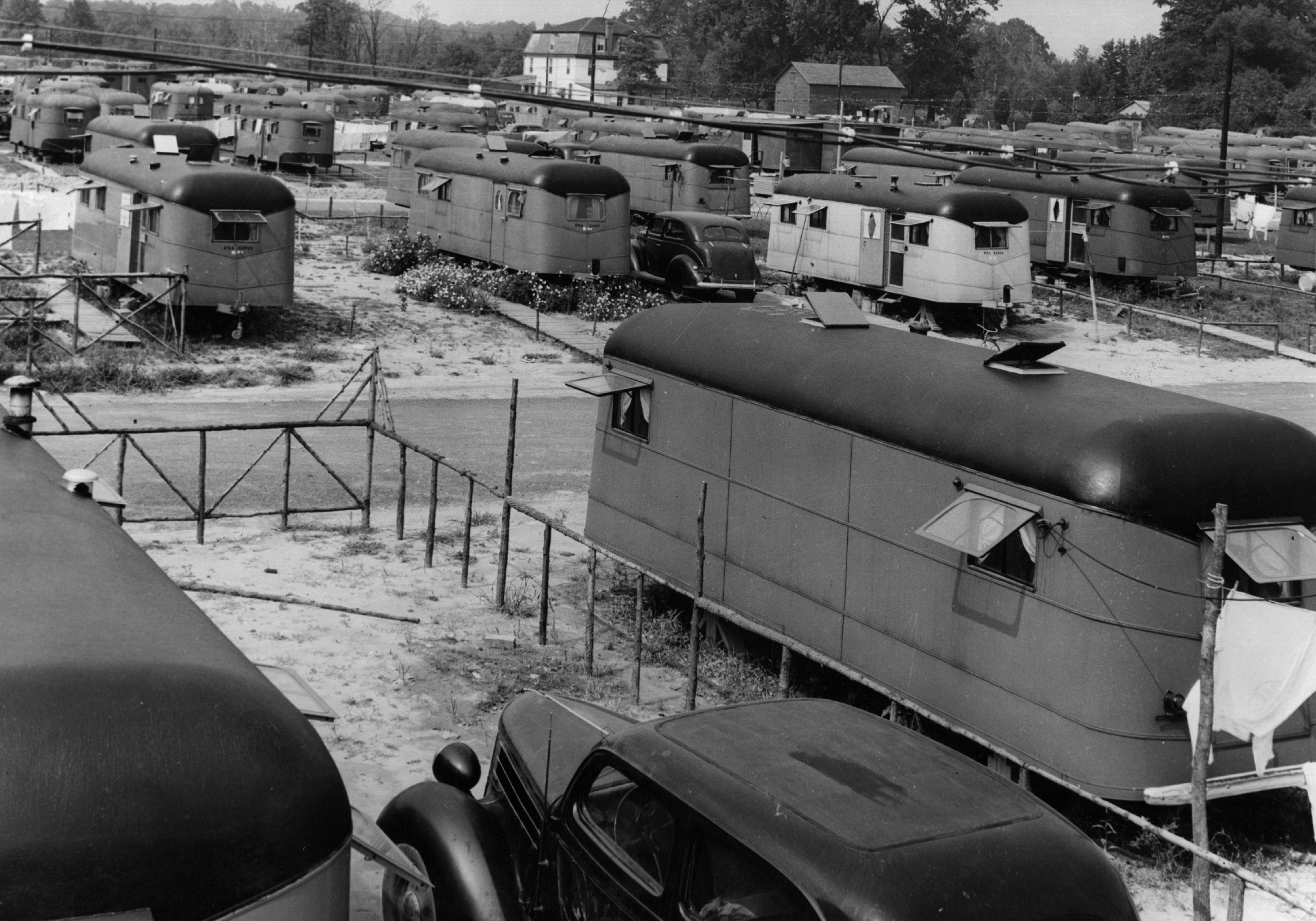
That logic explains why dormitories, trailers, communal facilities, and “demountable” homes made up a significant part of the wartime public housing program. I’m not saying these were policy failures — temporary housing is a sensible response to temporary demand — but they are just not a useful model for supplying millions of permanent homes in places where people will continue to live for decades.
The much more relevant analogy, which Serkin and Sharfstein dismiss, is what happened after the war ended.
Millions of service members returned to a country that lacked enough housing for them and their families. This was not a matter of moving a temporary workforce closer to a factory; it was a broad and durable mismatch between the number of American households and the number of American homes. That is much closer to the problem we face today.
The postwar government responded accordingly. It did not preserve the wartime emergency system of barracks and worker housing that Serkin and Sharfstein celebrate. Instead, it redirected scarce materials toward residential construction, guaranteed mortgages through the Federal Housing Administration and Veterans Administration, and encouraged builders to produce permanent homes at enormous scale. It also made infrastructure investments in energy and transportation to make it possible for the private market to meet the pressing demand for new housing.
All of the major financing tools that the federal government deployed in the postwar years to resolve the housing crisis are still available today. What’s changed? We’ve constructed an anti-growth web of political opposition, zoning regulations, environmental rules, and other restrictions that act together to choke off the private sector.
Now, on top of all that, we have to listen to law professors torture historic analogies4 and basic facts about housing policy.
The housing crisis is not about whether famous and brilliant architects can build a few dozen cool houses. It’s about whether we can quickly and efficiently build millions of homes in the places where people need them to access jobs, schools, and social networks.
Serkin and Sharfstein want you to think the private market failed to address the housing shortage, but that’s totally wrong. Enabled by government-backed financing tools — which are largely still in place today — we resolved a several-million-home shortage immediately after World War II by … helping the private market rip. By 1950, annual housing starts had reached a record 2 million, and roughly 4 million homes had been completed since the war.
It was the private market that commercialized and scaled innovations in factory-built housing, building materials, and construction methods: from mobile homes and prefabricated houses to plywood, fiberboard, and drywall, and from pre-cut wall panels to standardized plans and specialized crews moving from lot to lot in assembly-line sequence. This history is entirely missing from the one Serkin and Sharfstein tell because it’s inconvenient for their predetermined narrative.
But perhaps the biggest problem for Serkin and Sharfstein is that they remain totally ignorant of the most important problem facing a government that wants to build millions of new homes: Where are you going to get the money?
Upkeep and management of housing is not free! Managing a massive new public housing program isn’t free.
The thing about zoning is that it’s free
You know what is free? Going into your city’s zoning code, using Ctrl-F to find “minimum lot size,” and hitting delete. You can also do that for parking minimums and really anything else that has nothing to do with health and safety.
What you can’t do is conjure up free money out of thin air to build a bunch of housing. The era of cheap borrowing has come to an end. If the government wants to make large capital investments or spin up brand-new programs, it will have to either raise a lot of taxes (in the middle of a de facto tax revolt) or else borrow even more money, putting existing programs like Medicare or Social Security at risk.
An April 2025 report about the cost of housing shows that publicly financed affordable housing cost 1.5 times the average cost of market rate housing in California and more than four times the cost market-rate housing in Texas.5
This is a big reason why upzoning is so attractive. Taxpayers don’t have to pay out of pocket for an untested massive public housing program and can instead count on a bunch of private individuals, banks, and corporations to try to build a variety of new homes that will suddenly be legal if we upzone. Having private actors take on this risk themselves is actually better than expecting the government to build anywhere from 4 million to 20 million new homes. That’s not a worst-case scenario; that’s a best-case scenario.
Serkin and Sharfstein seem completely unaware of — or perhaps merely uninterested in — the boring details of land acquisition, available public financing tools, or the struggles the government has faced in management and upkeep of its existing public housing stock. None of these problems are meaningfully discussed in either their op-ed or their 71-page report.
The authors claim that they are merely annoyed by the overfocus on zoning, but previous scholarship indicates that their animosity toward removing existing barriers to housing is more pronounced than they admit.
Back in 2020, before the left had largely accepted the YIMBY diagnosis of the housing crisis, Serkin penned an article in the Notre Dame Law Review called “A Case for Zoning.” In it, he offers a “defense of zoning, and in particular density regulations.” Serkin argues that by “maintaining community character, enhancing property values, and allocating the costs of development between insiders and outsiders,” zoning offers a critical defense for incumbent homeowners.
It’s important to realize when someone is offering a good faith critique versus when they’ve exhibited longstanding hostility to the project of solving the housing supply crisis.
“Perhaps needless to say, these uses of zoning can easily shade into NIMBYism … and naked exclusion,” Serkin concedes before plowing forward, undeterred. He later adds, “A new apartment building in the middle of Manhattan is more consistent with reasonable expectations than the same building in Nashville, Tennessee.”
I’m sure Serkin’s concern for his neighbors in Nashville is entirely selfless.
Update 8/26/2026: This piece has been updated to further explain the policy positions of modern local AIA chapters.
Previous WTOTW:
When "technically true" becomes "actually misleading"

Staff writer Kelsey Piper thorougly dismantles The Atlantic's Tyler Austin Harper's argument about stochastic parrots.
What if Ozempic doesn't fix literally everything?

Some arguments are bad because the author has made an empirical error. Some of them are bad because the author has bad values. But in his recent columns for The Free Press, Arthur Brooks made a more fundamental error: He asked a bad question.
The Vanderbilt Policy Accelerator, which published the War Housing report written by Serkin and Sharfstein, was created to “conduct foundational research and work through the nuts and bolts of policy implementation.” If this report is what counts for nuts and bolts, we are in trouble. Unsurprisingly, the Vanderbilt Policy Accelerator was funded in no small part by $1.5 million from the Hewlett Foundation’s Economy and Society project, which seems to largely exist to spread economic misinformation.
Wright's available plans are not complete, so it's possible that some of these would have been addressed.
It’s normal to refer to the government as “building” infrastructure even if it contracts private firms to do the actual construction but in a piece where they are drawing such sharp distinctions between public and private development, deriding the latter, and failing to make clear the private markets role in public development, the use of the phrase “build” is misleading. They seem to even confuse themselves. At one point they claim that the Division of Defense Housing Coordination “recommended building 1,000 housing units and financing an additional 10,000 privately built units.” But their cited source says the paln called for “1,000 government-financed and 10,000 privately built family units.” Their paraphrase thus converts the government-financed units into government-built units while appearing to attribute government financing to the 10,000 privately built units. In a sufficiently capacious sense, much privately built housing is publicly financed. But if federally financed private construction counts as government building, then the postwar FHA/VA boom they dismiss as a failure is the largest public housing program in American history.
My editor made me cut this, but one of the most absurd anecdotes they linger on is the “bubble house” experiment in Falls Church, Virginia, where the government tested an “experimental system of spraying concrete onto hemispherical balloon forms” that would conserve materials necessary for the war effort by using neither wood nor metal. We’re talking about 12 houses that ultimately suffered from “moisture problems, crumbling plaster, and the difficulty of decorating curved walls.”
The main causes were that affordable housing developers had to “pay substantially above-market wages and unusually large architectural and engineering fees (particularly in Los Angeles) likely related to highly prescriptive design requirements.”
[But the core thing to understand is this: Just because the government is the developer of housing doesn’t mean you can ignore the fact that local opposition, zoning restrictions, building regulations, and environmental rules exist. ]
I think a lot of the pro-public housing people sort of know this but don't really believe it. They believe that the government could in fact pass a "ignore local opposition, zoning restrictions, building regulations, and environmental rules" law. That's why WWII gets invoked so often, the idea that if it's really a national crisis, why can't the government just do it and ignore the haters and the rules?
And in a lot of countries, I guess the government could do that.
I live in Stuyvesant Town in Manhattan which was a postwar public housing project and actually the largest housing project in the country (>10k units).
It's an incredibly nice place to live, especially w kids.
I am pretty sure it would be easier and faster to build a moon base than build another stuytown anywhere in NYC.
Also, unrelated, but I think one of the reasons that stuytown is such a nice place to live is that its owned and run by a giant corporation (Blackstone lol).