


Welcome to The Closing Argument, our verdict on the news, plus everything The Argument published and appeared in this week.
The Verdict, by Jerusalem Demsas
Readers — maybe even you — love to click on stories about how young men are becoming Andrew Tate acolytes and young women are becoming misandrist shrews. Scarcely a day goes by without the commentariat debating the plight of contemporary men and women in tired, circular arguments.
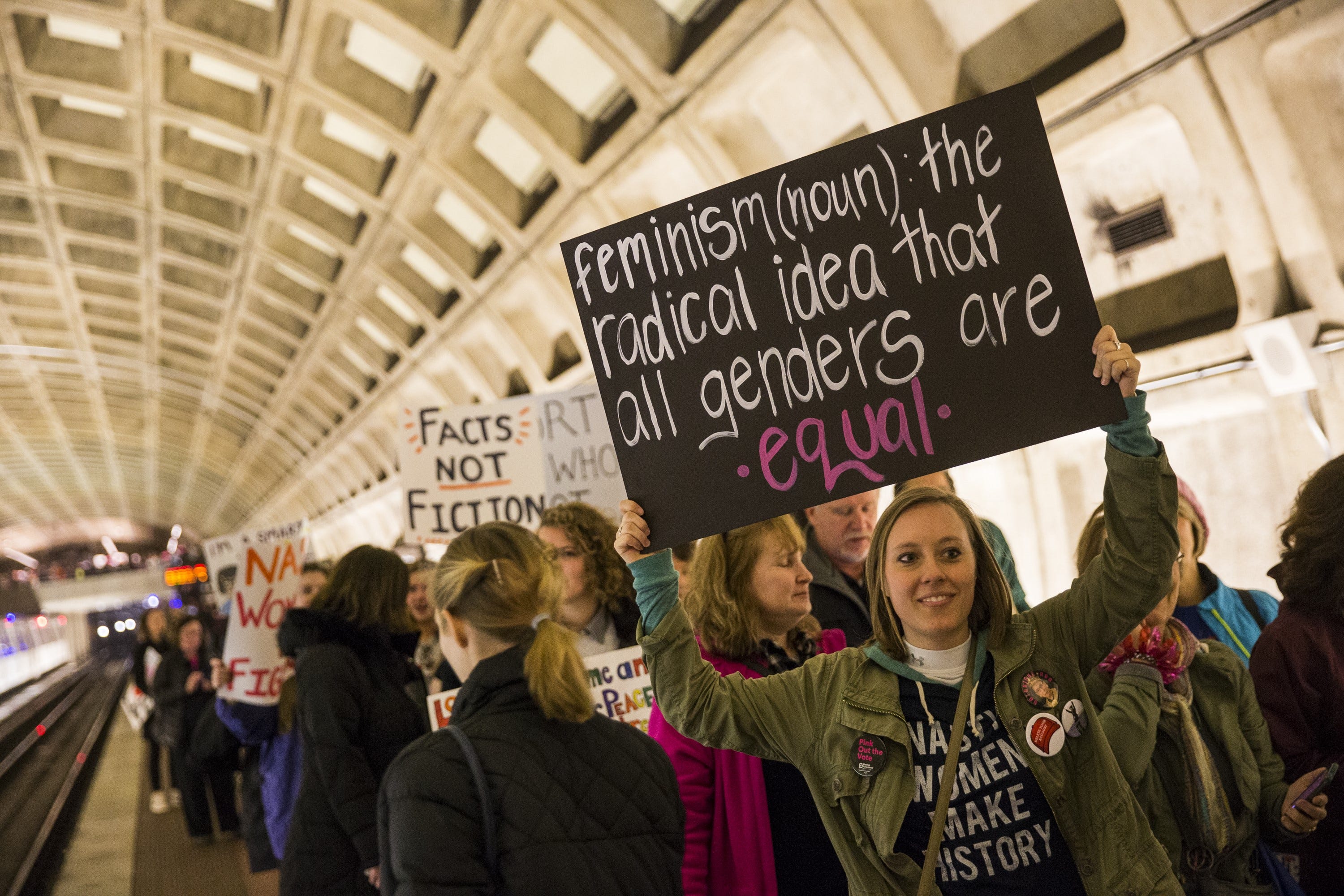
Yet many polls indicate that, while voters may shy away from the label “feminist,” they have broadly positive views on the idea of equality between men and women, which raises the question: What does everyone think feminism is doing?
We asked them.
In a poll of 3,000 registered voters conducted between July 20 and 26, The Argument asked respondents “which of the following — if any — do you believe describes ‘feminism’ in practice?”
A large majority — 64% — selected “the belief that men and women should be social, political, and economic equals.” No other potential answer broke 30%.
Notably, even among Trump 2024 voters, 51% agreed with that egalitarian definition of feminism.1
For access to our full cross-tabs and analysis on all of our original issue polling become a subscriber!
But when asked whether the majority of Americans and the majority of elites agreed with them, our respondents grew pessimistic.
Just 48% agreed that the majority of Americans would select the egalitarian definition of feminism, and just 28% thought the majority of elites would.
As our director of political data, Lakshya Jain, explained earlier this week, our poll generally shows a clear trend where “most people think their fellow Americans agree with them while elites disagree with them.” The feminism question complicates that pattern: There’s a 16 percentage point drop between those who personally define feminism as equality and those who think most Americans do.
That’s the single largest drop-off between personal views and majority perception in our poll, save one: the question about whether “men and women are equally suited to leadership,” where 81% personally agree but only 51% think most Americans do.
Americans’ gender egalitarianism is an underrated fact of our modern political landscape. In our earlier February poll of 3,003 registered voters, The Argument asked about a range of issues related to gender and sexuality. Normie feminist opinions repeatedly won out:
Only 18% agreed that women were “taking jobs that should go to men.”
Among respondents who thought one parent should stay home with children, 40% said it should be “whichever parent wants to stay home” and just 29% said it should be “the mother.”
Similarly, in our July polling, liberal feminism beat out explicitly hierarchical positions:
81% of voters agreed that men and women are equally suited to leadership, including 74% of Trump voters.
Only 31% of voters thought men should be the breadwinners.
These are all positions associated with the basic achievements of feminism: Women should be eligible for the same jobs and positions of authority as men, and family roles should not be automatically assigned according to sex. Substantive egalitarian principles that feminism fought to establish are considerably more popular than the endless gender-war commentary suggests.
Before I paint too rosy a picture, the polling does show some substantive disagreement on the question of feminism — not about the value of gender egalitarianism, but instead about whether or not we have already achieved it. In our polling, men are much more likely to believe that particular gender disparities have been overcome. Women are not so sure.
This disagreement on empirical questions is no small thing. If you believe that men and women have largely already achieved equality, then any further demands by feminists can be interpreted as women seeking unfair advantage. On the other hand, if you still think there’s a lot of progress yet to be made, then feminism is merely continuing its egalitarian project — and the doubters must be hostile to true equality.
This disagreement helps explain how a country where most people think equality between the sexes is desirable has found itself continuously locked in internecine gender feuds.
Millennials, we have a problem
As a millennial feminist, I was disheartened to see that 30-to-44-year-olds had the least egalitarian perception of feminism.2
Now, I don’t want to overstate this — 59% still believe that feminism in practice is the belief that men and women should be equals — but they were also the age group most likely to say feminism means women should have more power than men (19%) and that women are superior to men (also 19%).
Nor was this a one-off result: In The Argument’s February polling on gender issues, millennials lagged in several responses as well. They were nearly twice as likely as adults under 30 to say society would benefit from a return to traditional gender roles. They were also the age group most likely to agree that women were taking jobs that should go to men.
I want to refrain from making some grand pronouncement about what this generational divide means. It’s entirely possible that this has nothing to do with generational differences and everything to do with the fact that the 30-44 age cohort is in the middle of having children, dividing household labor, and confronting gender roles in intensely personal ways.
It’s wonderful that we can mostly agree on equality in the abstract. The question of the 21st century is whether those principles can be translated into who takes a hit at work to figure out after-school childcare.
Top stories this week, by Maibritt Henkel
In his piece covering our new poll’s headline findings, Lakshya Jain argues that voters, despite what folks like Christopher Rufo would have you believe, don’t actually think the elite means journalists and college professors. Rather, it is billionaires and celebrities who voters suspect don’t share their values.

The Argument columnist Matt Yglesias is not convinced that American seniors are hoarding power. In his column this week, he points out that there are many real problems plaguing society, none of which have to do with old people running for office or getting tenure. Instead, we should probably be celebrating the fact that more of us are living, working, and engaging in politics for longer.

Staff writer Kelsey Piper loves a Waymo. In her latest article, she takes on a group of people who have been lobbying against the autonomous vehicles under the radar: personal injury lawyers. Because AVs are on track to significantly reduce the number of people hurt or killed in car crashes, they threaten to put a dent in the trial lawyer business model. But no tiny self-interested group should be able to kill an invention with such immense potential to do good.

🌟Abundance Wins of the Week🌟
At least 8,400 apartments have now officially been enabled in Texas since Senate Bill 840 took effect last September.
Study finds that a GLP-1 pill can reduce heavy drinking in adults with alcohol use disorder.
Worth watching…
On the podcast this week, Jerusalem lays out one of her hottest takes: You don’t actually want to buy a house. Unlike George W. Bush, she does not want everybody in America to own their own home. But Matt, a very satisfied homeowner himself, thinks it is good for individuals — and society — when people save money through homeownership. (A friendly reminder that neither podcaster is a financial advisor.)
Tech and society fellow Kobe Yank-Jacobs engaged NYU researcher Nathan Witkin in a live discussion about the “most important graph in AI.” Stay tuned for more live Kobe content in the coming weeks.

What’s News with The Argument
The Argument recommends, by Maibritt Henkel
I asked the team to recommend cultural content that had recently made them cry. I’ll let you decide how seriously they followed that instruction.
Politics & polling fellow Milan Singh, for instance, recommended the new upload from his favorite YouTube channel The Wildlife Homestead. The 20-minute video follows a family of swallows from inside their bird box for an entire nesting season.
Operations manager Angela Tracy also recommended a wildlife vlog, this one of a guy swimming with giant tadpoles in Florida’s Ocklawaha River.
Both editor Eli Richman and staff writer Jeremiah Johnson recommended you go see the live stage recording of Hadestown, still playing in theaters thanks to huge popular demand. Here is what Eli had to say about it: “If you don't tear up at Hadestown, I don't know what to tell you. For the uninitiated, the musical reimagines the Orpheus-Eurydice and Hades-Persephone Greek myths in a sort of steampunk, dystopian setting. ‘It’s a sad song’ are among the first words uttered in the show, but knowing that doesn’t soften the blow.”
To this, Jeremiah added that Hadestown is an “honest tragedy,” one that “tells you directly that this has all played out before, that it's going to end badly, but that it will be beautiful anyways.”
I also recently shed a tear at the theater. Last weekend, I saw Arthur Miller’s Death of a Salesman on Broadway, starring Nathan Lane and Laurie Metcalf. Totally heart-wrenching and timeless. It made me desperately want to see the 1985 Dustin Hoffman film adaptation.
Tech and society fellow Kobe Yank-Jacobs recommended the song “Ooh La La” by Faces, sent to him by a friend on his 24th birthday. The lyrics — “Poor young grandson / There's nothing I can say / You'll have to learn / Just like me / And that's the hardest way” — hit him with force this past weekend while on a run. In a similar vein, senior editor John Robert Thomason recommended Bruce Springsteen’s “Racing in the Street.” Here is a live performance of the song from 1978.
Finally, I’ll leave you with editor-in-chief Jerusalem Demsas’ list of books that made her cry this year:
The Last Samurai by Helen DeWitt
The Golden Enclaves by Naomi Novik
This Kingdom Will Not Kill Me by Ilona Andrews
Sunburn by Chloe Michelle Howarth
The Sparrow by Mary Doria Russell
Possession by A.S. Byatt
The Employees by Olga Ravn
We have merch!
We have quarter-zips, keychains, hats, and stickers. Each one is a great conversation starter in its own way. Buy them here.
More to read:
Should we bribe the NIMBYs?

If we’re going to subsidize housing for the poor, inclusionary zoning is a really inefficient way to do it.
The simps who took down an alleged sex trafficker

This week, Jeremiah Johnson dives into what’s driving anti-capitalist messaging, how youths are disguising themselves as Charlie Kirk, and the young men who found community on a porn message board.
Young people like journalism, just not enough to consume it

Journalists... the profession of the working class?
Even among people who currently *strongly* approve of the job that Donald Trump is doing in office, 50% say feminism in practice is about the equality of the sexes.
Voters 65 and over were the most likely to give the equality definition, despite being the most Republican cohort in our sample.
This was super poignant and I think the “disagree about the actual facts -> disagree about the normative implications” pattern a) generalizes and b) is underdiscussed. Few things seem less fair than someone you perceive has pulled ahead asking for a *structural advantage to continue to pull ahead*; likewise few things seem less fair than someone you perceive as having an entrenched advantage saying “you don’t get to do things that jeopardize my entrenched advantage.”
Between these poll results and those of Lakshya's, I'm starting to believe that for functional purposes "elites" just equals "people I believe I disagree with" in American politics.