
Editor’s note: The first essay The Argument ever published asked, “How do we live with each other?” To mark our first anniversary on August 17, we’re returning to that founding question with a series about what we owe people whose beliefs and choices we may find difficult to accept or even understand. Over the next six weeks, familiar voices at The Argument and new voices alike will approach that question from different angles.
In today’s essay, economic historian Phil Magness — whom I first came across through his critique of The New York Times’ 1619 Project — turns his sights on Vice President JD Vance and the postliberal right. Postliberals, he argues, are willing to dismiss evidence that their policies make people poorer and impose their vision of the common good anyway. But if we’re going to live with people whose visions of the good differ from our own, we’re going to have to refrain from using political power to force them to live by ours.
To receive every essay in this series, subscribe today.
- Jerusalem Demsas
JD Vance’s disdain for economists has become a pronounced and recurring theme of his political career. In his new book Communion, the vice president devotes an entire chapter titled “A Dismal Science” to attacking the way that mainstream economists have allegedly distorted our entire political system for the worse.
It’s unclear if Vance knows that his chosen pejorative for economics — “the dismal science” — originated in a notorious pro-slavery essay by Thomas Carlyle. The abolition-inclined economists of the 19th century were “dismal” in Carlyle’s mind precisely because they wedded the tools of “supply and demand” to the “sacred cause of Black Emancipation,” and thereby upended what he saw as a natural social order. Vance largely misses that lesson, although he shares other dimensions of Carlyle’s famously acerbic disdain for measurements of economic prosperity.
Some of Vance’s grievances are expected. He dislikes how most economists favor free trade over his own protectionist beliefs. Others are unconventional, such as when he derides economists as something of a false deity that stepped into a void caused by a “decline of Christianity [that] has left us without a shared moral language.”
But the vice president’s central problem with economics is the common metric: GDP.
Gross domestic product is the best-known measure of the value of all the goods and services in an economy. When people talk about whether the economy is growing, they’re asking whether GDP is getting bigger. All sorts of things are counted in GDP: the clothes you buy, the babysitter you employ, the flowers you get your wife on your anniversary.
Of course, there are many valuable things that aren’t directly counted — taking care of your children, for one. Vance latches onto this age-old criticism of GDP (one that economists have long acknowledged) not because he wants to engage with the decades of debate over the best way to measure an economy’s health but because he wants to inoculate his political project from criticism — criticism that the world that he wants to usher us into will be a poorer one.
If GDP is fake and doesn’t measure what’s important, then that means we can safely ignore the flashing warning signs from economic indicators when the postliberal movement imposes tariffs, pushes for fewer women in the paid workforce, and carries out a hostile deportation program.
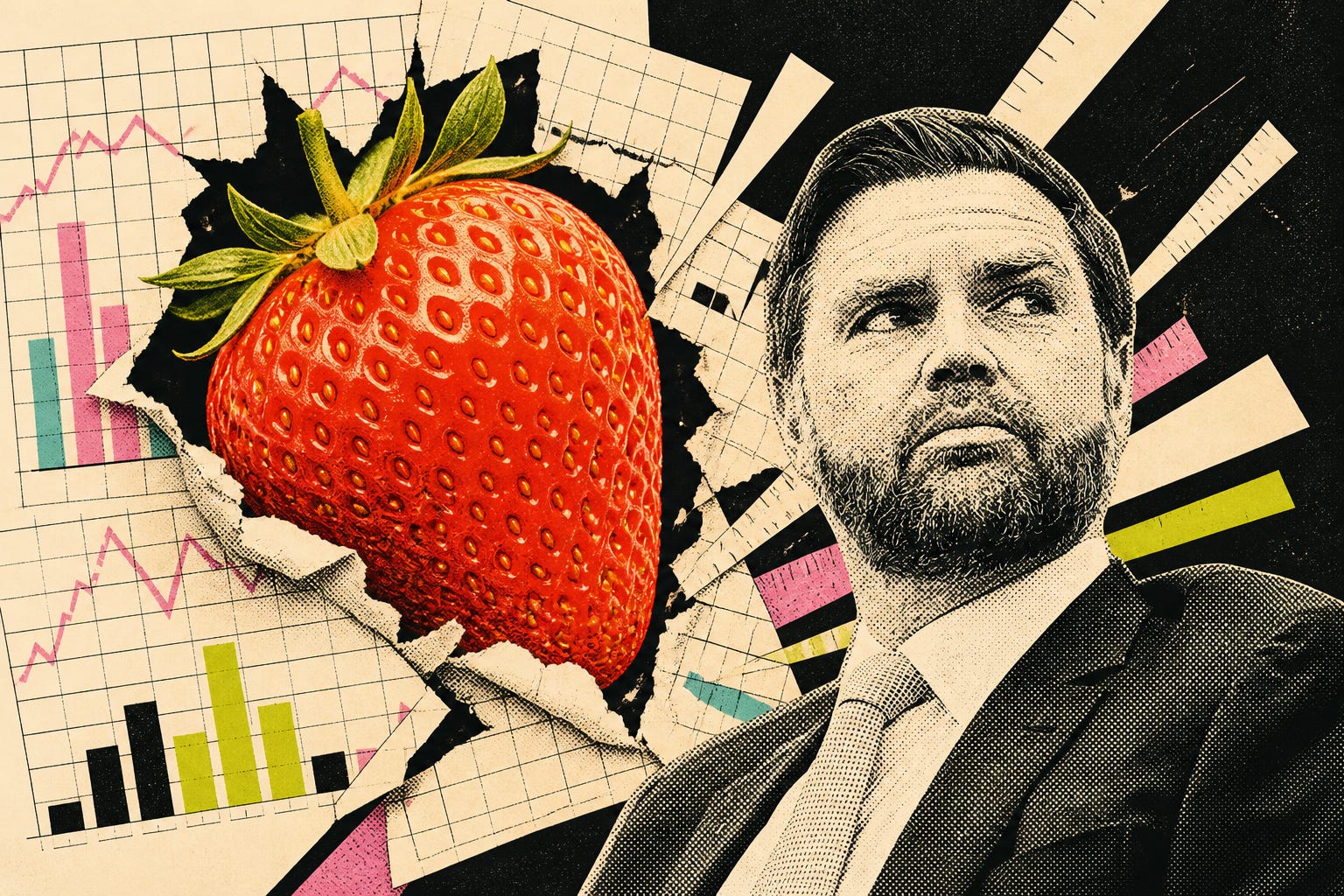
How a deeply confused hunt for Japanese strawberries one-shotted the vice president
Some years back, Vance went to Japan, where he had the opportunity to consume local strawberries. Each bite, he recalled, “tasted like the best strawberry you’ve ever eaten.” He had stumbled upon a famous feature of Japanese cuisine, where centuries of careful cultivation techniques such as hand selection for taste and appearance have transformed this common fruit into a renowned culinary delicacy that commands a premium price.
But this was not the lesson that Vance took from his meal. Instead, he attempted to extrapolate an eccentric lesson about economic measurement from his strawberry-tasting excursion: The existence of delicious Japanese strawberries somehow disproved the concept of GDP.
This head-scratching assertion initially led me to laughter, yet the next several paragraphs revealed that Vance was completely serious. He proceeded to lay out his case against GDP in a style befitting Captain Queeg’s similar obsession with the bright red fruit. As Vance explained:
“If you’re focused on GDP, a $6 pint of Japanese strawberries is no different from a $6 pint of American strawberries. If you’re focused on dollars and cents, each contributes equally to the economic indicators. But if everyone in Japan eats better strawberries than everyone in America, the economic indicators have failed to measure something meaningful.”
It was a peculiar discovery, and one that Vance eagerly shared with a friend who “asked me if I learned anything on my trip to Japan.”
“Yes,” Vance “snidely” quipped, per his own account. “Maybe economics is just fake.”
Except almost any economist could easily diagnose the many faults in Vance’s reasoning: It begins with the assumption that Japanese and American strawberries have identical prices. In reality, Japanese strawberries typically cost much more than the mass-cultivated produce-aisle versions in the United States. Choice Japanese specimens of the ultra-premium “Amaou” variety are known to sell for as much as $10 per berry, and grocery store packages of more common Japanese varieties go for substantially more than their American counterparts.
The Japanese strawberry market displays a classic example of what economists refer to as product differentiation on margins of taste, appearance, and even packaging — all with premium price tags and a niche consumer base of high-end food enthusiasts. Vance had mistaken two similar but quality-differentiated products for the same thing.
More importantly for Vance’s argument, GDP does not tabulate strawberry production by simply counting the number of berries produced — it measures the market value of their final sale. In the case of Japanese strawberries, the differences in taste and a multitude of other factors already register as part of GDP through their prices.
This type of mistake is common for Vance, who repeatedly tries to invalidate economic statistics that undermine his policy agenda.
In July 2025, Vance infamously tweeted, “It’s almost like the economics profession doesn’t fully understand tariffs” after a Producer Price Index (PPI) report came in lower than gloomy forecasts. But the PPI only measures stuff made in America — it excludes imported goods and the tariffs charged on them. Vance seemingly ignored all the other indicators that track tariff-responsive retail goods, showing unambiguous price increases in the wake of Donald Trump’s tariff policies.
But GDP, already conclusively debunked by the existence of Japanese strawberries, occupies a special place in his ire. Vance returns to this theme after griping that even family relationships between a husband and wife have been “infected by economics.”
In his mind, economists “struggle to put a value on anything that can’t be specifically measured” and respond by discounting its importance. Since family relationships allegedly fall outside of the measurable realm, they too succumb to the economists’ statistical tyranny.
GDP uber alles?
Vance isn’t alone in attacking GDP. He cites Oren Cass — the Harvard-trained lawyer who appointed himself as the “chief economist” of his own think tank, American Compass — as an influence. One of Cass’ main contentions is that the pursuit of growth statistics has created an “economic piety” that privileges consumerism over other unmeasurable tenets of life.
Of course, this whole thing is a straw man — no one is suggesting we sacrifice all that is good and meaningful on the altar of GDP. In fact, the U.S. regularly sacrifices growth in order to satisfy other goals. Most economists recognize some of those as bad — like stringent zoning codes that stifle growth in American cities — and others as good — like child labor laws.
Economic statistics don’t tell anyone what to do — they are just tools for measuring the effects of our choices. But, of course, Vance hates measurement too.
In a representative example from his book, Vance chastises the “language of technocratic cost-benefit analysis” and the “sanitized tone that is the hallmark of the dismal science” for allegedly supplanting moral considerations, even on quintessentially moral issues such as chattel slavery. If it wasn’t clear enough, cost-benefit analysis is the practice of tallying up the upsides and downsides of a policy and making sure the former column is bigger.
Just to put this plainly: The vice president of the United States and front-runner for the Republican nomination for president in 2028 is opposed to the concept of a pro-con list.
Vance isn’t searching for a better way to measure growth, though. He believes that measurement itself is a faulty task, that American society has gone astray by making other intangible values subordinate to numbers. Economists, he contends, have subjected us to rule “by numbers on a spreadsheet and the people who built those spreadsheets,” which leads to “a society almost blinded to considerations outside of the economic.”
One reason that Vance discounts economic indicators like GDP is that they don’t include unpaid domestic labor done by parents:
“Long before I ever held political office, it occurred to me that economic statistics often see kids as burdens despite the fact that they’re the best part of my life. Domestic labor—that done by moms and dads—if unpaid, is uncounted in measures like GDP. When I leave work to spend time with my children, when I cook them dinner or argue with them about eating their carrots, I am engaged in economically unproductive work. No money changes hands, so it doesn’t show up in our national figures. By contrast, if I left for dinner at 6 p.m. and returned to work until midnight while paying a total stranger to look after my kid, my contribution to GDP would be much higher.”
This hypothetical scenario is not merely speculative though, at least in Vance’s telling. He considers it to be the source of one of his main recurring objections to modern American society: the rise of two-income households. Vance is savvy enough to avoid prohibiting women from choosing to pursue professional careers, but it’s clear that he views the rapid expansion of female labor force participation rates since the 1950s as a consequence of GDP-driven “economic piety.”
As Vance explains, “a majority of women with small children wish to spend more time with their kids instead of at work.” But in our measurement-driven economy, “every one of these preferences is economically unproductive.”
Since household labor does not produce an exchange of money for goods or services, it does not contribute to GDP. Or, in Vance’s telling, “Each time you choose family time instead of working longer hours, you are doing something directly at odds with the cult of growth.”
The vice president has a long history of making offhanded comments that deprecate women pursuing professional careers. In a 2021 podcast for the American Moment group, Vance described this choice as a “path to misery” and faulted it for declining family formation.
He sees similar social ills everywhere, all attributable to reckless appeasement of “the gods of GDP.”
When seniors move into nursing homes instead of taking up multigenerational residency, it must be “for the simple reason that it’s not economically efficient.” “Every minute of a family member’s time spent tending to my great-grandmother was a dollar not spent paying someone else to do the job,” Vance explains. And “this reduces GDP.”
The Black Friday shopping escapades supposedly reinforce his indictment of “classical economics” as well, because they force service-industry employees to work a holiday shift in the name of “productivity” when they could be at home doing an “unproductive” task such as reading a book to a child. The relentless pursuit of GDP strikes again.
Barely a paragraph later, he shifts his line of attack to critiquing retailers for offering too few hours to these same employees and canceling their shifts on short notice. But the internal consistency of his argument does not matter, as he’s already settled on the relentless pursuit of GDP as the source of all problems.
Unsurprisingly, Vance’s claims do not hold up under empirical scrutiny.
For several decades, the Bureau of Economic Analysis (BEA) has provided detailed estimates of the economic value of household production, including unpaid work such as “cooking, cleaning, and child care.” Note that these are the very same “unmeasurable” tasks that Vance considers to be the Achilles heel of GDP. And yet, easily accessible reports from the BEA’s website not only measure them with a high degree of accuracy — they also estimate an “adjusted GDP” growth rate that incorporates these measurements.
If Vance’s story about two-income households were true, we might expect a sharp divergence between the growth rates of official GDP and the adjusted figure, including household production. Yet the BEA’s study reached a much more tempered conclusion: “From 1965 to 2020, the average annual growth rate of nominal GDP was 6.3 percent. When household production is included, this growth rate drops to 6.1 percent.”
Indeed, both the conventional and household-adjusted GDP growth rates have closely tracked each other since the early 2000s, with the lone exception of a temporary surge in the household figure during the COVID lockdowns of 2020.
No economist would ever maintain that GDP is a perfect measure of productivity, even after including the BEA’s household measure or any number of other accounting adjustments to the base data. But GDP-based measures do provide a useful approximation of a country’s output over time and, equally important, they strongly correlate with other indicators of prosperity and well-being.
Anti-empiricism offers a convenient escape from unwanted empirical data though, be it a BEA report that chafes with your claims about household production or numbers that show your flagship policies are not performing as promised.
For example, Vance and Trump have both made shrinking the U.S. trade deficit the pretext for their sweeping tariff agenda. They have cited this measurement across dozens of executive orders and court filings, even declaring it an economic “emergency.” Yet after more than a year of tariffs, trade deficits persist — exactly as many economists predicted they would.
Even by their own favored measure, the Trump-Vance tariff agenda has failed. And yet neither man shows any sign of changing course on this policy.
The same principle appears to be at play in Vance’s anti-GDP tirade. He views the measure as an incidental convenience if it shows positive growth but something to be conveniently overlooked if it delivers bad news. If an economic measurement suggests his policies have harmed the economy, it isn’t a failure — it’s just proof that other “unmeasurable” goals have taken precedence.
Or, as Vance puts it, “We care about GDP in the Trump administration, but we also care about wages, and how many people are dying of drug overdoses, and whether our country can get the things it needs in times of international emergency. If that means the GDP is a fraction of a percent lower, then so be it.”
The important point is not simply that Vance thinks GDP is an imperfect measure — nearly everyone does. It is what he believes follows from that observation.
Again and again, Vance treats the failure of economic statistics to fully capture family, community, national resilience, and other genuine goods as evidence that economic considerations have been granted too much authority in American life. (Notably, the American people rank cost-of-living and related economic concerns above almost every other issue, so Vance’s “populist” rhetoric does not even align with popular opinion.)
Vance has self-identified with the postliberal right, and it is his beliefs about GDP that most clearly link him to postliberal economics. Postliberals argue that the liberal fixation on economic growth actively crowds out higher goods, that politicians can and should have clear, prescriptive visions for what the common good is and impose that on the public even if that comes with severe economic costs.
Vance is comparatively guarded about where that logic leads. Other postliberal thinkers are not.
The road to postliberal degrowth
The same distaste for growth originally drew Vance’s friend and intellectual mentor Patrick Deneen to peak oil theory in the mid-2000s.
Convinced that he had discovered irrefutable proof of an impending resource depletion apocalypse, Deneen circulated a working paper that aimed to anchor his warnings in political theory. Mankind’s excessive consumption was a distortion of the “natural” order, as a global energy shortage would soon make clear.
Nature never reasserted herself — before the Iran War, the world was producing more oil than ever. Despite his falsified prediction, Deneen clung to his conclusions and repurposed them into an attack on GDP: we “are told that all is well because GDP and stock indices are higher, while unseen fellow citizens die in droves through suicide or self-medication amidst inexpressible loneliness.”

The culprit was “defenders of ‘classical liberalism,’” Deneen said, who “point to measures of economic and material success as proof of [its own] moral superiority.” These measures really concealed an “increasing, and even obscene, differentiation of wealth generated by the American economy and sanctioned by our political order,” all while making the public “indifferent to questions of the common good.”
Deneen would expand on this theme in a parallel article for Oren Cass’ group, American Compass: “The fact that advanced liberal democracies are wealthier has not translated into greater social health, but accelerated the decline of family, education, and religion.” Wealth was not merely a symptom but a cause of social decay, and recovery of the ill-defined “common good” that postliberals long for would require a willingness to forgo economic abundance in exchange for nonmeasurable things.
Elements of Deneen’s bromides against economic measurement appear throughout Vance’s book, although his most peculiar charge against GDP — its omission of household production and alleged incentivization of the breakdown in the family — has a striking resemblance to a more obscure source.
In early 2025, a near-identical argument appeared on the blog of the Claremont Institute, a California-based think tank that positioned itself as the intellectual wing of MAGA and has since shifted into a locus of postliberal theorizing. Written by Charles Haywood, the post lamented how “all discussion about the flourishing of our nation is reduced to GDP” — “an idol, a graven image we collectively worship.”
Haywood’s piece presages Vance’s own argument, often in nearly identical terms. He declared that GDP is “largely fake, disconnected from the actual production of value.” He then set out to “dethrone” this measure of prosperity by pointing out what he believes to be a devastating flaw in its tabulation.
As Haywood attempted to explain, “household work or a mother raising children, lacking a price, is not part of GDP—but a mother paying others to raise her children is part of GDP.” He went on to list other “unmeasured” forms of nonmonetary exchange around the household, or even subsistence production on small communal farms. He also considers many priced transactions to be “fake,” “arbitrary,” and “fictional” — they involve exchanges of products and services that he considers to have no value.
The full piece is an error-riddled jumble of the same economic fallacies found in Vance’s book: of chastising GDP for failing to measure that which it does not purport to measure, of confusing intermediary steps of production for unaccounted economic activity (GDP only registers final goods), of mistaking shifts in consumer preferences around fad products as “proof” that they had little value to begin with, and of projecting his own subjective tastes onto liked and disliked forms of production, declaring the latter to be objectively wasteful.
Long-acknowledged imprecisions of the metric become discrediting flaws, and simple descriptive accounting identities become nefarious and actionable strategies to coax American society into pursuing economic “growth” at all costs.
Haywood is substantially less guarded about the full extremes of his position than Vance. Haywood sees the pursuit of GDP as the source of two-income households — specifically “the socially coerced entrance of women to the price-mediated workforce” since the 1960s, whereas their previous position in the “household economy” was “not captured in GDP.” The result is a “deliberate political program” to erode conventional family arrangements, “which absorb resources yet produce what cannot be measured.”
The corrective, it follows, is degrowth with a right-wing spin: “We have all been propagandized for decades that a slowing in the rate of GDP increase is bad, and a drop in GDP is a catastrophe. Why, though? In fact, we would all likely be better off with a much smaller GDP, as currently measured.”
Even for a movement populated by reactionary eccentrics, Haywood is a bit of an oddball who likes to say the quiet parts out loud. His politics display clear authoritarian and conspiratorial tendencies.
He has long advocated a model postliberal society based on Spain’s mid-20th-century dictator Francisco Franco. He tweeted out an endorsement of a speech by Thomas Rousseau, founder of the white nationalist “Patriot Front” organization, after Rousseau led a masked march through Washington, D.C., on July 4. Haywood is also a devout follower of Nazi legal theorist Carl Schmitt (although he adamantly denies the easily verifiable fact of Schmitt’s Nazism), and views Schmitt’s theories on centralized executive power as a corrective to the flaws of U.S. constitutionalism.

In addition to offering heterodox theories about GDP, Haywood is a prominent funder of the political network around Vance. After selling a hair care products company in 2020, Haywood began disbursing the proceeds of his fortune through an entity called the “Howdy Doody Good Times Foundation.” The foundation’s tax records show that it’s a repeat donor to several groups in the postliberal universe, including the aforementioned Claremont Institute.1
In 2021, Haywood authored a bizarre political “manifesto” offering a chilling glimpse into how postliberals understand the relationship between government and the economy (the document has since disappeared from the website of the Vance-aligned group that republished it, although it may still be found on his personal website). In it, Haywood calls for the complete “subordination of economics to politics,” thereby placing market exchanges in the service of an amorphous “common good.”
Economics occupies a distinctive place in the postliberal worldview as an amoral excuse to shirk what its adherents see as a natural and virtuous order for society. Postliberals, from Deneen to Haywood to Vance, all depict free markets as a pathway to personal avarice and morally unconstrained consumption. They see the role of the state as bringing economic considerations under its own domain, where — through postliberals’ own “virtuous” statesmanship — it can be redirected to the “common good.” And they believe that 20th-century American conservatism lost sight of this objective, placing restrictions on the functions of government whenever it threatens to interfere with GDP growth.
And what exactly should happen if people disagree on postliberal definitions of the common good? If families simply want to earn more money instead of keeping mom home after having kids? If a nursing home truly is the best available solution for elderly care? Too bad.
Postliberal economic thought ignores that most conventional indicators of government intervention in the economy — spending, regulatory burdens, size of the state and local bureaucracy — have grown, belying the notion that the last 40 years have been some sort of austerity-driven, deregulatory “neoliberal” paradise.
But the facts really don’t matter here. The postliberals leave no room to disprove their own worldview, which will be exceptionally dangerous if they ever truly take power. Traditionally, if a president decides to enact his agenda, and GDP falls or inflation takes off or unemployment is on the rise, they seek to course correct. Sometimes they act too slowly or ineffectually, but they are nevertheless consistent with the understanding that it’s better if people are richer and worse if they are poorer. That does not capture everything that matters, but it captures a lot of what does.
Under Vance’s leadership, however, what will convince him that his policy agenda is hurting the American public? As the vice president puts it, GDP and other empirical indicators of economic prosperity allow “false prophet economists to argue the American Dream is healthy” when he already knows otherwise.
It’s a convenient card to have in his pocket when his own suite of tariffs cuts into our wallets at the checkout lane, when his budgetary profligacy saddles the next generation with interminable public debt, when his political allies take public stakes in private companies, and when his regulatory designs inject postliberal politics into every boardroom, just as woke politics did a decade before.
Recommended reading:
I don’t need you to believe I’m a woman

Cassie Pritchard confronts the painful reality that many of the people with whom she shares a country will never believe she is a woman. Rather than seek their affirmation, Pritchard demands something less intimate and more important: That they defend her freedom and security anyway.
God, Orban, and JD Vance

Why did the vice president of the United States campaign for a foreign autocrat?
Haywood's foundation also donated to the Edmund Burke Foundation, which runs the postliberal-aligned “National Conservatism” conference, and American Moment, a youth outreach organization set up by a group including two Vance proteges in 2021. Vance was a founding member of the group’s board and remained active in its operations until his election as vice president. Haywood also funds a flurry of Christian Nationalist projects with Nate Fischer, a Texas-based financier who’s personally close to Vance and equally active with Claremont.
What makes me angriest about Vance is that I'm convinced he knows better, and is a purely cynical power-seeker. He knows that he sold his soul and that these ideas are stupid, but they were a gateway to power, so...
As has been pointed out many times, without economic growth the only way to make your situation better is to make someone else's situation worse. Surely that's going to make it more difficult to live together.