


Welcome to The Closing Argument, our verdict on the news, plus everything The Argument published and appeared in this week.
The Verdict, by Jerusalem Demsas
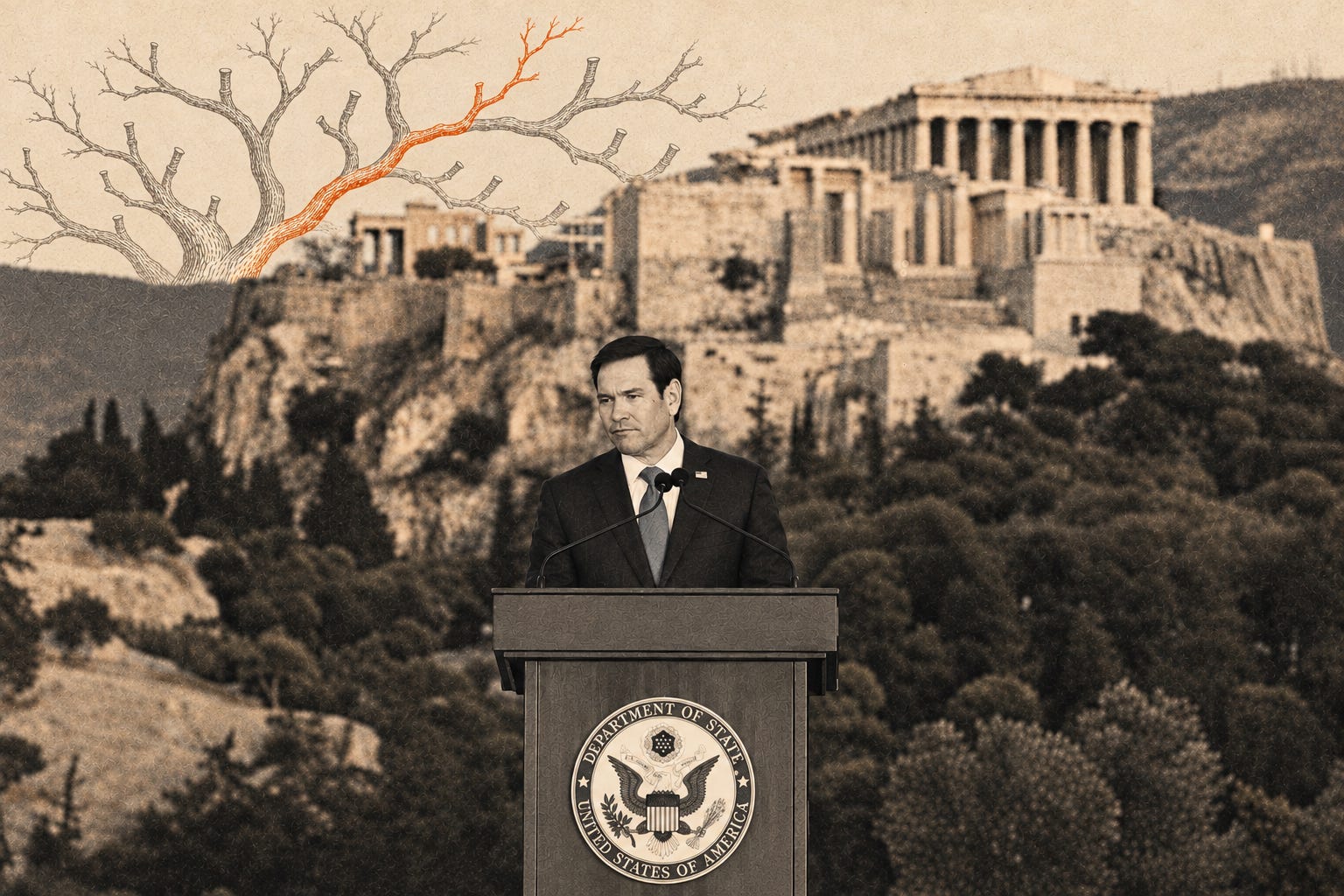
Earlier this week, in front of the ruins of the Acropolis, a son of Cuban immigrants claimed the mantle of Western civilization.
Secretary of State Marco Rubio stood on the hill where, once a year, the Athenian assembly voted on whether to banish any citizen who had grown too powerful. There he gave a speech in praise of “the great man: the exceptional individual who obtains immortality through his own deeds.” Rubio argued that the ancient Greeks idealized this type and organized all of civic life around “contest, ambition, competition.” Their thumos, “the fire of passion, strength, courage, pride,” was “the heart of great civilization.”
In Rubio’s telling, the fire is inherited. The greatest Americans, he says, “carried the unmistakable features of their forefathers — born in Athens, formed by Rome, baptized in Christendom.” Rubio casts this inheritance in the language of bloodlines, making a civilization of ideas sound like a family pedigree. Yet, for something supposedly in his blood, “Christendom” trips awkwardly off his tongue; twice he pronounces it like a child encountering the word on the page for the first time. (“Chris, ten, dom.”)
Rubio argues that the modern West has lost touch with the spirit that animated the Greeks: “Over time, we in the West came to feel ashamed of the very things that made us exceptional. We felt embarrassed that our achievements set us apart from the rest of the world. Our prosperity somehow became a source of guilt.”
I am a big fan of Western civilization. That’s why I refuse to let the Rubios of the world mangle its history and values. He has the Greeks backward on two counts.
Let’s start with thumos. The philosophers Rubio cites did prize spiritedness, but Plato thought those impulses needed to be governed by reason. In The Republic, thumos is reason’s “ally”: It should help us act on our judgement, rather than overpower it. Plato argued that when thumos, or the pursuit of honor, becomes a society’s highest goal, as it was in Sparta, that was the first stop on the road to tyranny.
In the Laws, Plato’s last word on politics, the highest good is “peace one with another and friendly feeling,” and courage ranks “no higher than fourth” among the virtues. When Plato sorted the world’s peoples by their dominant trait, he gave spiritedness to those the Greeks saw as barbarians (Thracians and Scythians) and love of learning to the Greeks. The very trait that Rubio venerates was, in Plato’s account, more characteristic of the people Greeks considered barbarians.
Athens built that lesson into its institutions. The Athenians were terrified by excessive ambition, which is why they created restraints. They were so worried about the destructiveness of unchecked great men that they reserved the right to banish them from Athens.
Rubio also provides a confused recounting of Greek “nationalism.” Modern western nations have treated nationalism like a “dirty word,” but the Greeks can apparently teach us better; they “knew that there was nothing selfish or wrong about loyalty to your nation.”
But the Greeks famously had no nations to be loyal to. They had cities that fought against one another for most of the classical age. James Madison laments that disunity in Federalist 18, and in Federalist 9, Alexander Hamilton writes that it’s “impossible to read the history of the petty republics of Greece” without “horror and disgust.” The solution? A “firm Union.”
When Athens did pursue “national power” without apology, historians chronicled the devastating results: Athens massacred the islanders of Melos for refusing to submit, lost its army and fleet invading Sicily, and eventually surrendered. The Greek lesson about nationalism is a warning for the future, not a playbook handed down through the centuries.
In The End of History and the Last Man, Francis Fukuyama invoked thumos because he worried that the very spiritedness Rubio celebrates could turn against liberal democracy. Citizens dissatisfied with modernity’s comforts might “struggle for the sake of struggle” — against peace, prosperity, and democracy itself. Perhaps Rubio is auditioning for the role of Last Man in search of a struggle.
Rubio’s second major error is his account of the role of kinship, and here Rubio’s speech refutes itself in a single aside. “The city where our Constitution was born — Philadelphia — is itself a Greek name,” Rubio notes, in order to firm up his connection between America and ancient Greece. For Plutarch, whom Rubio calls the Federalist Papers’ most-cited author1, philadelphia meant the love between actual siblings.2
American history tells a different story. When the Quaker William Penn gave the name to Pennsylvania’s capital, he was calling on the early Christian idea of brotherly love, which extended to strangers: “Be devoted to one another in brotherly love,” the apostle Paul wrote to a church of Jews and gentiles.
Penn was founding a refuge for Quakers, Huguenots, Mennonites, Lutherans, and Catholics whose only common ancestry was religious persecution. It’s ludicrous to cite the name he chose to claim that Americans are united only by blood. Philadelphia is a Greek word for a Christian idea, chosen by an Englishman for a city built on the premise that strangers could be brothers.
This is the West that Rubio belongs to.
In 2019, Rubio went on the PBS genealogy show Finding Your Roots and discovered that he wasn’t the first in his family to graduate law school. That honor likely belonged to his great-great-great grandfather who graduated from the University of Granada with a law degree in 1786. On his mother’s side, Rubio has a great-great-great-grandmother who was Native American.
Rubio’s claim to Western civilization does not run through a prosecutor in 18th-century Seville. It runs through the ideas that shaped his life and the institutions of the country his parents chose when they immigrated from Cuba. Abraham Lincoln said as much in 1858, defending immigrants with no ancestral tie to the founders; they have a right to claim the Declaration “as though they were blood of the blood, and flesh of the flesh of the men who wrote that Declaration, and so they are.”
Holding these views does not make one any less of a patriot. Lincoln was a nationalist, and so were the men who wrote NATO’s charter, which pledges to defend “the freedom, common heritage and civilisation of their peoples, founded on the principles of democracy, individual liberty and the rule of law.” The argument isn’t about whether you should love America (you should) but what makes you an American to begin with.
The explicit purpose of Rubio’s visit — the sixth U.S.-Greece Strategic Dialogue — flew in the face of the ideas he delivered in his speech. The agenda covered F-35s and F-16 upgrades, routing American natural gas into Europe through Greece, and a new counterterrorism information-sharing agreement. Every agenda item was a product of the liberal international order: open trade between nations, collective defense among allies, and law-enforcement cooperation built on the shared assumption that two democracies can trust each other’s courts and police.
Rubio is hardly the first member of the Trump administration to begin flirting with blood-and-soil nationalism. Vice president JD Vance has argued that America is not a set of principles but a homeland measured by the generations buried in its earth.


Some hoped Rubio could chart a different course for the Republican Party once President Trump is off the scene. But this speech confirms that the leading lights of the right are increasingly in thrall to a version of Vance’s post-liberalism, an anti-American ideology that mangles our histories, customs, and values in service of a pedigree so narrow that its own champion had to leave out his parents’ birthplace to claim it.
Midterm update
Lakshya Jain, our director of political data, uses data from The Argument’s polling operation to inform the Split Ticket 2026 House and Senate models. Here’s his update on the state of play this week:
The picture in the House is stable, as Democrats remain heavy favorites to win back the chamber with a win probability of 89%. That’s an even better situation than they faced in 2018. In the Senate, Democrats have a slight but growing edge, with a 65% chance of winning the chamber — that’s an all-time high for this cycle. The picture suddenly looks so good for them that even Kansas is barely in the Republican column at the moment. We’ve been here before, and the model has a lot of uncertainty baked in because of the potential for a systematic polling miss. But even with that, you’d rather be the Democrats.
These models update every day; bookmark this page to see the odds of each party taking the House and the Senate.
Top stories this week, by Maibritt Henkel
Accelerating the federal permitting process is great news for clean energy and grid expansion, but not all climate groups are happy about the Senate bill introduced last week. The Center for Biological Diversity (CBD) has strongly opposed the Bipartisan American Affordability and Jobs Act on the grounds that it rolls back environmental protections and allows for fossil fuel expansion. Jerusalem Demsas saw this coming. She argues that the CBD has a long and well-documented history of shutting down infrastructure projects, even ones that would significantly reduce carbon emissions, in the name of protecting endangered species. But does the organization really want more amphipods in Rock Creek Park? Or does it just want fewer humans?

Technology is not in itself progress. Derek Thompson reminded us of this fact in his guest essay this week. The printing press, the power loom, the radio — all of these technologies would go on to change society in positive ways, but only because government and civil society channeled them toward human well-being through regulation and adaptation. Before British cities developed the infrastructure to handle the sudden influx of rural workers, the Industrial Revolution was a complete and utter nightmare. First there were piles of human waste rotting in every basement; then there were sewage systems and paved streets. The AI era now needs an institutional and regulatory response that turns disaster into progress.

While the story of the 2026 midterms seems more or less written by now, the story of 2028 certainly isn’t. In his column this week, Lakshya Jain laid out what we know so far about the electorate that will determine the next president in two years. The numbers currently bode well for Democrats. The voters who secured Trump’s victory last time around are now turning on him in droves: net approval with registered Hispanic voters sits at -37. With young voters, that number is a startling -45. Time will tell whether Democrats manage to convert this disapproval into votes for their own side.

🌟Abundance Wins of the Week🌟
There is a new kind of solar panel gaining ground in the U.S., driven by a push to beat China in clean-energy manufacturing. These so-called tandem panels combine a mineral perovskite top layer with a silicon bottom layer and can generate up to 25% more energy than standard panels. This technology would allow energy companies to produce more electricity using the same number of resources.
The 2026 Nobel Prize in medicine was awarded to Karl Deisseroth, Peter Hegemann, and Georg Nagel earlier this week for optogenetics, a technique that Reuters described as using “light to control individual nerve cells in the brain.” The technology is already in early clinical trials for blindness.
Detroit officially opened the first phase of a new building project that will turn seven historic buildings into 170 residential units in the city’s Cass-Henry neighborhood. The project has been years in the making. The goal is to expand housing opportunities while also restoring part of Detroit’s history.
Worth watching…
Chinese President Xi Jinping visited Washington, D.C., a few weeks ago. On the podcast this week, Matt and Jerusalem have on ChinaTalk founder Jordan Schneider to discuss what the peculiar Trump-Xi summit actually amounted to (not much), how AI is shaping geopolitics (profoundly), and whether a dystopia of immortal dictators is possible (bad if true).
And if you can’t get enough of either AI and China, then don’t miss Kobe Yank-Jacob’s conversation with Lei Wang, a Carnegie Scholar who works on AI industrial policy. They discuss the fact that the two countries have very different conceptions of AI “safety”. For the Chinese Communist Party the biggest concern is losing control of the information that AI models put out. That is not the main fear in the US where information generally flows much more freely. This poses a challenge when it comes to collaborating with the CCP on incident reporting and other safety measures.
Permitting reform has been the talk of the town this week. Milan Singh read all 417 pages of the BAAJA legislative text so that you don’t have to. In a Substack Live conversation, he talked to Daniel Palken, director of infrastructure for energy and permitting at Arnold Ventures, and Pavan Venkatakrishnan, a policy fellow at the Searchlight Institute, about the motives behind the bill for each party and what the bill would accomplish if signed into law.
What’s News with The Argument
The Argument recommends, by Maibritt Henkel
With Columbus Day coming up, I thought I would ask the office for their favorite works produced by canceled individuals. Please don’t get mad at them for their pre-woke guilty pleasures.
Jerusalem Demsas went old school. She recognizes that the Tintin series was “undoubtedly chock-full of racist and colonialist content” but simply has too many fond memories of flipping through the books to entirely relinquish them. She also read Agatha Christie’s And Then There Were None before knowing about the “uh original name” and said it’s still worth reading if you like mysteries.
Jeremiah Johnson went for the 2010 Kanye West (not yet Ye) album, “My Beautiful Dark Twisted Fantasy,” which he called “one of the best albums of the last 25 years,” and added: “it’s incredible on every level: the production is gorgeous, the beats are so layered and complex, and the whole album revolves around Kanye’s introspection about how much of an asshole he is.” He acknowledged that things really started to go downhill after that. (Milan Singh also wanted to get in a Kanye rec while he had the chance. He recommended the song Saint Pablo “bc it has bars.”)
Senior editor John Robert Thomason wasn’t sure Sam Bankman-Fried’s Stanford Law professor parents were canceled alongside their son, but either way, he recommends Barbara Fried’s Facing Up to Scarcity, a “book-length defense of consequentialism that’s surprisingly brisk and compelling.” Does it address the question of whether it’s justifiable to start a scammy crypto company? “No,” John said, “but it also doesn’t not address that question.”
Kobe Yank-Jacobs played things a little safer. He recommended comedian Aziz Ansari’s apology special, Aziz Ansari: Right Now, because it is “one of the most humane, life-affirming artifacts of recent media I can think of.” And because he is a “canceled artist you won’t get canceled for liking.”
Video producer Justin Zuckerman recommended Franny and Zooey by J.D. Salinger, who he believes is canceled. Either way, “it’s a great combo of two short stories about trying to find meaning in a world that seems meaningless.”
I grew up with two American movies saved on my family laptop: The Three Musketeers adaptation from 1993 and, well, Gone With the Wind. There are certainly better ways to learn about the antebellum South, but looking back I am glad to have had that early exposure, even if it was imperfect. And man, it really is an incredible feat of 1930s cinema. I will forever have the burning of Atlanta seared into memory.
We have merch!
We have quarter-zips, keychains, hats, and stickers. Each one is a great conversation starter in its own way. Buy them here.
More to read:


I did not personally check this but Rubio’s claim here appears to be wrong — Montesquieu was. This error wasn’t random. Rubio’s speech jumps from “the furnace of medieval Europe” to the “English genius for liberty” and the only time Rubio even mentions The Enlightenment is to deny that Enlightenment philosophers mattered to the founders. Skipping the Enlightenment lets them skip classical liberalism, the philosophical tradition that actually made the West what it is today. Curious!
In “On Brotherly Love,” Plutarch argues that brothers should share resources, support each other, forgive quarrels, and take pleasure in each other’s success. He worries about competition for wealth, office, and reputation. Brotherly love meant restraining the envy and ambition that could tear a household apart.
Perhaps what bothers me the most about all this extremely naive classic-philosophical cosplay is how thinly-veiled the craving to participate in it is as a proxy for a deeper meaning-providing cultural worldview. The Christianity both Rubio and Vance espouse is plainly no longer normative, and instead of simply accepting that, they both crave roles as contemporary heirs to Hamilton/Madison/Jefferson in ushering forth a new ideology into political reality.
The difference of course is that Hamilton/Madison/Jefferson were languishing under the tyrannic English monarchy, whereas Rubio/Vance evangelize a spiritual need in search of a problem.
Those direct-descendant Greeks were among those targeted by the Immigration Act of 1924 because (from Wikipedia), they "arrived sick and starving, were less capable of contributing to the American economy, and were unable to adapt to American culture"
Jews, Slavs, Italians, etc. also were seen this way.
I'd be interested for a reporter to ask Rubio if he thinks that Jews, Poles, Italians, Greeks, and others haven't contributed to the American economy and haven't been able to adapt to American culture, as proponents of the Immigration Act of 1924 argued.