


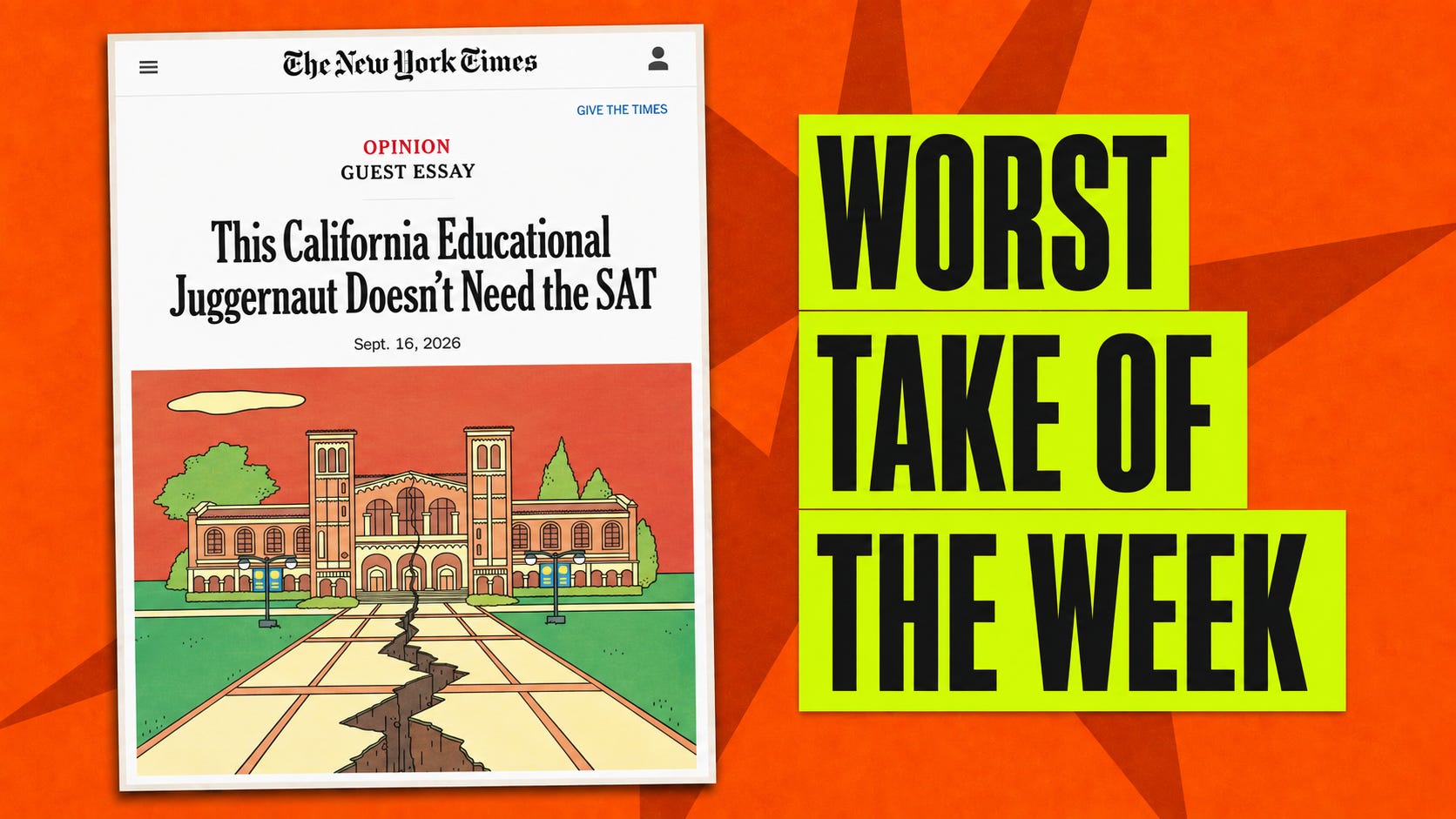
Welcome to The Closing Argument, our verdict on the news, plus everything The Argument published and appeared in this week.
The Verdict, by Kelsey Piper
Worst Take of the Week is a new occasional column where the author will rant about something we found stupid, annoying, bad, and/or irritating. While the title of this column was necessary for palindromic reasons, we cannot promise that entries will come out weekly or that each piece will literally be the worst take that week; this column would be boring and repetitive if each week we explained why genocide is bad in response to Twitter user @Nazi1488LoveHitler.
If I were to come up with a straw man caricature of the worst imaginable progressive ideas on education, it would sound something like this: “Sure, our kids can’t do basic math. But a successful education system isn’t one that teaches math. It’s one that hands out degrees to everyone. We are handing out more degrees than ever, so we’re succeeding.”
But this is precisely what longtime California journalist Miriam Pawel just argued in an astonishing op-ed in The New York Times. The piece calls on the University of California (UC) Board of Regents to override faculty requesting the SAT be restored as a requirement for admissions. Hundreds of UC faculty are saying that their jobs have not been doable since the SAT vanished. Pawel thinks the faculty are wrong and California’s system is working just fine.
“Students on University of California campuses may struggle with basic math, but they are graduating at record rates,” she wrote.
As a California resident myself, I hope Pawel and I agree that our universities should nurture students’ capabilities and grow their knowledge. If that part of their mission is broken, it’s no defense that they are handing out lots of diplomas.
As UC Berkeley political science professor Sean Gailmard observed: “It’s an astonishing mindset that teaching analytical skills and granting credentials are two distinct, severable things that universities do, *and* the second is the important one.”
Pawel’s position — and the reluctance of the UC Board of Regents to restore academic standards for admission — is not just a cynical, impoverished view of what college is for. It is also incredibly shortsighted. If students at UC schools are less capable than ever but graduating at higher rates than ever, the obvious conclusion is that standards are being lowered in order to achieve the desired graduation rates.
Recall that many in the recent crop of UC students admitted without standardized test scores struggled even in middle school remedial classes, and that some cannot add fractions; we’re not talking about mastery of calculus here.
Employers, and even employers in non-STEM fields, expect graduates of elite universities to be competent with basic math skills. If I were considering hiring a candidate who attended a UC school, Pawel’s op-ed is an extraordinarily strong argument that I should not consider their degree to be a credit to them. (Some majors are still rigorous, but they can’t all be if students are both less capable than ever and more likely to graduate than ever.) If you extrapolate this situation — with no test for academic readiness at admission and pressure to graduate everyone admitted — there will ultimately be no reason to believe a graduate of a UC school is any more qualified for a job than a person who never went to college.
Pawel’s entire argument for the importance of public access to the UCs is that they are engines of economic mobility for the poor. But the way in which they have, for their whole history, actually functioned as engines of economic mobility is by providing an excellent, rigorous education and reflecting strong evidence of skill in their degrees. The degree has communicated that the person who holds it is competent and qualified, has worked hard, and has learned a lot.
If degrees cease to communicate those things, then the UCs will no longer be engines of economic mobility at all.
Pawel acknowledges that it’s a big problem that so many California students lack basic math skills. But she dismisses admitting qualified students as “harvesting the best and brightest in a troubled system” and argues that, instead, the universities should have a plan to serve all Californians.
She is, apparently, unaware that this plan is already in place (an alarming oversight from the author of a forthcoming book on the “Making and Remaking of the University of California,” which has been approvingly blurbed by Jerry Brown and Kareem Abdul-Jabbar). California has a so-called Master Plan to achieve some of the best university access in the country, which it successfully executed over the course of decades after the plan was adopted in 1960.
As a result of the plan, all students can be admitted to a California community college and can frequently attend at no charge. And if they want a bachelor’s degree, students with tolerable high school grades can also attend California State University schools — those too are free for many students after financial aid.
The vision that long guided the university system was that the community colleges and Cal State schools would provide free college for everyone, while the UC schools would provide the state’s top students with a world-class education competitive with Stanford, MIT, or any Ivy League school. Crucially, the system was also designed to provide greater opportunity at every stage: Successful students at the lower-tier schools could transfer to more competitive schools when they were prepared for them.
It is common for ambitious students without a good high school transcript to start in a community college and then transfer to a UC: Nearly one-third of entering UC students are transfers, and 94% of California resident transfers are from community colleges. I think that is a fantastic feature of our system.
We can offer education to everybody without locking anyone into a prescribed path and without lowering standards at top schools — and we know that this can be done because we’ve been successfully doing it for decades! The California university system is an extraordinary achievement in which we should take great pride.
The only thing wrong with it is that a few misguided ideologues think that UC Berkeley and UC San Diego can provide a world-class education competitive with any Ivy League school even if their admitted students are not prepared to do any of the coursework. But they cannot.
The ability of these institutions to do their jobs is not infinite. Their incredible reputation requires a student body prepared to achieve at a high level, and it will collapse very rapidly if their student bodies cease to be qualified to do the work.
Well-qualified students with enough family money will just go to top-tier schools in other states instead. The victims of Pawel’s worldview will be the poor kids who are also well qualified — but who are regrettably stuck entering adulthood in a California that is no longer willing to admit that their talents matter.
Midterm update
Lakshya Jain, our director of political data, uses data from The Argument’s polling operation to inform the Split Ticket 2026 House and Senate models. These models update every day; bookmark this page to see the odds of each party taking the House and the Senate.
Top stories this week, by Maibritt Henkel
Everyone knows former FTC Chair Lina Khan has a problem with Amazon. She has long accused the e-commerce behemoth of engaging in monopolistic practices. In his piece this week, Milan Singh largely agrees with this diagnosis. But he argues that the proper remedy isn’t to break up Amazon, as some antitrust proponents would like, but instead to make sure the company can’t punish sellers who offer cheaper prices elsewhere.

Medicare for More doesn’t have the same ring to it as Medicare for All, but Eli Richman has a proposal that he thinks can please any liberal who wants to expand health care access: disease entitlement. He says we should expand the entitlement program so it covers people with the kinds of chronic illnesses that strike patients more or less at random, as the federal government did with end-stage renal disease in 1972. Type 1 diabetes turns out to be a particularly good candidate for the next expansion.

Few fault lines feel as clearly defined as the one that runs between pro-life and pro-choice Americans. And yet, as Leah Libresco Sargeant argues in her guest essay for our one-year anniversary series, the over 1 million embryos currently in storage across the U.S. could upset the current stalemate in the politics of reproduction. Excess embryos are largely inevitable byproducts of in vitro ferilization, a procedure that is poised only to grow in popularity as Americans decide to have children later. “As time goes on, more and more children will grow up and inherit the duty to decide what to do with their potential siblings,” Libresco Sargeant writes.

🌟Abundance Wins of the Week🌟
The city council in Bellingham, Washington, voted to streamline permitting for permanent affordable housing projects in the city — and to exempt such developments from “most zoning and land use regulations.” The new measure relieves qualifying projects of height, density, and parking requirements, as well as mandates to includes space for commercial businesses.
Just down the road in Seattle, the city’s light rail agency just announced a 40% boost in ridership following a major expansion in March. In just three years, the agency has increased the number of stations it serves by 65%; each weekday now regularly sees over 200,000 boardings. While this capital expansion has increased ridership, so too has the agency’s “Safe, Clean, and Welcoming Ride initiative,” which focuses on rider experience factors like “clean stations, working elevators and escalators, [and] visible staff.”
Airbnb launched a new $250 million housing construction fund intended to provide incremental capital to stalled projects. The fund will help restart developments that have cleared most regulatory hurdles but have been held up because of insufficient financing. The first $6.4 million is going toward affordable units in Austin, Texas.
Worth watching…
On this week’s podcast, Matt and Jerusalem discuss Friedrich Hayek’s most famous work, The Road to Serfdom, a 1944 jeremiad against central planning. The economist, who would go on to win the Nobel Prize in 1974, was a fierce defender of free-market capitalism. His main claim was that central planning and the undercutting of economic freedoms inevitably fuel totalitarianism. Was he right?
Lakshya Jain and VoteHub’s Zachary Donnini were recently joined by Rep. Brendan Boyle, D-Pa., on Substack Live. Boyle, a self-declared “Pennsylvania Supremacist,” gave his thoughts on the midterms, the controversies surrounding Sen. John Fetterman, and former Vice President Kamala Harris’s snub of Gov. Josh Shapiro when she was choosing a running mate in 2024.
What’s News with The Argument
The Argument recommends, by Maibritt Henkel
Because we celebrated The Argument’s one-year anniversary with a party on Thursday, I asked the office for birthday-themed culture recs.
Jerusalem Demsas recommends the 2004 classic 13 Going On 30, a film about 13-year-old Jenna, who wakes up after her disastrous birthday party as a 30-year-old played by Jennifer Garner. Here is what Jerusalem had to say about it: “Most movies by and for teens are very doom-y about getting older, and this one made me excited about gaining more agency and self-possession without losing the whimsical parts of being a kid.”
John Robert Thomason burned a birthday-themed CD for his best friend in ninth grade. He recommends the opening track: “Unhappy Birthday” by The Smiths. “Thankfully she thought it was funny,” he recalls.
Jeremiah Johnson says he particularly enjoyed the “Too Much Birthday” episode of the hit TV show Succession, describing it as “one of the most miserable birthday parties ever put on screen.”
Megha Fernandes actually has an entire list of birthday episodes from her favorite TV shows. She watches them every year during the week of her birthday. Just a few examples:
Friends season 7 episode 14: “The One Where They All Turn Thirty”
Gilmore Girls season 1 episode 6: “Rory’s Birthday Parties”
New Girl season 3 episode 13: “Birthday”
Modern Family season 1 episode 19: “Game Changer”
Justin Zuckerman recommends Harold Pinter’s The Birthday Party, a play about “two strangers who show up on a guy’s birthday and create chaos.” He first read it in a college drama class and calls it “absurd and original in the most entertaining way.”
The only birthday-related media that came to Eli Richman’s mind were the horror movie Happy Death Day and the role-playing video game “Clair Obscur: Expedition 33.” He admits that both are pretty “horrible examples for celebrating an anniversary,” but I think he deserves credit for out-of-the-box thinking.
Kobe Yank-Jacobs recommends birthday bike rides. He tells me that two of his last three birthday parties have been group bike rides to the beach or an overnight “bikepack.” (If you have never used that word before, you are not alone.) His pitch is pretty compelling: “It’s kind of impossible for people not to be in the birthday spirit when everyone is noodling around together, stopping here and there for a beer on the way.”
Turns out Angela is also a bit of a party visionary. For her birthday this year she co-hosted a First Council of Nicaea party (the Ecumenical Birthday Council, to be specific). This involved “bestowing everyone bishop titles, canonizing new core beliefs of Christianity, writing them on scrolls, passing around a heretic hat, etc.” She highly recommends specific, fun, and weird party themes.
Personally, I am a big fan of the birthday poem genre. One of my favorites is Richard Wilbur’s “For K.R. on Her Sixtieth Birthday,” which was written for fellow poet and critic Kathleen Raine. Here is the opening stanza:
Blow out the candles of your cake.
They will not leave you in the dark,
Who round with grace this dusky arc
Of the grand tour which souls must take.
We have merch!
We have quarter-zips, keychains, hats, and stickers. Each one is a great conversation starter in its own way. Buy them here.
More to read:
The election experts and the models can’t both be right

Since The Argument and Split Ticket released our 2026 midterms model, I keep being asked the same question: “Isn’t that awfully optimistic for Democrats?”
One policy that unites liberals and conservatives

The Argument's issue polling suggests that a successful electoral strategy could involve increasing the salience of popular government spending programs but treading with more caution on polarized fights over ideology and culture.
Arguably the worst dimension of the whole deal with the UC situation is that it is *actively antithetical to equity goals*, on top of the self-evident absurdity. If no one hires UC graduates because they know the degrees are nonsense, how is that any good for disadvantaged graduates?
Strong agreement here.
I wasnt ready to go right into college after high-school so I joined the army instead.
The army REALLY sucked, but when I got out I was more than ready to go to college. I went to a CC first, took the remedial classes I needed to, then transferred to UCSB
Later I got my CPA and MBA.
I got a great education at the CC. In many ways the classes were better than at UCSB. Smaller class sizes and the semester instead of quarter system.
Plus I saved a LOT of money. Moreover I was not ready to go directly to UCSB. I needed the solid foundation.
There's nothing wrong with going directly to a CC first, and for most kids its probably the better choice