


Quick note before we get to today’s piece: The Argument is expanding, and we’d love for you to be part of it. We’re adding an elections blog, deeper dives on abundance and policy, and more — plus we’ve just brought on our first class of writing fellows. If you want all of it delivered straight to your inbox, click here and opt in to the full magazine by clicking “The Mag”.
If you’re happy as you are, read on.
After Abundance the book was released, a wave of criticism rose from ostensibly pro-housing writers arguing that obsessing over housing regulations was at best, irrelevant, and at worst, evidence of nefarious intent.
Leftist author Malcolm Harris argued that while various regulatory reforms like “permitting single-stair apartment buildings” are “strong housing reform ideas” he likens them to “piss[ing] in a ditch and call[ing]it an ocean of lemonade.”
Zephyr Teachout, a stridently anti-abundance left-populist and former candidate for governor of New York, called reforming these rules “small-bore.”
The Washington Monthly’s Paul Glastris and Nate Weisberg have a helpfully-titled review (for my article, that is), “The Meager Agenda of Abundance Liberals,” which calls permitting reform “wildly insufficient to the immense tasks at hand.”
Anti-abundance arguments often begin by claiming that regulatory reform is a marginal part of resolving the housing crisis. (Perhaps a good analogy is that it’s like trying to take on corporate power by launching a war on hidden fees.)
If you buy this argument, then it’s easy to begin to question why so much time, effort, and energy has been spent trying to get people to care about minimum lot sizes and parking minimums and the intricacies of environmental permitting laws. One might begin to wonder whether there is an ulterior motive to the entire enterprise. A few zoning nerds yelling about Donald Shoup and NIMBYs on one corner of Twitter is one thing, but when advocacy groups begin to form in dozens of major cities, when prominent columnists devote thousands of words to these problems, when billionaires begin funding these projects, there must be something else going on.
This lays the foundation for many of the charges made that abundance liberals are in the pocket of developers who just want to extract more profit or perhaps unwitting dupes of libertarian and right-wing billionaires who want to convince more people to hate regulations and progressives.
For example, Glastris and Weisberg argue that the focus on the thicket of anti-growth regulations trades off with a much bigger problem: “while devoting so much attention to progressive contradictions, abundance liberals are almost completely silent on the alliance between corporate behemoths and anti-government politicians.”
More recent criticisms of abundance have veered away from the developer-stooge charge and instead now tend to focus on the accusation that abundance is a front for building data centers across the country. This shift may have happened because our critics noticed that developers are surprisingly not that present in funding YIMBY and abundance-related causes, but probably it’s because AI is now a hot-button issue.
In a piece published earlier this week in The New Republic, anti-abundance writer Dylan Gyauch-Lewis argued that “The Abundance Gang Has a Big AI Problem.” The piece itself meanders through a series of criticisms but its core argument is that abundance liberals — including this magazine — are too cozy with the AI industry.
There are many counter-arguments I could devote this column to: From the fact that, unlike housing in America’s most supply-constrained cities, developers are actually not having much trouble building data centers and simply do not need a YIMBY-like movement to help them, to the fact that the legislation that core abundance groups are working on have nothing to do with data centers.
But I think much of this confusion stems from a more fundamental disbelief that anyone could sincerely be motivated by a concern about the boring regulations that prevent the development of housing, transit, and clean energy. So let’s just start there.
Housing regulations actually are a very big deal
Economists Evan Soltas and Jonathan Gruber have a new paper out trying to quantify how costly the permitting process actually is to the development of housing. They look at Los Angeles County, where a landowner may acquire all the necessary permits for redevelopment before actually selling the property. That means it’s sometimes possible to compare the listed price of a property before and after the permitting process, which allows the researchers to measure how much developers value not having to go through the permitting process.
That is, if someone’s willing to pay a premium for the same piece of land just because the landowner has already obtained the necessary permits for redevelopment, then you can observe, in dollar terms, how much developers would pay to avoid going through the process themselves.
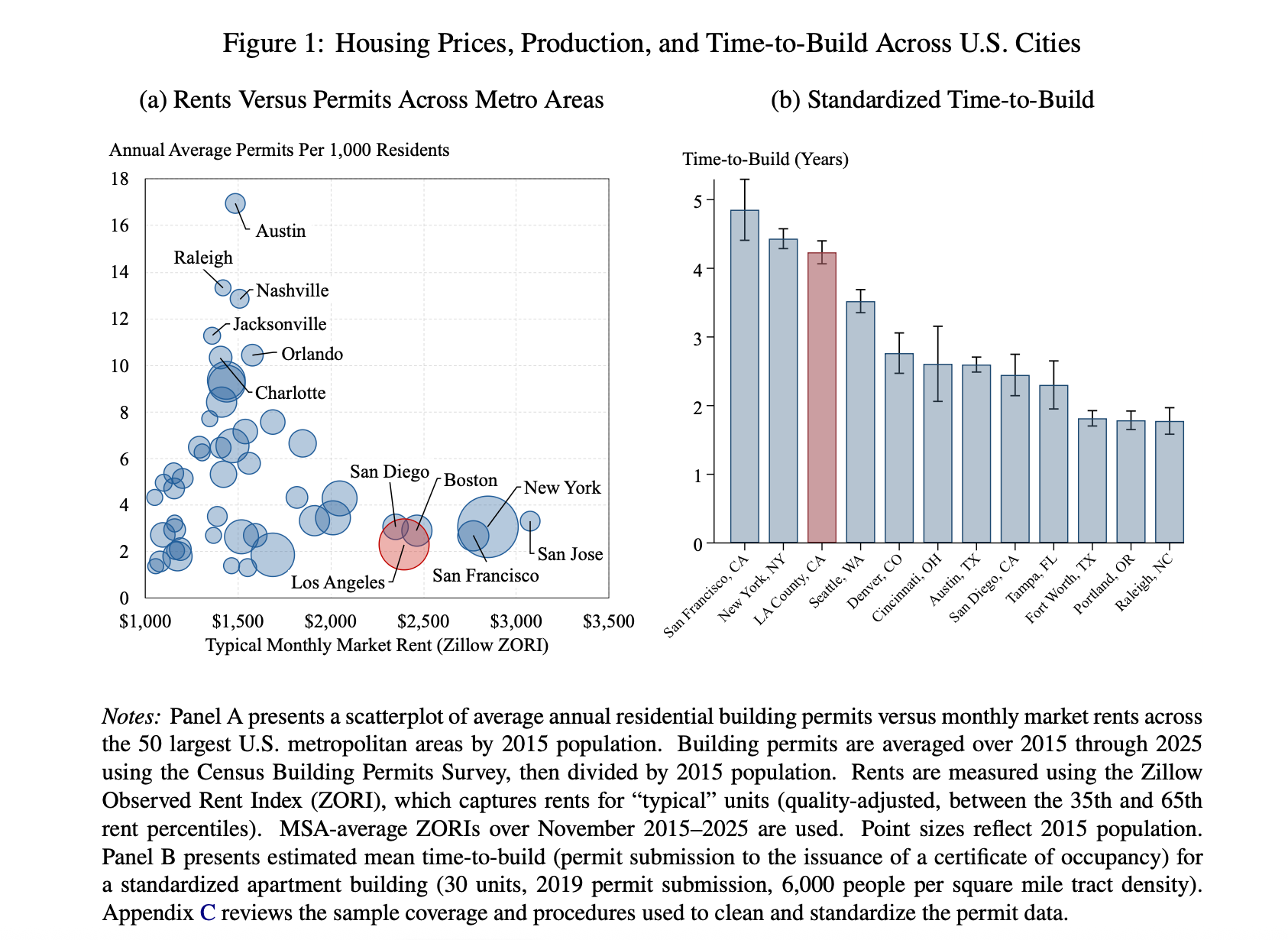
The paper provides some strong suggestive evidence that permitting is a big deal. As you can see below, if you plot the 50 largest metropolitan areas in the US by typical rent and average annual permits, you can see that there are no cities that permit a lot of housing and have high rents. In Los Angeles County for instance, a mid-sized apartment building would take on average 4.2 years to build which is roughly twice as long as in Raleigh, North Carolina and Fort Worth, Texas.
But their core findings are more rigorous1 and astounding: Soltas and Gruber find that permit approval raises the price of vacant land by 50% on average. That means that a typical property worth $1 million without all the necessary permits can actually be sold for $1.5 million with all the necessary permits. I tried to think about amenities that would raise the price of a home by fifty percent to illustrate how insane this is but there really aren’t many.
This isn’t like renovating your bathroom or finishing your basement, it’s the premium that comes with having a high-quality oceanfront view or adding a pool.
The authors go further than just observing these differences, however, they also help us answer the charge that permitting is just one small reason why housing prices have ballooned away from construction costs. In their analysis, permitting alone can explain a full third of the gap between how much it costs to build a house and how much it actually sells for.
To put some numbers on that, Soltas and Gruber find that permitting adds an extra $48 per square foot of land for the average property. For the non-developers out there, that means a 3,000-square-foot home would cost an additional $144,000.
This is not just about one clever paper. This is about more than 25 years of high-quality evidence showing that “small-bore” regulations are making it harder for people to move to good jobs, forcing people to spend more of their incomes on housing, pushing low-income renters into overcrowded and low-quality housing stock, and ballooning a homelessness crisis that is the darkest stain on the modern American economy.
At this point, the fact that building more housing, and yes, that includes housing for rich people and yuppie renters, has clear and fast benefits for renters all the way down to the bottom of the market. Whether you’re looking at Switzerland or Finland or Sweden or Honolulu all over the United States, the answer is the same: Housing markets are connected and when you build new private market housing, it loosens up supply down-market for everyone.
Housing is, in my opinion, the biggest economic issue of our time. Failing to build enough housing where people need it, near good jobs, near amenities they want, near transportation networks that get them where they want to go, is not only costing in GDP and average worker pay, but it is a direct tax on people’s freedom.
Now, Los Angeles County is not just one place, it is the single most populous county in the entire country and contains the second-largest city in America.
I have trouble controlling my anger when I think about LA, a city that has allowed its housing and homelessness problem to spiral out of control to the point where it is harder to find a toilet on Skid Row than in some refugee camps and where homeless people catch typhus, the disease that killed Anne Frank while she was imprisoned in a concentration camp.
In the face of this utter failure of public policy, elected officials like Los Angeles Mayor Karen Bass have continued to allow NIMBY politics to reign supreme, opposing efforts at every turn to increase the supply of new housing. Bass even reversed her own affordable housing policy when it became too successful and sparked backlash from homeowners.
Regulations are not a small part of this story. They are not a distraction from another more important problem. And they are not a ruse to secretly prop up tech billionaires. There are regulations and laws in this country that are directly responsible for the immiseration of hundreds of thousands of homeless people and the continued financial insecurity of millions of low income renters.
The reason I have spent most of my professional life writing about these regulations is because I think they are incredibly important, not because someone paid me to or duped me into a long con ten years ago so I’d one day run cover for data centers.
When I think back to my own childhood, I can trace the impact of these “wildly insufficient” regulations in every stitch. The townhomes I lived in as a child were a part of an inclusionary zoning policy to allow for the development of more affordable housing. My neighborhood, unlike the broader, wealthier community, was largely made up of recent immigrants and middle class Black families. The apartment I lived in as a high schooler was built as part of a controversial upzoning. Without it, I’m not sure I would have been able to continue going to one of the best magnet programs in the county.
The regulations that constrain housing can sound dry and technical, but the shifts they create in the lives of millions are very real. I grew up in the housing that someone’s zoning reforms built and it didn’t feel very small-bore to me.
More on housing:
Everybody hates renters

People forget, but J.D. Vance was a key architect of the populist myth that BlackRock is the primary villain in the housing crisis.
The NIMBY Christmas cinematic universe

If I only watched movies where the character turns directly to the camera and says “I’m exactly the kind of liberal you are,” I would not watch very many movies. Still, it’s hard not to doom when every holiday season I’m accosted with anti-development, NIMBY-coded feel-good rom-coms.
I’m not an economist but I’ve read hundreds of housing and housing-related economics papers and I’m really impressed by this one. This is a very difficult problem to measure and I was skeptical going in that it would be possible to reasonably avoid the selection issues inherent in measuring properties that come with ready-to-issue permits. But the authors conduct a cross-sectional analysis in addition to their repeat-listing analysis that finds very similar results and helps get around the selection problem.
This is completely true, I recently heard exactly this set of arguments from people in my municipality in Montgomery County, MD, where, as I’m sure you know better than me, there’s a lot of local opposition to Wes Moore’s starter and silver homes bill. One outright claimed that I had been duped by developers.
The problem I always want to point out is if the housing reform won’t actually cause more housing to be built, then why are you opposing it?
Outstanding. The real small-bore strategy is focusing exclusively on public housing, when that can barely satisfy 1/100th of the demand.
(No shade on public housing as a last resort.)