


This week on The Argument podcast, Matt Yglesias and I talk about the rise of the far right in Europe. Paid subscribers can watch or listen to the episode ad free here and read the transcript at the end of this post. Free subscribers can watch the episode on YouTube here or listen wherever you get your podcasts.
Subscribe: Apple Podcasts | Spotify | YouTube | Overcast | Pocket Casts
Lots of people don’t like immigrants. I remember, as a young child growing up in a very progressive city in suburban Maryland, a woman telling my family to “go back to where you came from.” From my (albeit flawed) childhood memory, the proximate cause of her distress was the limited seating at the Barnes & Noble Starbucks, but my mother’s accent tipped her over into xenophobia.
As a real abundance-head, my first instinct is to point out that scarcity can activate these sorts of insider-outsider dynamics in even the most trivial settings. If there were enough tables and chairs for everyone to sit comfortably, there would never have been any conflict over the scarce resources.
But while it’s true that this woman would likely have been annoyed and maybe even outwardly rude to a white, seemingly native-born family, it’s unlikely that she would have seen them as less deserving of Starbucks table space. That’s because there is a widespread underlying belief that longstanding membership as part of a nation or state or town makes you a more legitimate member of that community.
The first thing to say is that this belief is incorrect. Having lived somewhere longer does not make you more deserving of ordinary respect, fair treatment, human rights, or a seat at the combination Starbucks-Barnes & Noble. People do not acquire superior moral standing simply because one of their ancestors arrived somewhere earlier.
But the second thing to say is that most people seem to disagree with me. Unfortunately, due to a combination of bad reasoning and different values, many people think that accidents of birth are a just way of allocating rights.
I expect that most of the people reading this piece are relatively cosmopolitan individuals who find it sort of embarrassing that so many people in their coalitions hold beliefs like these. But that’s the world we live in. And it’s a problem that many thought leaders grasp for highbrow rationalizations that make these indisputably lowbrow views sound like conclusions compelled by economic research.
We have to be able to reckon with the fact that winning a democratic election means dealing with the fact that some people dislike immigration for no good reason without torturing logic and social science research to justify such views.
It takes a lot of effort to make immigration look zero-sum
As anti-immigration politics has roiled Western nations, elites have grasped for rationalizations of xenophobia in order to co-opt anti-immigration politics without obviously abandoning their commitments to empiricism and cosmopolitanism. In so doing, they have begun to distort economic reasoning to try to justify ideas like Immigration reduces wages for the native-born and, increasingly, Immigrants are a fiscal drag.
The idea that immigrants reduce native-born wages is so difficult to produce evidence for that its boosters have to resort to looking at sub-sub-groups like “non-Hispanic men without high school diplomas” to find even the slightest effects. For instance, the famous result from economist George Borjas’ paper on the Mariel Boatlift, which brought a wave of Cuban immigrants to Miami, is that the boatlift led to 10% to 30% wage declines among 25- to 59-year-old non-Hispanic high school dropouts.
Other economists later found that the survey behind Borjas’ famous study began sampling a larger share of Black workers around the same time that the refugees arrived. Because Black workers already earn less on average, that is a likely explanation of the apparent wage decline among this subgroup.
To accept that Borjas was right about the wage effects on this subgroup, you also have to ignore the tiny sample (an average of 19.5 per year), the suspicious fact that similar effects do not appear if female or Hispanic workers are included, and that the effect disappears if slightly different age ranges are used or if high school graduates are included.
His work also has nothing to say about the fact that these same workers benefited from expanded output and lower prices as a result of the boatlift.
And that’s before you consider the lion’s share of studies that find that immigration does not make native-born workers worse off.
This wage argument is still around, but the new smart anti-immigration take isn’t about native-born wages; it’s about whether immigrants are a net drain on government coffers. As the Financial Times’ John Burn-Murdoch recently wrote: “concerns about the economic impacts of immigration on high-income countries have shifted from fears that incomers are taking the jobs of existing residents to worries that the low (or no) pay of arrivals will place a growing financial burden on the host country.”
In the U.S., Vice President JD Vance has argued that unauthorized immigration plus generous benefits would “bankrupt this country more than any other policy.”

In the U.K., a (then) prominent Conservative Party leadership candidate argued that each person arriving illegally “costs the taxpayer roughly £400,000 over their lifetime.”

The fsical argument has gained traction among mainstream journalists with substantial sway in liberal circles. In a now-viral chart produced by The Economist, migrants from the Middle East, North Africa, Pakistan, and Turkey appear as a net drain on Denmark’s government spending at every point in their lives.
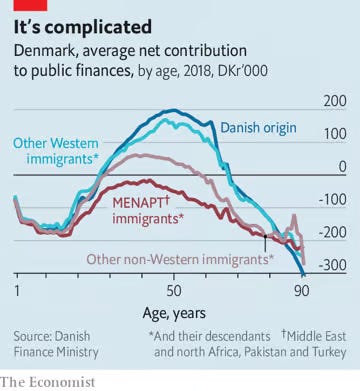
It is straightforwardly true that if you make it very difficult to work as a newcomer (as many European countries do) and then make it very easy to get benefits (as many European countries also do), then the net fiscal cost will be higher.
But those fiscal costs would then be a direct result of policy choices that countries could easily change — for instance, the United States does not extend the same level of universal benefits to noncitizens, and it also makes it easier for them to work. But also, most of the studies that these claims rely on just do not prove that immigrants are a net cost!
Burn-Murdoch relies on new research from Stanford Institute for Economic Policy Research’s Usama Polani to illustrate the fiscal costs of low-earning couples in France, Spain, Germany, and the United Kingdom. The paper calculates the government revenue attributed to migrant households (mostly taxes they pay) and subtracts the government spending on them (everything from welfare benefits to shares of public goods).
Polani, to his credit, acknowledged his study’s limitations and admirably incorporated corporate taxes that do account for some of the indirect fiscal benefits of immigration. But even that still misses large pathways by which immigrants contribute to the tax base like the effects on other residents’ wages and labor supply.
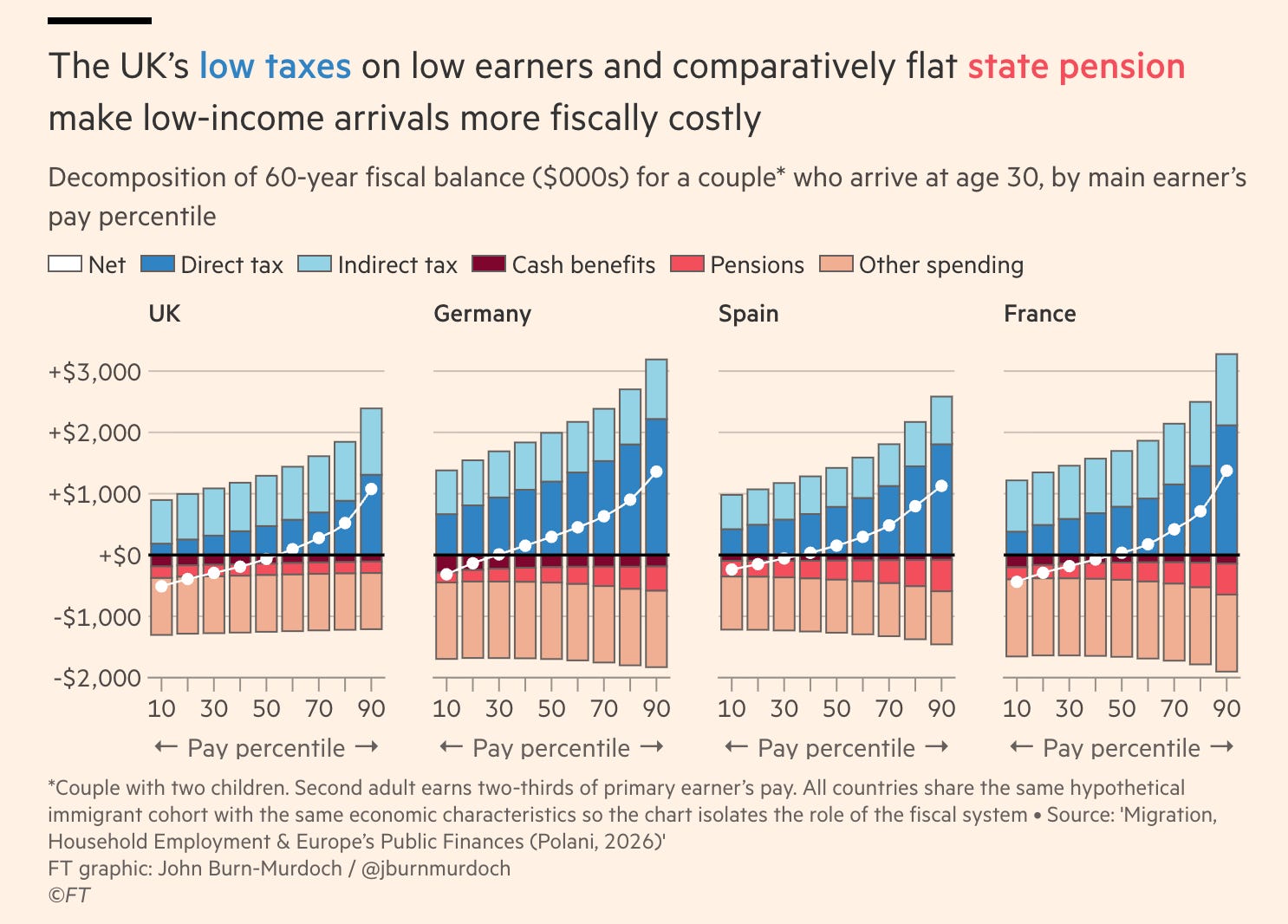
These graphs do a bunch of argumentative work by giving readers a salary threshold below which an immigrant family costs taxpayers money on net under the model’s assumptions. It’s totally fine to do this as an academic accounting exercise, but the obvious takeaway to a general audience is that immigrants cost the taxpayers more than they contribute.
That is not actually true.
Fundamentally, if you’re trying to understand the impact of a person on government coffers, you can’t just hold everything else constant. New people are not just consumers of government benefits and producers of taxes — they are also both consumers and producers of goods and services.
Increased demand for goods and services induces companies to make more products, which means hiring more people and investing more capital. That, in turn, produces more income and corporate taxes.
Another indirect fiscal benefit comes when immigrants provide childcare, allowing a parent to work more hours or even re-enter the workforce. This increases the taxes received by the government.
These are not mere hypotheticals; research has found that immigration stimulates business investment, allows high-earning women to spend more time in paid work, and generates indirect fiscal benefits through its effects on other residents’ wages and employment.
When you are thinking about the fiscal costs and benefits of immigration, you can’t just look at a simple accounting exercise; you have to actually ask the question: What would the fiscal situation look like with and without immigration?
Overlooking this broader context is depressingly common in debates on the fiscal effects of immigration. In 2023, economist Michael Clemens published a paper showing that when you account for the increased corporate taxes collected by the government, the net fiscal impact of average recent U.S. immigrants rose by a factor of 3.2, with a much smaller gap between the net contributions of highly educated and less-educated immigrants. Even average recent immigrants with less than a high school education are net positive!
A 2024 economics paper estimated the indirect fiscal effects of low-skilled immigration through changes in existing residents’ wages and labor supply. It found that in the U.S. context, these immigrants each produce an indirect fiscal benefit of roughly $750 annually on average. The mechanism is that low-skilled immigrants raise wages of workers whose skills complement theirs: More construction workers can raise wages for construction managers, for instance. That means those construction managers earn more and pay more in taxes.1
Another example of fiscal benefits of immigration came from a 2024 Congressional Budget Office report that modeled projections of the deficit with and without the immigration surge from 2021 to 2026. The projected federal budget deficit from 2024 to 2034 was roughly $900 billion lower than it would have been without the new residents.
I don’t have direct proof that anyone’s commitment to these highbrow rationalizations is insincere. But I will say that I have yet to see anyone have the courage of their convictions when it comes to the idea that we should reject new people if they are a net fiscal cost to the government.
If any of the fiscal-costs truthers took their own logic seriously, that would mean the average birth was a net fiscal drag on any government currently running deficits. After all, if the government is spending more than it is bringing in, that means the average person is taking more than they are giving. Time for mass sterilization!2
Accept reality. There are dumb and wrong people who get to vote.
There is more that countries can do — particularly in Europe — to make sure labor markets are prepared to absorb new people in order to maximize the economic benefits and minimize the fiscal costs. And they should do those things!
As Alexander Kustov and my colleague Kelsey Piper wrote earlier this year, one reason why America is so much better at assimilating immigrants is that “Europe makes it structurally much harder for immigrants to work. Rigid employment protection, sector-wide collective bargaining, and high effective minimum wages create insider-outsider dynamics that hit newcomers hardest.”
But even if countries do make needed changes, there will still be a lot of people in Western liberal democracies who neither understand nor seem to care very much that immigration is clearly an economic benefit. The important objections to immigration come in three categories: crime, disorder, and culture.
Consider what happens when immigrants obviously pass every economic test. In a recent discussion of “The Indian Question,” the Manhattan Institute’s Christopher Rufo pointed out that Indians have high rates of college matriculation and earnings, but he nevertheless offered a highbrow rationalization for preferring a homogeneous society because of “higher trust, higher cooperation.” His co-host, the popular right-wing commentator Lomez, argued that preferring an ethnically homogeneous country doesn’t need an economic justification, comparing it to preferring one food over another.
In polling conducted by The Argument, pluralities of respondents told us that they believed immigration had a positive impact economically, culturally, and overall. The only place that a greater share of respondents reported negative effects was public safety.
We even asked whether forcing immigrants to pay higher taxes — a policy I have supported! — would get respondents to support more legal immigration. Just 9% of voters said yes to this. In contrast, 52% said that “close vetting of immigrants to prevent criminals and terrorists from entering” would make them more comfortable with “increasing the number of legal immigrants admitted each year.” Notably, this is also irrational given that immigrants commit way less crime than native-born Americans do on a per-capita basis!
In today’s episode of The Argument, my co-host Matt Yglesias argues that I’m not sympathetic to the plight of the white moderate who is struggling to reconcile the electorate’s discomfort with immigration with their own personal cosmopolitanism.
“This is my criticism of you,” he argues. “I think you don’t engage sympathetically with the dilemma that people, especially white Americans who are trying to nudge Democrats into a more politically pragmatic view on immigration, face. Because if you say, ‘We need to pander to the racism of the electorate,’ people are going to say, ‘Nope, that’s not allowed,’ right?”
I separate my advice into two parts. First, to people who are in truth-seeking roles in academia, journalism, and think tanks: Attempts to find smart-person reasons for why everyone’s mad at immigration risk polluting the elite epistemic environment without resolving any of the concerns that real anti-immigration voters have.
Second, to politicians: I do not think you should say that we should pander to racists, and I don’t think taking bigotry seriously means capitulating to it.
Instead, immigration advocates like myself should focus on the following: reducing the amount of zero-sum competition that pits native-born citizens and immigrants against one another, taking crime very seriously and holding a hard line against immigrants who commit crimes, investing in orderly immigration processes to eliminate irregular border encounters, and demanding cultural assimilation from newcomers.
Taking these substantive concerns seriously is ultimately better for the pro-immigration cause and more respectful to the democratic views of immigration-skeptical voters than torturing the empirical literature to rationalize the false view that immigration is a resource-draining, zero-sum competition.
Matt and I talk about all this, plus unrelated reasons that the far right is rising in Europe, on this week’s podcast.
The Argument. Libbing out.
Paying subscribers can find the transcript for this post beneath the paywall.
WATCH THE EPISODE ON YOUTUBE HERE
New episodes post every Thursday.
For an ad-free version and full transcript, subscribe at TheArgumentMag.com.
Corrections and clarifications:
Around 2:12, Matt describes a voter who says she voted “for Helmut Kohl against Gerhard Schröder in 2002.” Schröder defeated Kohl in 1998 and Edmund Stoiber in 2002.
Around 9:00, Jerusalem says there is a right “enshrined in the Magna Carta for anyone to enter” Britain. This is likely a reference to the document’s clause 42, which gives people the less-expansive right to “depart from our kingdom, and to return to it.” This clause only lasted a few weeks before being annulled by the pope and was not included in future reissues.
Around 9:10, after mentioning William Blackstone, Jerusalem cites “William Gladstone talking about how all of the rights that we care about are predicated on being able to move.” This was also meant to be a reference to Blackstone, who wrote about the “power of locomotion” in Commentaries on the Laws of England.
Around 22:50, Jerusalem says the Darién Gap is how “people get to the U.S. from Latin America, mostly.” Crossings of the gap peaked in 2023 at around 520,000, but this was still a minority of the over 2 million encounters at the Southwest border that year. Only migrants traveling from South America need to cross the gap.
Around 29:00, Matt says that Wyoming and Maine have “dramatically higher murder rates than any European country.” In 2024, Maine (2.6 murders per 100,000 residents) had similar murder rates to Lithuania (2.6) and Latvia (2.4).
Around 35:20, Jerusalem says “Trump had the highest number of Southwest border encounters in 2019 than anyone had ever seen before in American history.” 2019 saw about 852,000 encounters at the U.S.-Mexico border, which made it the highest number since 2007, when there were around 859,000.
Around 48:00, Matt says the U.K. has a subsidy program for electric heat pumps that excludes pumps with a dual cooling function. This was changed in the regulations this year.
Around 57:40, Matt says the Peer Review paper showed that mothers aged 25 to 55 with “over two children persistently do remote work at a higher rate than other people.” The paper’s study sample is of mothers in that age group with two or more children.
Show notes:
Dril tweet referenced by Matt:

“Liberals don’t have to lose on immigration,” article by Jerusalem: The Argument article
“Why the left is wrong about assimilation,” previous podcast episode: The Argument podcast
“Even In a Liberal Democracy, Some People Need to Be Deported,” article by Alexander Kustov, referenced by Matt: Popular by Design article
“The immigration problem is a crime problem,” article by Lakshya Jain, referenced by Jerusalem: The Argument article
“Why America is so much better than Europe at immigration,” article by Alexander Kustov and Kelsey Piper, referenced by Jerusalem: The Argument article
Peer Review: “The Impact of Fertility on Mothers’ Remote Work,” article by Benjamin W. Cowan and Mohamed Hafis Zida: NBER working paper
Transcript:
Remarkably, this model found those effects even as it presumed that immigration lowers some workers’ wages.
Furthermore, does anyone really believe that the right-wing industrial policy people who argued that deportations would revitalize manufacturing are going to suddenly change their minds about immigration now that the Trump experiment has been a failure?
"...accidents of birth are a just way of allocating rights..."
This strikes me as a tautology:
Nation states have different governments. Governments have different policies and confer different benefits and rights. Determination of citizenship is an underlying need, particularly as the difference in rights and benefits widen across nation states.
To act on the moral question inherent to this requires meta-national thinking a la the EU, but that is not relevant in any way to the current political discourse and is currently in no way close to an acceptable concept in US politics ("e.g., One World Government").
This tension is something everyone on the left needs to contend rather than ignore.
Scarcity really activates the debate around having citizenship by way of birth but also via other means and "let's broaden the other pathways". Scarcity environments make people think about this less generously.
However, the underlying tension between universal rights and nation states is still there.