

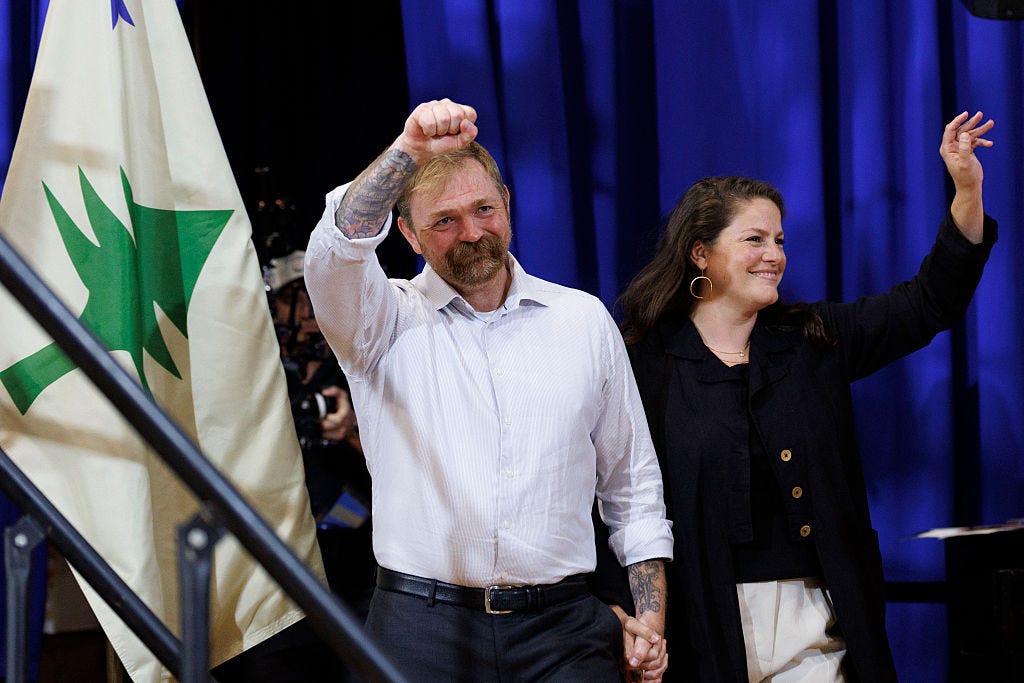
Well before the horrifying, credible, and disqualifying sexual assault allegations, Graham Platner had become a liability for the Democratic Party. And it wasn’t due to his edgelord Reddit posting, or even due to the Nazi Totenkopf tattoo he sported for years on his chest. Instead, the problems really began when an infidelity scandal engulfed his campaign in late May.
Americans view cheating as one of the most toxic moral failures imaginable. In 2020, Cal Cunningham, the Democratic nominee for U.S. Senate in North Carolina, discovered this the hard way, as he watched his campaign unravel after details of an extramarital affair emerged in the last month of the election.
But while Platner technically “survived” his cheating scandal,1 he was actually impacted far more by this than Cunningham was. In fact, by our estimates, he lost much more ground than Cunningham did in polling.
Platner’s candidacy was centered around the troubled soldier finding the light. Having gone to Iraq and come back disillusioned, the story goes, he spent years in darkness and drink before finding love and redemption, reforming himself to be a better person in the process and finding his political awakening.
In her recent piece on Platner, my colleague Jerusalem Demsas argued that this redemption story was a Teflon-like protection against scandal, since scandals could merely be folded into the myth. In essence, supporters and voters alike could rebut the stories by saying “we already knew he had a troubled past. Why is the media harping on something from so long ago?”
The cheating story broke this narrative in many ways, because Platner didn’t just cheat in the distant past. He was cheating when his campaign for Senate launched. This, combined with The New York Times reporting a pattern of troubling behavior in his past relationships, shattered the carefully manicured image of Platner and gave voters reason to doubt his character, honesty, and fitness for office.
The double-whammy of the infidelity scandal and the subsequent Times story made it clear that Platner had not been honest about his past or present. Over the following month, Platner lost nearly 7 points of support. That’s similar to the amount of ground Mark Robinson lost in North Carolina after his salacious “Nude Africa” scandal broke.2
My views on Platner were clear from the start, and I was particularly impacted by him lying about his Totenkopf. But it’s obvious from reviewing the public opinion data that Maine voters did not see it like I did.
At first, people earnestly bought the story of the redeemed Marine who fought through hell and came out better for it. They didn’t find the tattoo to be especially relevant in forming judgments about his fitness for office.
We know this to be true because Platner saw absolutely no visible public opinion hit from either his Nazi tattoo or his unsavory Reddit posts. Until the adultery scandal emerged, he was doing remarkably well against Susan Collins in head-to-head general election polling and outpacing Janet Mills’ margin in such polls by several percentage points. (In fact, after a small initial dip, his survey lead actually significantly expanded between the time of the tattoo story breaking and the first adultery scandal in late May.)
There are lessons to be learned here that go beyond “bad behavior is correlated,” especially when it comes to what voters care about. Namely, many of the scandals that engulfed Platner at the start of his candidacy did absolutely nothing to diminish his appeal. The tattoo and unsavory Reddit posts were things that disqualified him in the eyes of some highly online, hyper-engaged politicos (like me), but they did not do anything to dent his standing in the eyes of the average Maine voter, who earnestly believed the “redemption” narrative.
It’s harder to imagine this being the case in the pre-Trump era, back when the bar for a scandal was a lot lower. But, today, to the extent these early red flags mattered, it was in the way they gave hints about what kind of person he was and what else lay under the surface.
So it’s worth repeating in the autopsy of Platner’s campaign that the tattoo, in and of itself, wasn’t the thing that broke him, and neither were the Reddit posts. It was the infidelity that first knocked him down from a clear favorite to a toss-up, before the rape allegations destroyed his candidacy completely.
Replacing your nominee four months before a general election of titanic implications is not ideal, especially given the immense amount of ground they will have to cover in fundraising. In some ways, though, it might also be a boon — a new candidate lets the party shed the albatross that Platner had become without having to resort to Janet Mills, a weak candidate in her own right.
But it’s hard to argue that this wasn’t all easily avoidable. When people tell you who they are, believe them.
Recommended reading:
Americans hate cheaters

Fully 90% of Americans called stepping out on your spouse “morally unacceptable."

After all, if it weren’t for the rape allegations, he’d still be the party’s nominee.
Nude Africa is the pornographic site where Robinson called himself a Black Nazi and posted highly explicit stories of an affair with his sister-in-law.
I really wish someone would pay more attention to what kik, the site where Platner had a shirtless pic posted, is. It's really quite damning for a middle aged man to be on there.
- 70% of Kik users are aged between 13 and 24 years old.
- "Kik chat app 'involved in 1,100 child abuse cases'" https://www.bbc.com/news/uk-45568276
Some comments from: https://www.reddit.com/r/OlderGenZ/comments/1j25ax9/is_kik_still_a_thing/
"Every adult who sent me unsolicited messages on that app deserves jail. Unspeakable fucking horrors on that stupid app."
"Ah yes my first memories of getting groomed"
"It was filled with creepy old men being “eating disorder” coaches. I probably lost a few brain cells and year off my life because of KiK"
Many, many more.
Thank God we only have another two weeks of Platner discourse.
Both cheating and being a Nazi are bad. But Americans only have a vague idea of what facism/National Socialism means, and calling someone a Nazi is so oversaturated and unfalsifiable that the term has become meaningless.
On the other hand, everyone knows what cheating is, why it's bad, and why you shouldn't do it. Not surprised that moved the needle more.