

Welcome back to The Argument’s poll series, where we survey Americans on the issues everyone’s fighting about. Our full crosstabs are available below the paywall at the end of this post. Our last surveys have asked about immigration, education and parenting, the lingering politics of COVID-19, immigration, AI, and free speech. The Argument’s full methodology can be read here.
I have developed a pretty good system for blocking out drive-by social media criticism, but one side effect of being a writer is that your friends will unwittingly send you the posts of all the people you’ve muted.1 This is how I learned that many people are under the impression that our recently released poll on gender issues is, as journalist Parker Molloy put it, “consent manufacturing at its finest.”
My least charitable response is to question whether Molloy has actually read Manufacturing Consent, since Herman and Chomsky’s propaganda model doesn’t exactly fit neatly onto a small magazine without advertisers publishing its poll and methodology, and inviting dissent. In fact, what I take most from the book while editing this magazine is the risk of public retaliation increasing the cost of publishing certain viewpoints. Hmm…
But more to the point, I think it’s worth grappling seriously with why so many people think the only options are throwing trans people under the bus or burying our heads in the sand about public opinion.
Yesterday, The Argument published a large and wide-ranging poll of more than 3,000 U.S. voters focused on issues related to gender. Lakshya Jain, our director of political data, described the backlash to trans rights we observed in the data: voters have flipped on supporting trans people’s right to use the bathroom of their choosing and are largely opposed to extending parents of trans children the traditional right to make medical decisions for their children in consultation with a doctor.
For critics like Molloy, it seems obvious that the purpose of our poll was to influence elected officials to throw trans people under the bus. There’s no value in getting into a debate about our intentions because I actually think the meta-concern has some merit. It’s reasonable to think these poll findings will convince some elected officials to support stripping trans people of their rights. But preventing elected officials from making that mistake requires engaging with reality, not ignoring it.
Don’t let Trump break your brain
The gravitational force of the Trump presidency and the threat of a Vance successorship forces nearly every political debate into the same narrow frame: How to prevent the illiberal right from continuing to notch electoral victories?
The threat of fascism can be a disciplining force, but it can also be paralyzing. In a frenzy to prevent further damage, people will strike out randomly to try and turn the tide. Progressives often get criticized for not thinking strategically enough, but I think part of why it’s become so hard to have nuanced, difficult conversations on how to respond to the growing gap between voter preferences on many issues of trans policy and the preferences of Democratic lawmakers is because of clumsy, high profile thoughtless moderation.
After Democrats lost the 2024 presidential election, a bunch of them bandwagoned on the Laken Riley Act in a desperate attempt to “read the room” on the immigration backlash.
The Laken Riley Act does two things: First, it mandates that some noncitizens be held without bond if they are charged with committing certain crimes, including shoplifting.
This isn’t even the truly dumb part of the bill. No, because the Laken Riley Act also gives state attorneys general immense power to veto the federal government’s immigration policy if they don’t like it. If a state can show that federal immigration policy costs them more than $100 (not net $100, to be clear) courts have to grant them standing to sue over immigration decisions, but also expedite their cases.
Quite literally this means that state AGs have been handed the power to hold up entire legal immigration pathways, from parole pathways to “sweeping bans on all visas from countries such as India or China.”
Despite the American public being extraordinarily clear that they rejected chaotic, illegal immigration, not legal, orderly immigration, Democrats joined with Republicans to vote for a bill that would imperil legal pathways.
Several Democrats have even admitted to regretting their votes.
Voting for the Laken Riley Act wasn’t reading the tea leaves, it wasn’t a brilliant electoral strategy, it wasn’t engaging meaningfully with the views of people different from you. No, voting for the Laken Riley Act was thoughtless moderation. It was treating voters like morons who simply want you to gesture in their general direction instead of addressing specific, concrete concerns.
And the price will be paid by every successive administration that has to try and get a handle on immigration policy as state AGs sue them for directing immigrants to legal pathways.
A single vote, certain to be forgotten before the next election, was never going to meaningfully impact anyone’s electoral chances. But more importantly, this bill will make it that much harder for a future president to actually address migration pressure.
More to the point of our recent poll, Rep. Seth Moulton provided a case study in thoughtless moderation in late 2024 when he decided to buck progressives on trans rights. Speaking with the New York Times, Moulton argued “I have two little girls. I don’t want them getting run over on a playing field by a male or formerly male athlete.”
Moulton’s oldest child at the time was about 6 years old, which means she was still at the age where boys and girls play sports together and any trans kids playing with them are not the hulking monsters he invoked but mere children.
Voters are not asking elected officials to bully elementary school students. They are not afraid of their six-year-old daughters playing touch football with their peers, whatever their gender. They are, largely, raising questions about when it’s appropriate to give medical transition care to minors and trying to figure out how various women’s sporting events should handle the boundaries of who is allowed to compete.
The solution to being out of touch with voters is to learn more about their views and engage with them like a normal person. Part of that will require costly signals that may cause people in your coalition to get mad at you, but politicians should not actually lose sight of the merits.
The small-l liberal public
A liberal elected official who skims the results from our trans policy questions might conclude that, in order to hew more closely to public opinion, the answer is just brute force to become more socially conservative on trans issues.
This is not actually what our poll indicates. For one thing, as Lakshya wrote yesterday, there’s little evidence that people are actually shifting their votes on this issue in the short run. But more broadly, as a believer in democracy, I think it’s good for elected officials to try and represent their voters.
The public’s capacity to hold nuanced opinions may not be great, but it may be greater than many elected officials give them credit for.
Yes, a majority of voters think “it’s better when men look and act like men, and women look and act like women.” A plurality thinks that “saying you are a gender that is different than the one you were born as is morally wrong.”
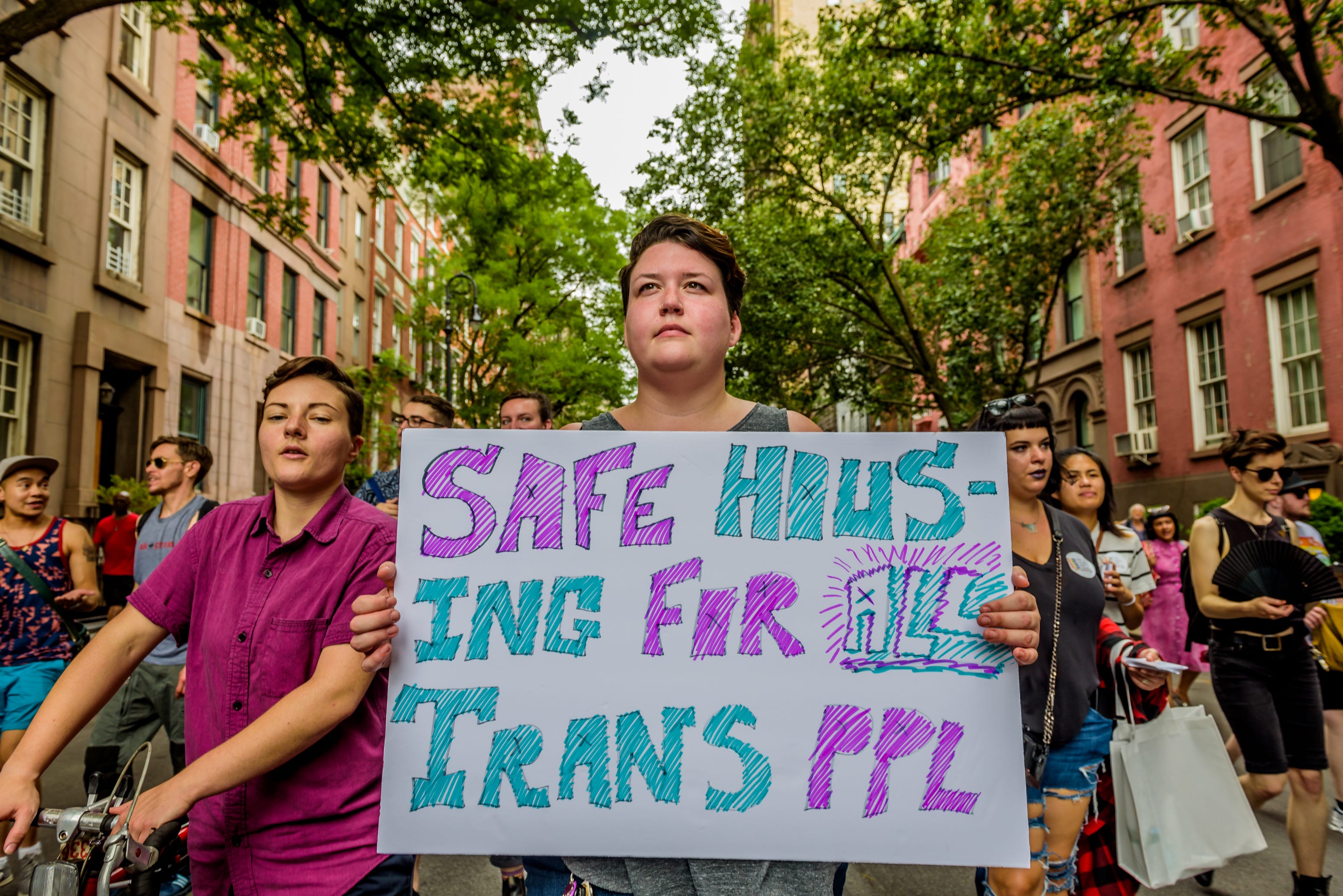
And yet! And yet! In the very same poll, a significantly larger majority of voters (63%) want to ban discrimination against transgender people in hiring and housing. Not a single subgroup — including Trump 2024 voters — opposes such legislation.
Molloy’s concern that elected officials will just abandon trans people is legitimate as a description of what bad politicians do with polls — they skim, they panic, they gesture — but the solution to that isn’t to suppress the data, it’s to actually read it. The poll itself disproves the case for thoughtless moderation.
Our findings indicate that a significant chunk of Americans are willing to support the fundamental rights of people they have moral disagreements with. In short, they’re liberals!
This gap isn’t just in our polling. In 2022, the Pew Research Center found that while 64% of respondents favored laws or policies that would protect trans people from discrimination in housing, jobs, and public spaces, almost that many (60%) agreed that “whether a person is a man or a woman is determined by sex assigned at birth.”
This provides a genuinely valuable pathway for LGBTQ+ advocates. Last July, Iowa’s governor passed enacted a law removing gender identity as a protected class in the Iowa Civil Rights Act. That means trans adults are no longer protected from discrimination as they look for housing and in other public accommodations. Right now, Iowa lawmakers are trying to make it harder for local governments to pass their own civil rights protections.
Iowa was the first to remove such protections, but more than half of U.S. states do not fully ban discrimination against trans people in housing and employment.
If you care about building durable protections, you have to build them in the world as it actually exists, not the world you wish you could rhetorically enforce into being. Molloy’s instinct is to treat messy public opinion as a threat that must be managed. But the path to civil rights has never run through making disagreement illegal, it runs through insisting that equal treatment doesn’t require total agreement. It runs through liberalism.
Correction: An earlier version of this article incorrectly stated that Iowa's recent civil rights amendment was passed last July. It was enacted last July but passed last February.
More on the moderation wars:


If you are alive in 2026, you are drowning in feedback — particularly if you are on social media or write publicly. I used to think it was valuable to just take in as much of it as possible, but now I think you’ll just drown if you don’t create pretty blunt filters. Years ago, I began the practice of developing a list of people whose opinions I would either seek out or sit with if they ever commented on my work and ignoring basically everyone else.
There are several good points here, but the hit on Seth Moulton is nonsense. His daughters aren't going to be six years old forever.
I’ll echo the Moulton takes. You can’t characterize moderation in the frame of legislation with the Laken Riley Act, then point to rhetoric as a form of moderation. You need to separate these two things out.
As others have said, Moulton was voicing legitimate fears parents have. And the fact that parents get shut down by progressive scolds is what makes thoughtful moderation difficult because there’s no room for debate.
Finally, others have pointed out his actual legislative record but more recently look at his campaign. He’s doing events with former service members booted from the military for being trans. Isn’t “we need to respect the safety of girls in sport but trans people are encouraged to serve the country in uniform” something close to thoughtful moderation on this issue?