


Welcome to The Closing Argument, our verdict on the news, plus everything The Argument published and appeared in this week.
The Verdict, by Jerusalem Demsas
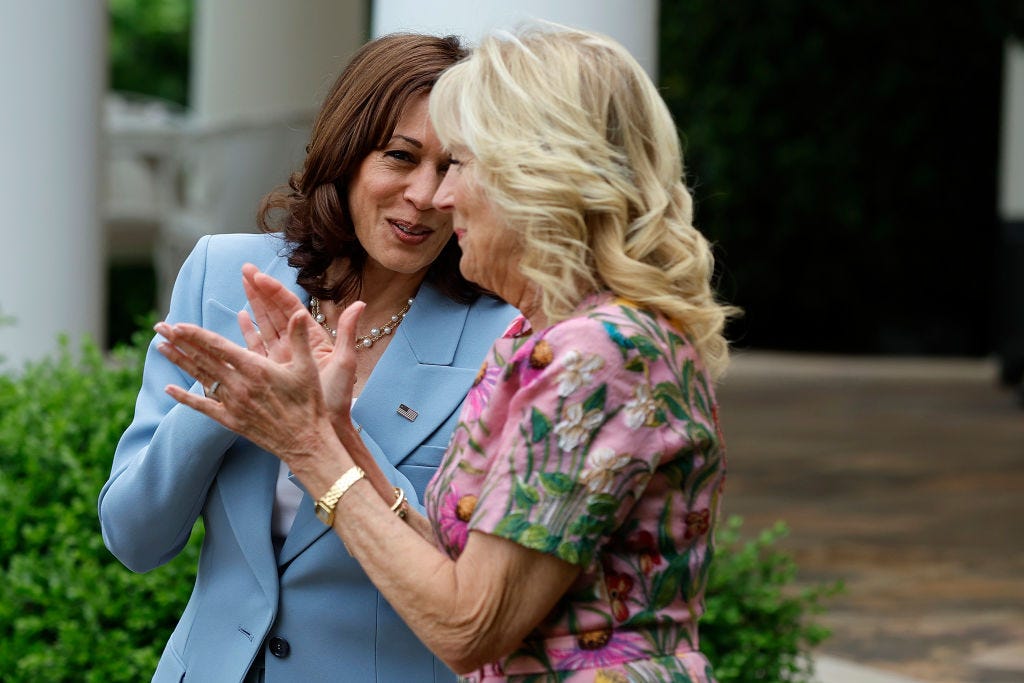
Jill Biden is back in the news this week, seemingly incapable of fading into obscurity as honor demands. The former first lady is on a promotional tour for her new book (out June 2) View from the East Wing, in which she revives her well-known grudge against former Vice President Kamala Harris.
I’d heard whispers of this grudge, but it was first publicly reported in two books by political journalists out in 2021 and 2022. During a Democratic presidential primary debate in June 2019, Harris famously slammed Joe Biden for opposing busing integration programs similar to the ones she used as a “little girl in California.” Jill Biden did not forgive Harris, reportedly arguing against her selection as vice president, and Harris complained of poor treatment from the White House team throughout her time in office.
Now, Jill Biden is making news by recounting Harris’ insistence that Joe Biden immediately endorse her following his disastrous debate performance against Donald Trump nearly two years ago. According to USA Today, Jill Biden describes Harris as going into “courtroom prosecutor mode” by repeatedly insisting that he make the endorsement quickly to head off any buzz about other potential candidates.
Jill Biden recounts walking out of the room in apparent anger.
Jill Biden presumably thinks this reflects poorly on Harris, but when I first heard this anecdote, my first reaction was: “Where was this Kamala Harris on the campaign trail?” The Kamala Harris who could push through the awkwardness of demanding that a man watching his career fall apart in a public and embarrassing manner put that aside and help her clinch the nomination.
That Kamala Harris would never say “Not a thing that comes to mind” when asked what she would have done differently from Biden; she would have spent 107 days railing against the former president’s failures on inflation.
It is a long-standing tension in moral debates about what one should do when one’s obligations to country conflict with one’s obligations to friends, teammates, and loved ones. Prominent English author and self-described political liberal E.M. Forster’s 1938 essay “What I Believe” is a wonderful, sprawling piece that includes some of my favorite defenses of individualism, but it also contains one very wrong idea:
“I hate the idea of causes, and if I had to choose between betraying my country and betraying my friend, I hope I should have the guts to betray my country. Such a choice may scandalize the modern reader, and he may stretch out his patriotic hand to the telephone at once and ring up the police. It would not have shocked Dante, though. Dante places Brutus and Cassius in the lowest circle of Hell because they had chosen to betray their friend Julius Caesar rather than their country Rome … Love and loyalty to an individual can run counter to the claims of the State. When they do—down with the State, say I, which means that the State would down me.”
I think the Democratic Party has been in an excessively Forster-ian mood in this respect. When people called on the aging and potentially senile 89-year-old Dianne Feinstein to resign, they were called sexist. When Rep. Marie Gluesenkamp Perez called out Congressional Hispanic Caucus member Chuy Garcia for timing his retirement to ensure his handpicked successor clinched the nomination, she was castigated for being divisive.
In politics, loyalty is both vice and virtue. Most people are bound not just by policy commitments, but by personal ones. Mass democratic politics is built on millions of personal loyalties, and representative democracy in particular demands an exchange of trust that rests significantly on policy considerations but not entirely.
And yet, an excess of loyalty is deadly. It breeds corruption and incompetence, and instead of making an organization stronger, it makes it vulnerable to outside attack.
Top stories this week, by Maibritt Henkel
As we grow, we want to make sure you see everything we’re doing without flooding your inbox with dozens of emails. But, for the real libs, you can get every post as it drops by opting into The Mag here.
Jeremiah Johnson closed out the week with a take to make the heart of any culture writer sing: Bo Burnham’s comedy special Inside is the definitive art of the 2020s. Five years ago, Burnham’s wacky lyrical masterpiece took the internet by storm, with hits such as “All Eyes on Me,” and “White Woman’s Instagram.” According to Johnson, Inside was an early indicator of the perplexing vibecession to come: a famous funny white guy who seems to have it all, plagued by the anxious melancholia of the digital age, just like the rest of us.

Earlier this week, staff writer Kelsey Piper wrote about how literary magazines are sleepwalking into disaster as AI-generated content takes over. Among the regional winners for the Commonwealth Foundation’s 2026 Short Story Prize, three appear to be written by AI. The foundation says it did not run submissions through an AI detector. But Kelsey points out that, whether we like it or not, the age of simply trusting writers to submit human-generated work is over.

The econ wonks are fighting! Did COVID-era wage growth provide the answer to rising income inequality? Economics writer Matt Bruenig calls this explanation “confused and wrong” in his piece this week. Read more about why:

🌟Abundance Wins of the Week🌟
New York City Mayor Zohran Mamdani released his Block by Block: The Housing Plan for a New Era. The plan
The International Energy Agency (IEA) dropped its annual investment report, which projects global solar investment will reach $365 billion this year. According to the report, the effective closure of the Strait of Hormuz has driven many countries to double down on their renewable energy infrastructure.
A new preclinical study published by researchers at Penn Medicine found that blocking a certain protein could disrupt the spread of toxins to healthy neurons, a promising indication that this process could be used to slow the progression of Parkinson’s disease.
Worth watching…
On the pod this week, Jerusalem and Matt unpack the falling rate of crime. America is about to have its lowest homicide year since the 19th century, but how did that happen?
Why is crime falling everywhere?

A frustrating fact about the politics of crime is that everyone freaks out when crime goes up, but the reaction when crime goes down is much more muted.
Subscribe: Apple Podcasts | Spotify | YouTube | Overcast | Pocket Casts
On Tuesday night, Texas Attorney General Ken Paxton won the Republican primary runoff in Texas, defeating incumbent Sen. John Cornyn. In their livestream from Wednesday morning, The Argument’s Lakshya Jain, Split Ticket’s Armin Thomas, and VoteHub’s Zachary Donnini discuss Paxton’s victory and what it means for the general election in November.
What’s News with The Argument
The Argument recommends, by Maibritt Henkel
First up, Jerusalem watched Run Lola Run, a German film from the 1990s that she calls an “incredibly bizarre and fun movie.” It wrestles with free will and how far a girl will go to get 100,000 Deutschmarks for her loser criminal boyfriend.
Operations manager Angela Tracy has long been encouraging the team to get into reading (not watching) plays. She’s been making her way through the collected works of Paula Vogel, and says the 1984 satirical comedy And Baby Makes Seven “absolutely floored” her. The script follows two lesbian women expecting a baby with their gay friend, Peter. But before the baby arrives, the trio gets “wildly deep into role-playing three imaginary kids that they ‘kill off’ one by one.” Sounds like a trip.
Video producer Justin Zuckerman saw a screening of the 2020 Joe Swanberg film Build the Wall, which follows a middle-aged man whose romantic weekend gets interrupted when a friend insists on building him a stone wall. “It was a refreshing watch since I don’t think you really see a lot of films that focus on people in that age group dealing with things like dating and friendship,” he told me. Hear, hear.
If you’re wanting to watch TV and, like Milan Singh, have an Apple TV free trial you’re looking to make the most of, the show Your Friends & Neighbors might be for you. He watched it with his mom and said: “first season good, second season didn't really need to be made.” Apparently Jon Hamm plays a Don Draper-type character.
Kobe Yank-Jacobs is our music guy this week. He went to a festival last weekend and saw a “joyous” set by the Brazilian DJ Mochakk. I can only add that the Mochakk remix of Nina Simone’s “See-Line Woman” is indeed pretty great (although the original track is more or less unbeatable).
To spice things up, I asked around the office for some visual art recs. I was delighted when Eli Richman agreed to share this painting by his dad, Sam Richman. It hangs in his living room and shows a lifeguard perched under a red umbrella against a vast, yet gentle, ocean.

I will leave you with another landscape painting, which feels at once foreboding and peaceful. Ross Dickinson’s Valley Farms (1934, oil on canvas) hangs in the Smithsonian American Art Museum. It is a depiction of California farm country, and the first time I came across it, I was disturbed by the creeping shadows and the rising smoke. Now, the scene strikes me as less ominous — the mountains, tired and unbothered, less hostile. If you live in D.C., I highly recommend you go see it in person.
We have merch!
We have quarter-zips, keychains, hats, and stickers. Each one is a great conversation starter in its own way. Buy them here.
More to read:
In defense of "Enjoy the long weekend."

How we turned Memorial Day into a three-day summer kick-off.
Big "Run Lola Run" fan! It came out (at least in the U.S.) just a few months before "Being John Malkovich" and together they helped make the second half of 1999 one of my all time favorite movie seasons.
Although Forster gives the example of Dante's judgment of Cassius and Brutus, his essay seems to be focused on personal relationships, not relationships among political allies. "It is a matter for the heart, which signs no documents," he writes, contrasting this with business relationships, governed by contract. The ethics involved in loyalty to friends is close to ethics involving loyalty to family, and the examples of Jill Biden and Kamala Harris, and of the various Democratic officeholders who criticize other Democrats are different in kind, I think, from the relationships that give Forster's point its force. Throwing a true personal friend under the bus as an act of patriotism is a lot more vexed than throwing a political ally under the bus. In any event, forbidding criticism of allies is more a matter of disagreement about electoral strategy than about ethics and conflicting imperatives. Those who disapprove of intra-party criticism are worried, often wrongheadedly, about providing ammunition to the opposition; personal loyalty is not the issue. (At least, that is the case within the party that is not a personality cult.)
What I see as unethical is not Harris's unwillingness to criticize Biden, but his unwillingness to tell her she should do whatever was required to prevent a Trump return, including criticizing him to the skies -- and to instruct his staff to refrain from any form of retaliation. That failure was unpatriotic on Biden's part, in my view. (And I say that although I generally admire Biden and do not admire Harris.)