

On Monday, progressive pollster Adam Carlson posted a spreadsheet highlighting the “battle for the soul of the Democratic Party.” Its purpose was to compare how each faction was faring in this year’s primaries. He acknowledged the subjectivity of his labeling system — but those subjective choices are, I think, very telling.
There are three columns: “Left,” “Progressive and/or Anti-establishment,” and “Center-Left/Establishment.” There is no room in this taxonomy for pro-establishment progressives or anti-establishment centrists. Why? Because centrist and pro-establishment are synonymous in many political debates.
In Carlson’s taxonomy, that meant “Progressive and/or Anti-establishment” included incumbent Sen. Ed Markey, billionaire megadonor Tom Steyer, Colorado Attorney General Phil Weiser, and elected officials who have long held prominent roles in the Democratic Party.
Simultaneously, the “Center-Left/Establishment” column included idiosyncratic moderates like Washington’s Rep. Marie Gluesenkamp Perez, who seems poised to be disciplined by Democratic leadership (an establishment if there ever was one) for voting with Republicans, and Bobby Pulido, a congressional hopeful who has repeatedly bucked Democratic orthodoxy on issues like fracking.

The upshot is that political commentary treats anti-establishment as an ideological category rather than a clean descriptor of someone’s relationship to power.
Carlson’s nomenclature reflects the hazy definition of “center-left” in today’s political system. Socialists have the DSA, but there is no official center-left organization that you can join and pay dues to. And while politicians wear the “democratic socialist” and “progressive” monikers with pride, moderates rarely self-describe as “center-left.”
In July, elections analyst Nate Silver wrote a piece raising questions that he thinks the center-left — a faction with which he sort-of self identifies — has to answer if it wants to avoid “dying out.”
My co-host Matt Yglesias and The Argument staff writer Jeremiah Johnson were intrigued by these questions and decided to join me and Nate on our biggest (and longest) podcast episode yet.
Matt argues that the problem facing the center-left is the political media’s concentration in New York City. Because it is a very left-wing city, the messenger class is overly influenced by left-wing victories that have little to say about the national electorate.
Nate lays more blame at the feet of the establishment itself, arguing that Democratic leaders exercised enormous influence over the 2016 and 2020 presidential nomination processes and lost credibility as a result. The establishment got its preferred candidate in Hillary Clinton, who lost to Trump, and then it got its preferred candidate in Joe Biden, whose incredibly unpopular presidency put us in the mess we’re in today.
The bill, Nate argues, is due. If you’re going to exercise power and things go wrong, it’s going to affect your legitimacy.
I’m interested in a more basic question: Why has “center-left” been conflated with liberalism? As I’ve written about before, I don’t subscribe to centrism and think that the conflation of liberalism with centrism has ignored how immoderate liberal ideas can often be: An abundance agenda that seeks to build millions of homes despite entrenched local opposition (an establishment, if you will) is not a compromise with the status quo, or the point between two extremes. It is itself an extreme position!
Jeremiah identifies a different obstacle for the center-left: Much of modern progress is “the dog that doesn’t bark.” People don’t notice murders that no longer happen, the smog they no longer breathe, or the acid rain that no longer falls. The center-left’s victories frequently consist of catastrophes prevented and problems gradually diminished — the kinds of accomplishments that are hardest to see and easiest to take for granted.
We argue about all this and more wherever you get your podcasts.
This month, Matt and I are reading F.A. Hayek’s The Road to Serfdom. If you have comments or questions about the book you’d like us to discuss, drop a line in the comments below!
The Argument. Libbing out.
Paying subscribers can find the transcript for this post beneath the paywall.
WATCH THE EPISODE ON YOUTUBE HERE
New episodes post every Thursday.
For an ad-free version and full transcript, subscribe at TheArgumentMag.com.
Show notes:
The New Liberal Podcast, podcast hosted by Jeremiah: Center for New Liberalism page
“12 questions for the center-left,” article by Nate that served as much of the inspiration for this episode: Silver Bulletin article
“Why I’m Not a Centrist,” article by Jerusalem distinguishing liberalism from centrism: The Argument article
“FLIPR” 2026 midterm election forecast: Silver Bulletin model
The Revolt of the Public and the Crisis of Authority, book by Martin Gurri that was referenced by Jeremiah: Goodreads page
Referenced David Wallace-Wells tweet:


The Rise and Fall of American Growth: The U.S. Standard of Living since the Civil War, book by Robert J. Gordon that was referenced by Nate: Goodreads page
“Why We Feel Screwed: Immigration, Growth, and the Zero-Sum Mindset,” podcast episode with Sahil Chinoy, Harvard-educated economist: The Argument podcast
“Hillbilly economics,” article by Phil Magness about Vice President JD Vance’s skepticism toward the GDP measure: The Argument article
“No, Senator Murphy, I don’t want to join your cult,” article by Jerusalem responding to Sen. Chris Murphy’s “cult of the common good”: The Argument article
“The DSA sweet spot: highly educated, downwardly mobile,” article by Nate that went viral: Silver Bulletin article
Referenced Matt Stoller tweet that has since been deleted:
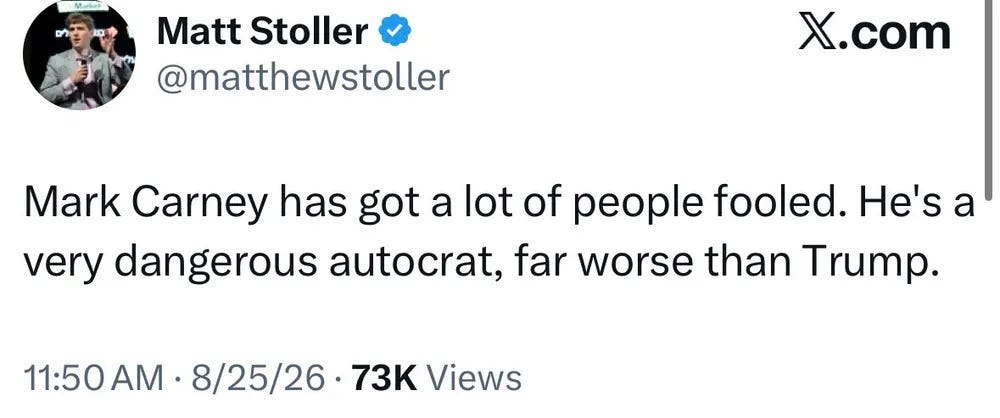
“When ‘economic liberty’ means central planning,” article by Matt in response to Matt Stoller’s tweet about Canadian Prime Minister Mark Carney: The Argument article
Peer Review: “Better Together? A Field Experiment on Human-Algorithm Interaction in Child Protection,” article by Marie-Pascale Grimon and Christopher Mills: arXiv article
“Telling white people the criminal justice system is racist makes them like it more,” article by Dara Lind, referenced by Matt: Vox article
The Road to Serfdom, book by F.A. Hayek that will serve as the basis for an upcoming episode: Goodreads page
Looking forward to your discussion of Road To Serfdom! I don't see many explicit calls for central planning these days, but I do see demands for industrial policy or small d democratic control of all sorts of aspects of our environment these days. How are these modern pursuits different from ye olde central planning? What do you see as the appropriate realms for democratic control vs individual decision making?
And primaries are not real life.