

Welcome to the The Closing Argument, our verdict on the news, plus everything The Argument published and appeared in this week.
The Verdict
On Friday, The Washington Post’s Megan McArdle helpfully provided discourse bait for the weekend by admitting to using AI to aid her journalism.
McArdle’s professed uses of AI are limited to helping her find things to read and explain parts of academic papers, transcribing interviews, generating pushback on her column thesis, suggesting trims, improving her podcast interview questions, and fact-checking.1
She summed up her professional advice to other journalists as “think of your chatbot as a combination of an intern, a first-pass editor, and a fact-checker. Its job is to do grunt work and help you turn in cleaner copy, not to ‘inspire’ you.”
McArdle’s confession became evidence of the growing polarization around AI use in the media — both because we’re still in the early days of journalists admitting they use AI and because of her perch as a center-right opinion columnist at the now-deeply politicized and diminished Post.
A philosopher at Rutgers remarked that “In a healthier media culture, an admission like this would at the very least get [McArdle] fired.”2
A journalist called McArdle’s admission “deeply embarrassing” and several others argued that AI’s limitations (hallucinations in particular) made it useless at fact-checking or assisting with research.
Taking a step back from whether or not it is an abdication of journalistic practice to use AI for parts of your job,3 I think it’s worth noting how bad it feels when your industry goes through a period of technological disruption.
There’s a repetitive discursive cycle about Luddites that comes up whenever a labor-saving productivity measure presents itself. On the one hand, people point out that textile workers had a point and were very much made obsolete by the factory system. On the other, people cast Luddites as mere sands in the gears of progress.
What many struggle with is the truth that being an obstacle to Progress and having a Legitimate Grievance are not mutually exclusive.
Here at The Argument, we spend a lot of time thinking through the economics of AI and what path we expect the technology to take because many of us know intimately from working with these tools just how powerful they are.
I love being a writer. I love that I get to spend my days reading and asking questions of brilliant people. I love that I’m paid to work through what I believe about things, and as an editor, I love helping other people work through all that too.
Part of why I started The Argument is because I think there’s a version of this work that can’t be replicated by a machine — journalism that’s built on judgment, voice, and a willingness to say things that are true but uncomfortable.
The truth is that journalists who are angry at McArdle are rightly noticing that labor-saving technology could threaten to remake the media industry again; this time, turning it into one where being paid for spending time thinking through hard problems, reporting out difficult stories, and using personal judgment gleaned from years of experience may no longer be possible.
Instead, journalism could become an industry where editors feed a set of facts and arguments into a large language model, which then knits those into an article that is then quickly edited. Even if you’re the type of perennial optimist who believes this will lead to a better world with more and better journalism, it’s not all upside. McArdle didn’t argue for any of this, but the reaction isn’t really about her; it’s about the fear of what will come next, even if everything goes “well.”
In the 1940s, the American Federation of Musicians fought against commercial recording, afraid that live performance gigs in dance halls, restaurants, or theaters were going to get wiped out. In a broad sense, musicians were wrong to worry about live performances; live music revenue has exploded, even as recorded music revenue remained modest. Listening to a track on Spotify became a marketing vehicle for live performances — complements not substitutes.
But that doesn’t mean nothing was lost.
Lots of working musicians lost their livelihoods to jukeboxes and radios replacing them in hotels, bars, and restaurants. I love a jukebox as much as the next girl, but it’s not the same as walking into a diner and hearing a live performance.
Industries that are highly exposed to technological disruption are forced to reckon with the core question of what makes their work valuable. Cab drivers learned that their encyclopedic knowledge of back streets and traffic shortcuts were made worthless with the advent of GPS. Handloom weavers learned that consumers don’t actually care about artisanal quality when machine-produced cloth is one-tenth of the price.
Now it’s time for journalists to learn what all our reporting and puzzling and drafting is worth.
It’s possible the answer is much less than we thought.
Note: The footnotes in this article were accidentally left out of the emailed version.
Chart of the week
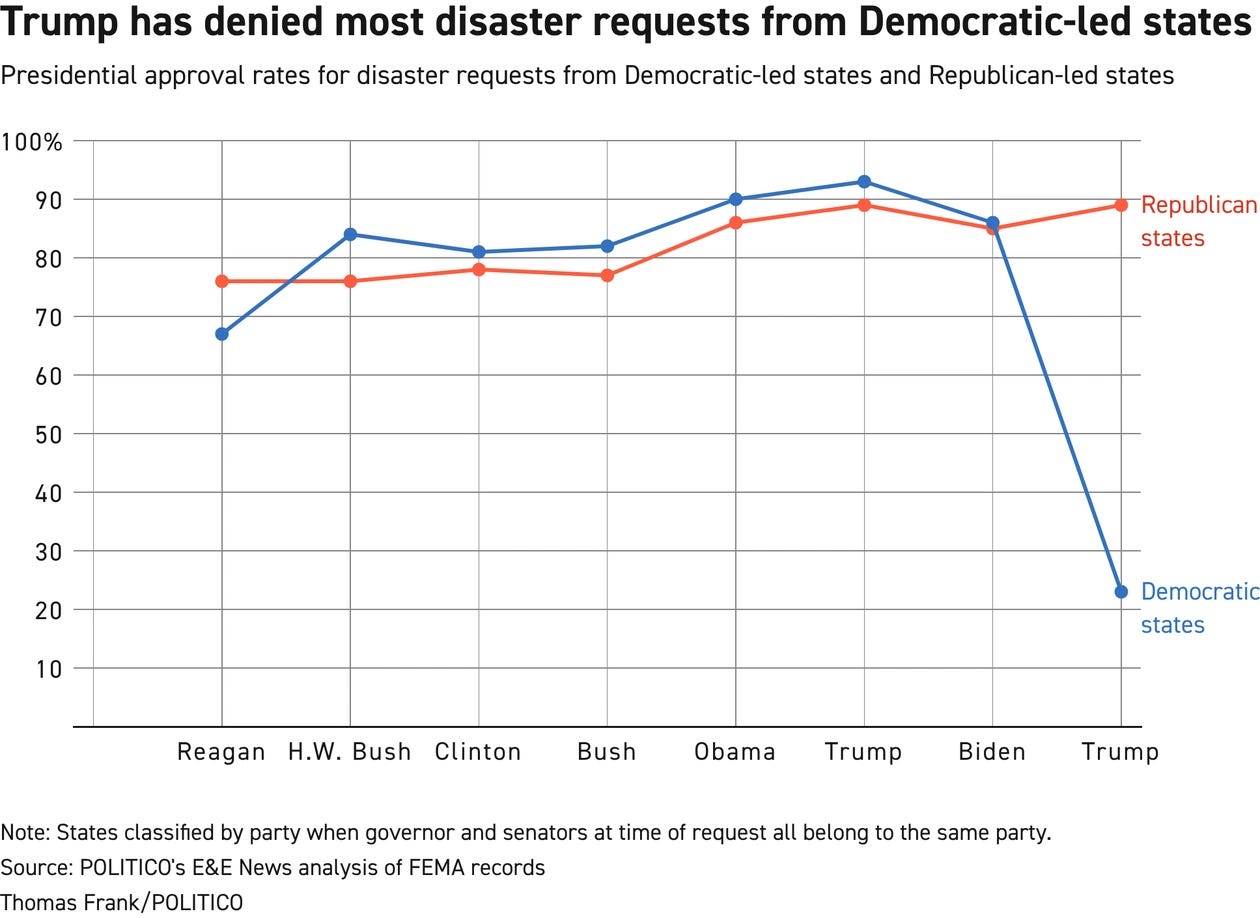
It’s still somehow underrated how uniquely bad Trump is. He is not a normal Republican, and so much of our current timeline is contingent on his behavior.
Top stories this week


As we grow, I want to make sure you see everything we’re doing without flooding your inbox with dozens of emails. But for the real libs, you can get every post as it drops by opting into The Mag here.
🌟Abundance Wins of the Week🌟
Honolulu votes to allow denser apartment development
FDA approves stronger Wegovy dose under its new fast-track program
Virginia sends sweeping YIMBY housing package to the governor’s desk
Idaho bills to approve smaller homes advance
Worth watching...
Every Wednesday, Lakshya Jain, our director of political data, will go live on Substack with leading election nerds to discuss what’s going on in politics that week.
This week, Lakshya joined Split Ticket’s Armin Thomas and VoteHub’s Zachary Donnini to discuss the electoral implications of the war in Iran.

Subscribe to The Mag so you don’t miss future live election breakdowns.
What’s News with The Argument
We’re hiring a Senior Editor to join our team. Are you a liberal? Do you love to argue? Do you read social science research for fun? Apply!
The Argument recommends
Here’s what our staff is watching, reading, and listening to this week:
Books:
Teach Us to Outgrow Our Madness by Kenzaburō Ōe, John Nathan (Translator)
Babbitt by Sinclair Lewis
The Sorrows of Young Werther by Johann Wolfgang von Goethe
The Bully Pulpit by Doris Kearns Goodwin
TV/Movies:
Audio:
Yiyun Li reading her story “Calm Sea and Hard Faring”
Radio Cure by Wilco
Ghost Town by Lankum
We have merch!
My favorite merch is either the hat or the keychain, but we have stickers and quarter-zips too! Buy them here.
Send us a picture of you with your merch, and we might just feature it in this weekly roundup.
MORE: Derek Thompson’s two-part series on the Smartphone Theory of Everything:


Here at The Argument, using AI to write our articles is strictly verboten. Our writers and fellows are encouraged to use it for data analysis, research, and preliminary fact-checking (we also employ a fact-checker, thanks Eli!).
Perhaps he thinks she should be drawn and quartered at most.
Of course, it entirely depends on how it is used. Everyone who has written anything they are proud of understands that wrestling with the ideas, reading carefully, and hunting through useless sources for a goldmine is often an integral part of what constitutes "writing." But only you can say whether your use of labor-saving technology is making you better or worse in the short run. In the long run, well, all of us will know.
I’m glad you’re engaging with this (and I had a back and forth with Megan on X). I think the more important issue is revising the prose, which is what I spend time on my Substack. My recent piece on paragraphs (!) has over 100 likes, which is crazy for a piece on human v. LLM paragraphs! My piece last month on “not x but y” has over 300 likes. There is clearly a need for engagement with craft and how to tell the difference.
"Lots of working musicians lost their livelihoods to jukeboxes and radios replacing them in hotels, bars, and restaurants."
Worldwide there are more working musicians now than there were then, per capita.
Every single time that technological change has been predicted to be a net job killer, that change has proven to be a net job creator. Every single time. And the only reason people have to believe that now is different is because they live now and they need to believe that they live in a unique, special time. But there's nothing special about them and there's nothing special about now.