


Welcome to The Closing Argument, our verdict on the news, plus everything The Argument published and appeared in this week.
The Verdict, by Jerusalem Demsas
Irving Howe, founding editor of Dissent, once quipped that “when intellectuals can do nothing else, they start a magazine.”
The founding of a political magazine is almost inevitably the result of a disaffected spirit. Those with power are too busy running the country and are likely satisfied with existing publications.
But if starting a magazine is a sign of discontent, it is simultaneously an act of hubris. The impulse to write manifestos and screeds, and to make the case for your ideological perspective, may only come to those who can observe the near-infinite amount of content being produced and decide still that they could do better.
The American Prospect openly embraced this impulse in its 1989 prospectus: “The natural reaction to any proposal for a new journal is that we are already swimming in a sea of words: Why more?”
My answer is the same as theirs: Because we are different.
The Prospect wasn’t the first magazine to make this claim,1 and The Argument won’t be the last. On the eve of this magazine’s anniversary, I went back to read the earliest issues of 20th-century political magazines. In the words of a junior writer at National Review: “Flushed with self-importance, we call attention to the fact that this is our First Anniversary issue and confess that we want to talk about it, or better, about ourselves, always an enjoyable way to pass the time.”
Some are more afraid of such overt self-aggrandizement and instead adopt a posture “at once modest and presumptuous,” in the words of Daniel Bell and Irving Kristol in the first issue of The Public Interest (which was something like the Vox of its day).2
Or take this from The New Republic’s opening issue in November 1914: “The New Republic is frankly an experiment.… Its success inevitably depends on public support, but if we are unable to achieve that success under the conditions essential to sound and disinterested thinking, we shall discontinue our experiment and make way for better men.”
That’s nice, but you’ll have to pry this magazine out of my cold, dead hands.
Libs athwart history
Despite founding a liberal publication myself, I recognized The Argument less in the modesty of The New Republic and The Public Interest than in the stridency of their conservative counterparts. It was while reading the latter that I saw my own frustration reflected back to me in biting prose.
Felix Morley, a Pulitzer Prize-winning journalist who left The Washington Post amid growing disagreement over U.S. intervention, co-founded Human Events in 1944. In the opening essay of the conservative anti-interventionist magazine’s first annual bound edition, Morley railed against “journalistic debasement” in coverage of international affairs, going so far as to compare it to Nazi propaganda: “While we have not yet carried these practices as far as did the unlamented Dr. Goebbels, the general direction of governmental propaganda has paid that Nazi leader the sincerest form of flattery.”
Other magazines on the right indulged in similar bluster. The famous one, of course, is National Review’s self-description as “standing athwart history, yelling stop.” Another is Reason magazine, launched in June 1968, which proclaimed: “We accept the responsibility that others have defaulted on. Others preferred to smear the issues with irrelevancies and falsifications. We don’t. Others preferred to be incomprehensible and incoherent. We don’t. Others preferred to ignore your mind. We won’t.”
The resemblance between these upstarts and The Argument is not ideological but positional: Magazines founded to advise a governing status quo can afford modesty, but magazines founded to help build a new paradigm cannot.
Liberalism was ascendant or hegemonic when America’s most significant liberal magazines were founded. The New Republic was started by men who sought to influence President Woodrow Wilson’s administration; The Public Interest was founded right after President Lyndon B. Johnson’s landslide victory and the triumph of civil rights legislation. While The American Prospect began publication in 1990 after three consecutive Republican presidential victories, small-l liberalism was still dominant: Democrats controlled Congress, the Cold War was coming to an end, and liberal democracy was on the rise around the world.
National Review, on the other hand, was founded as conservatism sought to claw its way back to relevance. The New Deal settlement had entrenched itself so thoroughly that, under the banner of what he called Modern Republicanism, President Dwight D. Eisenhower expanded Social Security, raised the federal minimum wage, and broadened unemployment-insurance coverage from within the GOP.
Reviewing these decades-old essays has also reminded me how far magazines can stray from their original purpose. Reason, once an Objectivist magazine, is now best characterized as libertarian; Commentary, once the flagship of liberal anti-Stalinism, is now a hawkish neoconservative outfit.
Part of what made The Argument necessary is that I found little of liberalism left in outlets like The American Prospect. In its 1989 prospectus, the latter called markets invaluable and defended the moniker “liberal” against attempts to rebrand as “progressive” or “populist”: “Denying the ‘liberal label’ suggests embarrassment and shame more than open-mindedness.” Now, the Prospect’s “about” page says it is devoted to the “progressive perspective.” Long gone is the magazine’s healthy respect for the market mechanism.3 Its editorial leadership is in the thrall to neo-Brandeisian economic populism and wouldn’t even take a clean stand against President Donald Trump’s illegal (and unpopular) tariffs.
It is a dark time for liberalism. The Trump administration has dispatched federal agents against law-abiding American citizens, lied brazenly to the courts, and begun dismantling the twin engines of progress: immigration and scientific research. Elite resistance to this assault on the American system is divided among left-wing populists with a tenuous relationship to basic tenets of liberty, centrist Democrats who lack any positive vision, and a dying breed of right-liberals.
Long liberalism
The Argument’s task is not to debate the policy agenda of an establishment that shares our commitments, but to make the case for a completely different paradigm. Things may seem dire, but I’m long liberalism:
No other ideology has been capable of delivering mass prosperity, economic growth, and scientific progress while protecting and expanding civil rights.
Despite decades of elite hostility to markets, capped off by Trump’s tariff regime, Americans remain committed to key tenets of economic liberalism and its promise of abundance.
In defiance of efforts to divide us by race, religion, and origin, Americans continue to believe that rights belong to individuals, that the law should treat us as equals, and that anyone can become fully and equally American.
While there are many individual liberals scattered throughout the great magazines and newspapers of this country, none of those publications offers a clear institutional voice willing to engage in the type of ideological combat necessary to rebuild American liberalism.
One thing I share with all the great political magazine founders, from the socialist dissenters to the Ayn Rand obsessives, is a belief in the power of ideas.
Howe, the Dissent editor whose line about intellectuals starting a magazine is oft-quoted, had more to say. In the very next sentence, he adds: “But starting a magazine is also doing something: at the very least it is thinking in common. And thinking in common can have unforeseen results.”4
The Argument is a bet on readers like you: ones who believe in a vision of liberalism abandoned by the current factions in American politics, who treasure rigorous, public debate as a tool for advancing the best ideas, and who are excited to be a part of a community as varied as this one. In the years to come, we’re going to keep picking fights and running polls and publishing pathbreaking essays. Thanks for libbing out with us.
Midterm update
Lakshya Jain, our director of political data, used data from The Argument’s polling operation to inform the Split Ticket 2026 House and Senate models. These models update every day; bookmark this page to see the odds of each party taking the House and the Senate.
Top stories this week, by Kobe Yank-Jacobs
This coming week marks one year since the launch of The Argument. To celebrate the occasion, we’ve launched an essay series on the question at the heart of political liberalism: How do we live with each other? In the coming weeks, you’ll get to see writers like Derek Thompson and Dylan Matthews wrestle with what we owe to people we disagree with in a liberal society, looking at the theme through a wide set of issues.
This week, Cassie Pritchard got us off to a strong start. She argues trans rights supporters need to stop arguing about whether trans women are women and focus instead on civil rights:

Economic historian Phil Magness followed this up with a rigorous case against JD Vance’s economics — or, rather, against Vance’s total ignorance of the field. Vance dedicates a whole chapter of his latest book to arguing that metrics like GDP distort our values, but he bases his gripes on absurd misunderstandings and nearly farcical anecdotes. Click to watch Magness lay a blow to the heart of MAGA economics:

Finally, while we answer the weighty questions at the heart of liberalism, we also continue to duke it out in the daily news cycle. This week, Jeremiah Johnson had some strong thoughts about the Hank Green AI-use controversy. To him, the most interesting thing about the episode isn’t the misuse of AI. It’s how wildly dogmatic Green’s science-minded fan base has become:

🌟Abundance wins of the week🌟
Bellingham, Washington, eliminated parking minimums, allowing developers to decide how many spaces new projects need while, of course, lowering construction costs.
In Connecticut, Eli Sabin beat a 21-term incumbent in the primary for a seat in the state legislature. Sabin was a leading advocate to upzone New Haven and may get to pick up his efforts in the state House should he notch a win in the general.
The FDA gave accelerated approval to a cancer drug for treatment-resistant advanced melanoma.
Worth watching…
In recent decades, we’ve faced many crises of social connection: the loneliness epidemic, the deaths-of-despair phenomenon, the effects of phones on teens. But before all these, the source text for civic atrophy was Robert Putnam’s Bowling Alone, which documented a decline in U.S. associational life. No more bowling leagues, no more Rotary Clubs. Our chief malady, Putnam argued, was a decline in “social capital.”
Jerusalem is skeptical. This week on the pod, Jerusalem and Matt reassess one of the foundational texts of the 21st century and argue about how relevant it is to our current afflictions. Click below to see how it holds up:
Lakshya Jain hosted Rep. Kristen McDonald Rivet from Michigan’s 8th District. In their discussion, she shared some tricks of the trade. First, she emphasized how different primary and general electorates are. But the tip that hooked me was this one: She has a burner phone so she can escape the algorithm and listen to people outside of her ideological lane.
What’s News with The Argument
The Argument recommends, by Kobe Yank-Jacobs
Politicians never change their minds. They “evolve” on the issues. But here at The Argument, sometimes — just sometimes — we do change our minds. In fact, we even grow as people. New things appeal to us, old passions fade out.
That’s what I wanted to capture in this week’s recommendations section.
I asked the team to share media with social commentary that they used to agree with, and immediately, our social media director, Megha Fernandes, nailed it on my highly specific request:
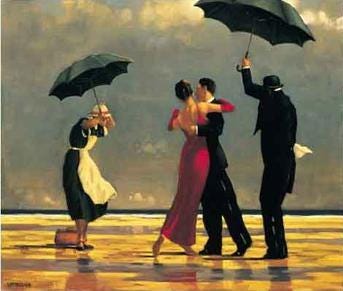
This is a painting known as The Singing Butler by Jack Vettriano. So, um, what’s the social commentary here? you might ask. At first, Megha saw none either.
“To me, it was a beautiful depiction of being so in love that nothing else mattered,” she said. “The couple at the center didn’t even seem to notice the rain since they were too caught up in dancing together.”
But when she returned to her parents’ house as an adult, where a print hangs on the wall, she saw it differently. This was “class warfare,” she asserted over drinks at a team hangout the other night.
“Were they paid fairly? Did they even want to be out there?” she asked of the butler and the maid. “Suddenly, it seemed a lot easier for the couple to dance carefree in the rain when someone else was standing by, waiting with an umbrella.”
What I loved about Megha’s take was how closely she was reading the image. It prompted other teammates to take a second look at works they used to find meaning in.
It brought Jerusalem Demsas back to her own teenage radicalism. The social commentary she renounced? “Baby, I’m an Anarchist” by Against Me. For the record, she still thinks it’s a great song but declines to endorse the message.
“I no longer stand behind teenage Jerusalem's disdain for people who wouldn't throw rocks through Starbucks windows or hurl Molotov cocktails.”
God bless the parents of all teenagers.
Milan Singh followed this with an influential teenage experience of his own. He read The Omnivore’s Dilemma by Michael Pollan and became a vegetarian for five years. In his case, he doesn’t renounce the decision. In fact, he wishes he could stick with it. It’s just that, when he got to college, he found it hard to put on muscle on his ethical diet.
For my part? I actually had a few items in consideration, but the question to the team was motivated by a joyous car ride I spent relistening to Father John Misty’s 2017 album Pure Comedy. This is perhaps among the most wry and timely albums of social commentary I can imagine. It skewers the social media age in songs like “Total Entertainment Forever,” which closes:
When the historians find us we’ll be in our homes /
plugged into our hubs /
skin and bones, /
a frozen smile on every face /
as the stories replay /
This must have been a wonderful place
At the time, I was a self-branded Luddite, refusing as many conveniences of phones as I could manage while maintaining a college social life. Almost a decade later, it’s not so much that I disagree as that I’m resigned. I look back on my fickle resistance and finally understand Misty’s tone.
It’s ironic, in part, because in every song, his knowing speaker also participates in the shallow society he dismisses. He has to. How else can you be a good critic? So far away from the thing you critique?
As the team concluded our chat, weaving in and out of old anecdotes, I started to appreciate how much people treasured the items they’d stepped away from. It reminded me of a line from a Simon & Garfunkel song.5 “After changes upon changes we are more or less the same. / After changes, we are more or less the same.”
We have merch!
We have quarter-zips, keychains, hats, and stickers. Each one is a great conversation starter in its own way. Buy them here.
More to read:


Commonweal, a liberal Catholic magazine founded in 1924, opened its first issue by sheepishly noting: “The question will naturally arise why the editors of The Commonweal believe there is room for another journal to discuss public affairs, to review the important publications of the day, and produce original fiction, essays and poetry. … We believe that The Commonweal will be so fundamentally different to our contemporaries that in place of competition in an over-crowded field we shall occupy a position that hitherto has been left vacant.” With all the love in the world, many such cases!
Bell and Kristol admit they’re probably going to write some boring stuff: “...just as not all mathematical problems are exciting (intellectually, aesthetically, emotionally), so not all social problems are, either. Only the incurably adolescent mind will find this fact of life distressing. Unfortunately, there are always more adolescent minds than adolescents around.”
See the Prospect‘s prospectus, which directly calls market mechanisms “invaluable,” treats markets and democratic politics as complementary, and acknowledges that liberals in another context might favor “greater reliance on market forces.”
See also Arthur Schlesinger Jr.’s opening salvo for the Prospect: “The liberal answers of the past were not infallible. Affirmative government sometimes tried to do too much. Regulations became intrusive and burdensome. Government programs miscarried. And the public interest, liberals must understand, is something more than, and very often different from, the sum of the interests of organized groups in our society.”
See also Cass Sunstein’s 1990 piece calling the private market “usually an engine of individual freedom and economic welfare.”
Commentary likened editors to “well-diggers”: “We roll up our sleeves and in the sweat of our brows, we dig. And if the time and place are right, and the omens are propitious — of a sudden, fresh, cool, flowing waters.… To this task, soberly and earnestly, we dedicate ourselves.”
Who subscribes to journals & magazines in print anymore?
Raises hand while sitting next to this quarter’s physical print editions stacked higher than I am comfortable sharing. :)
(weeklies & monthlies get scattered around home, cars & bags so that one is always in reach to be picked up on a whim when a moment of respite presents itself. Highly recommend this tactic…..especially if you have children around. Good for them to see you picking up physical books, mags, journals, etc instead of a kindle/phone in order to drive home reading through example.
2nd tip - purposefully emotionally respond as you’re reading, eg laughing or expressing inquisitiveness. Even when you’re not reading, & really watching your child. Or using the magazine to hide your expression to whatever has just happened in order to take a breath before addressing…especially when this.)
Perhaps there is a more fundamental reason people start new magazines.
A structure that already works tends to keep following paths that have already been validated. Existing paths make outcomes more predictable, while leaving them for the unknown introduces risk.
But this creates a tension: paths that worked in the past can reduce risk, but they cannot guarantee an answer to changes that have not yet appeared.
So established institutions often become better at preserving what already works, while new magazines and new intellectual spaces tend to emerge outside them—where the risks are higher, but where there is still room to explore new paths.