


Welcome to The Closing Argument, our verdict on the news, plus everything The Argument published and appeared in this week.
The Verdict, by Jerusalem Demsas
At concerts, coffee shops, dinners, and dance parties, the ubiquity of cell phones as tools of surveillance and avoidance is killing the vibe.
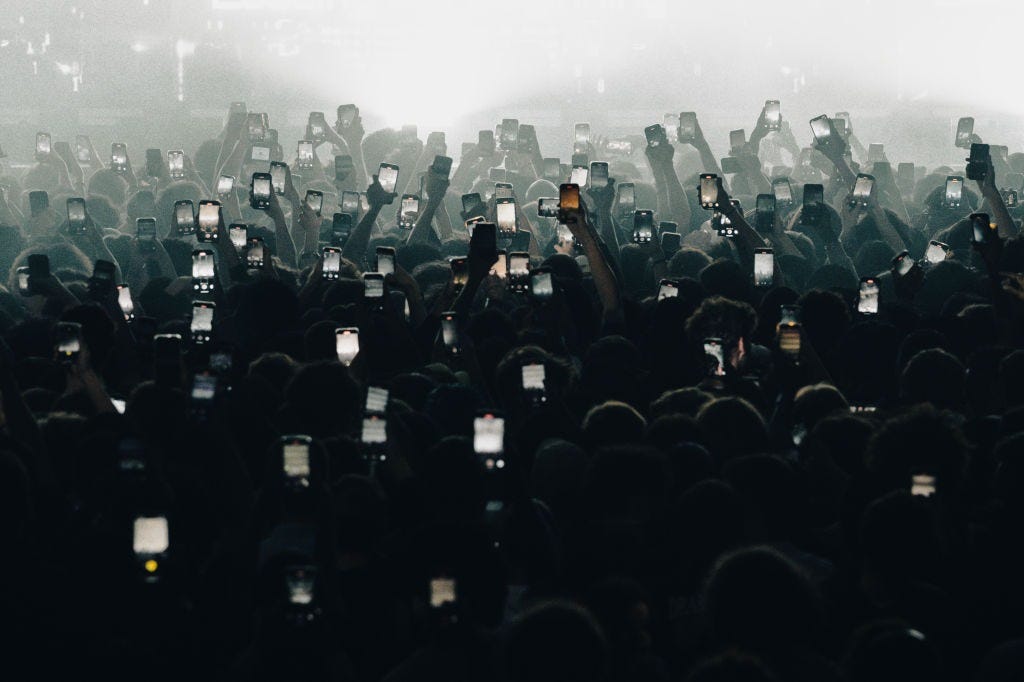
While most people agree that a crowd of cell phones recording a concert is suboptimal, the dominant reaction has largely been one of despair: No one is going to make it illegal to film a concert, so what can you even do? It’s not illegal to be a downer.
Well, at least one person has finally decided to exhibit some agency.
Phoebe Bridgers, the artist perhaps best known for her 2020 album “Punisher,” which got her nominated for Best New Artist at the Grammys, has decided her next concert will be totally phone free. Others have done phone-free shows, but, to my knowledge, Bridgers is one of the first to attempt it for an arena-scale tour.
“Upon arrival at all venues, all phones, smart watches, and accessories will be secured in Yondr pouches that guests will maintain possession of at all times … Anyone seen using a non-permitted device during the performance will be escorted out of the venue,” reads Bridgers’ press release.
Some people got very angry at this announcement. Reasons ranged from the respectably honest — like wanting to record concertgoers’ favorite artist so they can remember the experience — to the absurd suggestion that some people need their phones for their disabilities and aren’t capable of requesting an accommodation.


One Twitter user claimed that “phone-free concerts are classist” because many people cannot afford live music events and therefore can only experience the show through shaky video footage on social media.

But I love what Bridgers is doing: helping us develop a better moral code for how to live in a world with smartphones.
The smartphone is a relatively new invention. The iPhone was first released in 2007, and by 2011, 35% of American adults had a smartphone. By 2023, 90% did. (Worldwide, roughly 54% of all people, including children, have smartphones.)
And society has struggled to keep up. Is it okay to play a video without headphones? What if it’s a busy street? What about FaceTime? Is that really different from talking to a real person in front of you? What are the rules for behavior?

Debates about stopping disorderly conduct are often spurred by conservatives, in large part because liberals are concerned with expanding the sphere of police influence (and because they are skeptical of private action producing widespread positive change). But while few people would want to see someone arrested for playing their TikTok videos loudly on the train, most of us would very much like them to stop.
The problem is that too many of us have forgotten the large set of responses between “do nothing” and “call the police.” But Phoebe Bridgers hasn’t.
Private action to set the rules for behavior is more important in a multicultural society, not less. Having a clear set of rules gives people something tangible to debate over. Everyone knows the discomfort of realizing you’ve broken some unwritten rule and struggling to figure out what you did and why. It’s much better to know that there are strong expectations; then you can decide whether it’s worth it for you to break them.
People who come from different walks of life often have different intuitions about what they find annoying or disturbing, but quasi-public spaces cannot accommodate “live and let live” in all instances. If I decide to be loud, I have decided that for everyone.
One of the best-studied areas that illuminate differences in behavioral norms is queuing. If you’re standing in line at a coffee shop and someone cuts in front of you, basically everyone thinks that’s rude. But when you’re waiting for your group to get called at an airport gate, many people mill about aimlessly, then rush in to get an early spot.
On Black Friday, norms seem to entirely disappear, and crushing forward and trampling others underfoot becomes bizarrely acceptable.
One newsletter I read characterized different queue expectations in several countries:
Japanese queues are extremely orderly.
Indians queue very near one another.
Thai people use their sandals to queue.
Chinese line-cutting got so bad that Shanghai Disneyland had to reportedly construct “narrow, single-person queue lanes so that people could not cut ahead of each other.”
More artists should follow Bridgers’ example, but also, more people should get comfortable voicing their opinions. I was sitting in a diner doing some work a few weeks ago, and a couple began watching TV on their iPad. So, I just asked them if they could use headphones, and they turned it off. I did the same at a coffee shop a few days later, and the other person apologized and turned it down.
You shouldn’t call the police on people who irritate you. But you also shouldn’t act as if the social norms of the most disruptive are natural and immutable. At the very least, you should speak up.
Top stories this week, by Kobe Yank-Jacobs
As we grow, we want to make sure you see everything we’re doing without flooding your inbox with dozens of emails. But, for the real libs, you can get every post as it drops by opting into The Mag here.
This week, Lakshya Jain, our director of political data, published original, state-by-state analysis of Trump’s approval among likely 2026 voters. It showed that Trump is above water in just 15 states of the 31 he won in 2024 — an unprecedentedly bad showing for an incumbent president. What does this mean for the Senate? Should Democrats get their hopes up? Read Lakshya’s analysis to learn more:

Speaking of the Senate, Jerusalem Demsas took on the commentators who are trying to excuse Graham Platner’s cheating scandal. Somehow, they’ve convinced themselves that criticizing Platner’s infidelity is an elitist concern and that overlooking it is a way to get in touch with “the people.” Find out how many Americans will fess up to cheating:

Finally, I answer why LLMs can’t count the number of R’s in “strawberry.” How is it that they have made such rapid progress on science, math, and coding but still fail at simple questions like these? The answer has something to do with human memory and the ways it’s replicated, or not, in these systems:

🌟Abundance Wins of the Week🌟
Big news out of New York, where the state budget exempted certain housing projects from the State Environmental Quality Review Act with the governor’s support.
A bill to speed up geothermal energy permitting passed the House by a unanimous voice vote this week. The bill was championed by AOC and Rep. Bruce Westerman, R-Ark., who is known for being friendly to the oil and gas industry. Geothermal has a big tent.
In a study at UPenn, GLP-1s showed promise for treating breast cancer: “A retrospective analysis of more than 110,000 women between the ages of 45 and 80 found that those who took GLP-1 medications were about 30 percent less likely to develop breast cancer than those who did not take GLP-1 medications.”
Worth watching…
Great news! If you missed The Argument’s first-ever debate in San Francisco, now is your chance to watch it. Jerusalem and Kelsey hashed out whether AI will cure cancer, while audience members also weighed in with strictly refereed, one-minute questions (and rants — rants encouraged!). It was an unforgettable night, where together, we not only pressed on major societal questions, but demonstrated the immense value of airing debate. Tune in for top-notch content:
Subscribe: Apple Podcasts | Spotify | YouTube | Overcast | Pocket Casts
California had an election this week. The day afterward, it looked like Republicans might capture the top two slots in a number of House districts, locking Democrats out of the general election in those places. (In California, the top two-vote getters advance regardless of party.) In this video, Lakshya Jain and Zachary Donnini explain that later ballots tilt heavily Democratic, which will shift the early results. They also debate whether taking so long to call a winner undermines voter trust. Check it out:
What’s News with The Argument
The Argument recommends, by Kobe Yank-Jacobs
I normally wouldn’t start with my own recommendation, but I am so enthusiastic about the film Train Dreams that I have to take the privilege.
The story follows Robert Grainier in the early 1900s as he builds a life with his family in the woods of Idaho, only to be repeatedly pulled away from them by his work as a logger and then to be haunted by mounting tragedies. I can’t understate how poignant the character arc is; how vivid the supporting characters; how gorgeous the forested backdrop. Throughout, you see the growth of the modern world steadily encroach on the periphery of the great outdoors — just a small taste of what this historical transition must have actually felt like. The movie is truly an experience.
Speaking of experiences, Maibritt Henkel shook up the normal slate of music, TV, films, and books with a baking recommendation this week: an NYT Cooking recipe for chocolate zucchini bread.
“A friend and I baked this zucchini bread for a dinner party and it was a hit,” she reported. “Moist, easy to transport, and not at all vegetably.” I can confirm.
Meanwhile, Justin Zuckerman took us to the basketball court, where he’s been watching on the Knicks’ “generational run” this playoff season. Across the office, Milan Singh said he’s rooting for the Spurs, but he is mainly happy that the Thunder got knocked out. (If there are any OKC fans on the mailing list, feel free to take it to the comments section.)
In addition to the NBA finals, Milan chimed in on music, calling Tha Carter V by Lil Wayne “the best album of all time.” I felt the need to confirm whether he really meant it was the best or just embellishing for effect.
“You’re not going to say this again later about something else? You really mean ‘best?’”
He nodded confidently, didn’t even say anything.
Finally, Eli Richman pitched us all on an opportunity to learn about British land use regulations, farming economics, and livestock welfare in the new season of Clarkson’s Farm, which started coming out this week.
“I know, ‘You should watch this unscripted show about farming hosted by an infamous jerk,’ is a tough sell,” Eli confessed. “But it’s really worth checking out.”
“A city slicker who knows jack-all about farming but insists on doing everything himself helps make all of this accessible,” Eli added, and “his absurd battles with the town council, which repeatedly impedes him from using his own farm in various inoffensive ways,” make it entertaining.
I actually debated putting this in the abundance section of the newsletter. A reality TV show about the horrors of land use regulation as enforced by an imperious local governing body? Eli knows his audience.
We have merch!
We have quarter-zips, keychains, hats, and stickers. Each one is a great conversation starter in its own way. Buy them here.
More to read:
The age of snark

It’s impossible to address the subject of internet snark without first revisiting the classic Tom Scocca essay “On Smarm.” Published on Gawker almost 13 years ago, the essay’s influence continued well past the death of the site.
I was hopeful for the headline, but then the actual post meandered around different ideas. Phoebe Bridgers runs the venue and has the power to throw people out if they don't obey. That's not a social rule, that's just a rule enforced by real consequences. It doesn't tell people it is unacceptable to film concerts, it tells them that it is a specific rule at a Bridgers concert that you can't do that.
On the other hand if you tell someone to turn off a television program in a diner and they ignore you, then you can't kick them out. Only the diner owner can do that. Or for airline queuing, I've seen the "everyone clumps up and comes in at once", but I've also seen "the airline tells everyone to line up according to a specific order and boards them in that exact order". The airline has the full power to do that if they want. Shanghai Disneyland had to shove everyone in a single person wide funnel so it's impossible to line jump... but they could do that and did.
And here's something really interesting. I noticed something new on the comment box for this post, something I've never seen before. It's a dropdown called "The Argument reply rules".
===
The Argument reply rules
We welcome strong and even harsh disagreement but personal attacks or gratuitously offensive language will be deleted and repeat offenders barred from commenting.
===
So people behaving rudely will be kicked out of the venue, even if they paid to attend. Sounds an awful lot like a Bridgers concert!
Is the real lesson here not that random bystanders should be more aggressive in staging social inteventions, but that venue owners and managers should be more aggressive in enforcing actual rules to make life easier for all the regular users?
agreed! I made a relevant argument about the in-between things here: https://thepursuitofliberalism.substack.com/p/the-over-delegation-problem?r=n8nwg&utm_medium=ios